Butterfly Effect: Revelation

Sometime before I started reviewing things, I saw a cool sci-fi movie in which Ashton Kutcher can relive his past, modify events to make things better, and then wake up out of his memories to find a world of improvements, right? Except, there’s always some kind of unintended consequence that makes things worse, and he just missed the intervening years, so he has to figure out what went wrong, and then go back and fix it better, which will work this time, right? And yeah, it’s pretty cool. You should see it.

I missed the sequel, but Butterfly Effect 3 was my second movie of the festival, and, well… if I wanted to have some minimal grasp of the underpinnings of the world, it’s a good thing I saw the first one. Plus, it’s not really much like they followed exactly those same rules anyway, but at least I knew in advance there’s a dude who came jump back in time and then wander around changing things if he feels like it, despite knowing that it’s usually a bad idea. Only, his murdered high-school girlfriend’s sister comes to him requesting assistance in discovering her murderer. And that can’t hurt anything, right? He certainly won’t accidentally create a serial killer for whom he is usually the police’s prime suspect! …right?

If you can ignore the physics-underpinnings part and just accept that he can go to whenever he wants, etc., the plot is a pretty nice mystery that I figure took me over half the film to work out. Watch for Rachel Miner as a threepeat Horrorfest actress. Good for her!
From Within

Remember back in November, when I didn’t go to the third Horrorfest and then review a massive pile of movies, and it was very concerning and you were kind of sad to miss out on an entire new batch of movies you will never, ever see yourself, but you at least kind of want to know what it would be like for someone who likes the idea of that kind of thing. Well, there’s good news! As part of an apparent line of mistakes made by the people in charge, whoever they are, it didn’t happen until this weekend instead. So, here we are.

The first flick, From Within, is a real improvement over last year’s mediocre opening. There’s this small generic town that’s dominated by a mega-church, which, come to think of it, is maybe implausible? And one day, a goth-looking guy reads some Latin out of a book, which everyone knows means shit is about to go down. Except, instead of doing anything cool and magical, he kills himself. And then, his girlfriend dies under apparently suicidal but certainly mysterious circumstances. The rest of the movie follows around a girl present at the first girl’s death who is trying to figure out what happened, the dead goth’s brooding brother with a dark past and a pretty plum role as a recognizable teen on the Sarah Connor Chronicles, and the holy war that is about to hit Grovetown. Mostly, though, the brooding! I’m pretty sure this was a fraction of what seeing Twilight would have been like, only without the irritating audience and with enough entertaining violence to balance the tweeness.

Best part, though, is the brooding dude’s cousin, who is sufficiently full of snark that she plays piano chords of doom when we learn about the horrible thing that is about to happen to our plucky heroine. I may be in love.

Gran Torino

Except for the fact that I’m willing to see it again, this might get me in trouble with my father. But after several intriguing previews in front of all the art house flicks I’ve been seeing in the past couple of months, I went to see Clint Eastwood’s new movie, Gran Torino. And it’s good! Eastwood still sees himself as incredibly bad-ass, which seems ridiculous for a 79 year-old man. Yet, either through weight of history, gravelliness of voice, or sheer force of will, he can still pull it off. Hell, the gravelly moans were as much an extra character in every scene as the titular vehicle was.

So Eastwood lives in his house in Detroit, in the neighborhood he hasn’t left since the Korean War ended, and he has gradually watched his friends move away or die and be replaced by a bunch of Asians that basically all look alike to him. His family is useless and his wife has just died, which leaves him a bitter racist, alone with nothing but time on his hands and his sweet, sexy sports car that he never drives. Oh, and his dog who is old like him, but I’m sure nothing bad will happen to, right? Right?

The downside to all this, if you leave out his existential twilight, non-stop racist anger, and the Catholic priest who won’t stop hanging on the bell day and night, is that there’s a Ricer gang terrorizing the neighbors (well, really the neighborhood in general, but he probably wouldn’t know if it weren’t happening in his front yard), and once he’s scared them off, he becomes the last thing he wants to be: a hero. After that, things start to get complicated.

There are moments of cringe-inducing uncomfortableness, genuine warmth, understated hilarity, and raw-edged fury. But as much good acting and scripting as was crammed into the film, I think what I like best about it is that it isn’t a story of redemption where the crusty old racist learns a valuable lesson and loves everyone. It might be cool if it happened in real life, but the truth is, that kind of thing mostly doesn’t, and I’ve seen it often enough on screen that it was refreshing to see something different. I think Eastwood-the-director only took the easy way out of a scene once in the entire film, and more power to him for it. I like movies that aren’t perfectly easy to watch or perfectly easy to pin down and categorize.

Ultimate X-Men: New Mutants

I’m not sure what, if indeed anything, it indicates, but I find that the Ultimate X-Men volumes are the ones that make me remember that I really need to find a way to continue my thoroughly stalled read of of the original Marvel runs. Are the Ultimate X-Men the least divergent from their 1960s counterparts? If so, I don’t consider that a bad thing; the X-Men are still what I want most to read, supplanted only by Spider-Man after something like thirty years’ of combined comics reading from that era.

And in relatedly good news, New Mutants continues the UXM trend of ever-increasing quality. Despite the addition of several familiar faces from the original X-Men, the story returns to basics: mutant-human relations, the people trying to improve them, and the people trying to destroy them, complete with politicking and knock-down, drag-out fights. It really is a great gimmick. Mutation contains themes of racism, teenaged outsider feelings, and the religion/science dichotomy in one neat package. Plus, one shocking event may change everything I take for granted in the Ultimate universe!

But the best part of the book was a short one-off issue between a newly discovered mutant and Wolverine, in which we discover the length, breadth, and depth of Professor Charles Xavier’s commitment to permanent peace between homo superior and homo sapiens. I am pretty pleased by this revelation and what it says about the series.

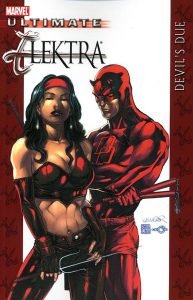
Ultimate Elektra: Devil’s Due

It has not been difficult for me to find graphic novels from the Ultimate Marvel series in my various used bookstores. I don’t have all of them by any means, but I’ve been able to pick up a lot just by keeping my eyes open. And then there’s the ambitiously numbered volume one of the Ultimate Elektra series, which seemed to have five or more copies available at every store I entered over the course of 2008. Which, despite the underlying snarkiness of that fact, is not to say that it was a bad book.

I imagine that if you knew nothing about the characters, even had not seen the Daredevil movie[1], then Devil’s Due might have told a pretty good story. See, there’s this ninja chick named Elektra, and she wants to protect her father from various lowlife thugs who are trying to destroy his business and / or manipulate him as part of a money-laundering scheme, presumedly because he owns a dry-cleanery. There’s also a blind lawyer who will probably be the Ultimate Daredevil someday, only he’s shown up in other Ultimate entries as himself instead of a shoddily-costumed law student; am I to assume this occurs before the rest of the Ultimate universe timeline? But I digress.

Anyhow, Daredevil, being the law and order type, wants Elektra to stop being such a deadly vigilante, she wants him to get off her back and stop being such a drag, and Manhattan crime boss Wilson Fisk, AKA the Kingpin, wants the lot of them to stop doing things that might result in his prosecution. The story has potential for nuanced shades of grey and moral quandaries; I think the biggest failure of the book lay in the knowledge that no character was ever going to budge from their initial position, which removed any hope of moral drama.

On a more nitpicky note, if Matt Murdock is going to dress all in dark clothes with a bandanna mask over his eyes, can they stop showing him in the red Daredevil uniform on the covers?

[1] You are incredibly lucky, by the way, for this one.

Just after Sunset

For the first time in a while, a Stephen King release slipped by me. (Although typing that feels familiar, and it could be that a delve into the archives would prove me wrong. We’ll pretend this is not my problem and proceed, nevertheless.) But I noticed it just a couple of weeks later and easily found a copy at Half Price Books next time I was in, because he’s one of those authors that is big enough to fill the inexplicable niche of people who pay hardback prices, only to resell the book at a pittance the moment they’ve finished reading. Contrariwise, while I may love books[3] at only a slightly above-average amount for my circle of friends, I’m pretty sure that in the general population, I’d be the inexplicable one, so there you go.

Just after Sunset is a short story collection, which makes me feel a bit better about having run late on it; after all, I’ve read a couple of these already in Playboy, months or years beforehand. Which maybe balances out the month or so I ran behind on the rest of the stories? And they’re, you know, Stephen King. None were bad, and a few were hovering right in that range that I’d call brilliant. He can scare you, sure, but his best talent has always been the way he can shine a spotlight on the human soul. The fear, the anger, the grime, the longing, the love, just all of it. And I think some of that is effortless, but I have to think that some of it is carefully honed craft. I can say this because some of my favorite of his stories over the past decade (including, in this book, N.) are natural[1] successors to H.P. Lovecraft’s terror over the worlds that lie just to the left of ours and yet are unbearably alien and unthinkingly malevolent. And he rarely wrote in that style before, which makes me imagine that one day there was a conscious effort to start. And now, lots of success at it!

Plus, he wrote a story that perfectly captured the spirit of my sporadically recurrent nuclear explosion nightmares. I’m glad[2] I’m not the only one that still gets hit by that, every so often.

[1] And more importantly, modernized! I mean, the language more than the topic-space. ‘Cause… yeah.
[2] “Glad” is probably not the right word. Relieved is closer, but a little too far the other direction.
[3] Not specifically reading, although that too!

Milk (2008)

I remember how absurdly pleased I was at the sneak preview of Tropic Thunder when the crowd mostly applauded for the gay couple.[1] Restored my faith in humanity, a bit. But, y’know, there’s always the other side of the coin. I’m not shocked by that; it’s all around the political landscape, right? And nevermind all the more personal examples. This stuff is pretty much exactly what Milk is about, which is why I could not have predicted an example right in the theater.

See, the first thing that happens in the movie is eventual gay activist Harvey Milk meets and hooks up with the guy who will be his long-time partner. Pretty much inevitably, this means dudely make-outs. Therein lies my surprise: you would have a hard time going to a movie about a famous gay politician during the first days of the gay rights movement, and not expect to see some gay men doing gay things, right? But as soon as Sean Penn and Harry Osborne started kissing in the subway (I want to reiterate that the movie had not been on for five minutes yet), a [straight] couple got up and left the theater. It was almost a perfect moment for underlining everything the movie was trying to say; thinking about it now, I could almost believe they’d been planted to bolster the rest of the audience into feeling good about themselves.

Anyhow, the flick itself starts off a little choppy. They needed to dump a lot of set-up information, but it never really came together until Harvey decided to get into politics, maybe 20 minutes in. After that, the acting shines through, and it really is an inspiring story. Maybe it could win a few people over. The only thing that bothers me about it is that I’m sad people still need to be won over to what seems like an obvious message: let people have their happiness where they can find it, instead of stealing it from them.

I know there’s more to do, but it really was a little horrifying to see how bad things were around the time I was born. I’m really glad it’s better, and I’m going to be more thoughtful about what I can do in small ways to keep it improving. ‘Cause, yeah, I’m a bit inspired. Not so much with the going activist or having my gay friends hook me up with the parade calendar or anything, but for sure I won’t be as quick to let things go that I’m used to ignoring for the sake of peace. This is important shit, right here. It’s peoples’ lives.

[1] Which, okay, that doesn’t exactly make sense, but I don’t want to ruin it, either; the point is, it was an overwhelmingly positive response to something that I would have expected my Dallas peeps to react to neutrally at best.
[2] Unreferenced footnote: I just want to apologize for my inability to write today. Sorry you had to read this, instead of just having the gestalt beamed into your brain.

Saw V

So I caught Saw V[1] last week, and, y’know, that happened. Which is to say, it had the Rube Goreberg stuff going for it, and the usual test set up where the Jigsaw killer gives you a choice in which you have to do something that is against your nature to avoid certain death. And it had the FBI guy and the local PD guy who looked exactly alike again, but at least this time I knew in advance. And it had a mini-hook for yet another sequel. But the truth is, the first and second movies were very good, each in their own way, yet no entry in the series has matched them since. There’s a lot of information floating around, and each new movie adds pieces to the jigsaw puzzle[2], but it’s just not enough to convince anyone to pick up these sequels, unless you were gonna do that anyway.

At least there’s a lot to ponder about while it’s happening. I’ve watched other horror movies and franchises with far less benefit than the mental exercise these ones give me.

[1] See what I… aw, damn, this footnote ruins it. Nevermind.
[2] And, okay, that’s pretty cool; I can see what they did there!

Transporter 3

It is the rare movie that arrives exactly as advertised. Assuming you’re aware of the Transporter series, I have nothing else to say. But since you might not be, a little more explanation is in order. There’s this guy, Frank Martin. He is an American expatriate who drives things from European places to other European places for people. Specialized things that said people think might have trouble arriving, such as a bunch of mysterious bags in the trunk or a red-headed Ukrainian party girl in the passenger seat. But Frank never cares what the package is, only that he does the job and gets paid. (Will he eventually break this rule in every single movie in the series, and discover that there are layers that might make him change his definition of the job? You betcha, but plot is so far to the side of the point of the movie that it has caught up to the leading edge of the Big Bang.)

No, what is important about Transporter 3 is that it includes the same signature car chases, explosions, sexual tension, and kung fu action that each of the other entries in the series has contained. And a shirtless Jason Statham is probably an important ingredient to some members of the audience; I will not begrudge them it. So, if you want to see a lot of over-the-top action sequences of the types described above, you’ll love it. It is exactly what it pretends to be, neither more nor less. And that’s kind of refreshing, even in a year where I have seen a lot of exceptional films.

Ex Machina: Smoke, Smoke

The Ex Machina series has settled into a predictable pattern wherein three things happen in every volume: 1) Mayor Hundred tackles some kind of political firestorm, usually of his own creation that 2) is reminiscent of an adventure that his superhero alter-ego The Great Machine partook in before Mitchell Hundred ran for mayor, while 3) events transpire around him over which he has little control, such as a crime spree that may or may not relate to the (alien?) oddities surrounding his powers and those of his one-time nemesis or perhaps a behind-the-scenes conspiracy arrayed against him and getting closer step by incremental step.

And if it was not for the fact that the writing is pretty decent and I really enjoy the little drops of information about what’s behind it all, I think the predictability would get me to start losing my interest, by and large. Especially in books like Smoke, Smoke where our hero isn’t even particularly all that likable. But then again, I trust the author by now, too, so that helps me maintain momentum.

In case you were wondering, thing 1 relates to marijuana, thing 2 relates to a vigilante drug bust, and thing 3 mostly involves a firefighter on a crime spree that is, unfortunately, played far more for shocks than for story arc relevance. But there’s some pretty cool stuff going on too, most especially in the stand-alone final issue contained in the book. So don’t believe it’s as dire as I seem to be letting on. But I will want to like the protagonist again by the next book; that’s pretty important.