Tag Archives: science fiction

Source Code

I knew Source Code was a sci-fi movie, but I think if I had known that it really was full-on science fiction, instead of just with the trappings, you understand, I would have pushed myself to see it sooner. As it is, there’s hardly any time left to recommend it to people, what with the summer movie season having started yesterday. And that’s downright unfortunate, because it’s the kind of workmanlike, personal sci-fi story that people should ought to see, and that really should ought to be made more often in the first place.

Jake Gyllenhal plays his affable everyman self, military edition, attached to a top-secret project called the Source Code.[1] Using the brain patterns of a train-bombing victim, the project coordinators are able to place him into the last eight minutes of that man’s life, again and again, to determine the identity of the bomber before he can strike again. All of which is enough by itself to make for a rollicking good sci-fi / action movie, but then they went and focused on Captain Stevens’ experience in the virtual reality: his growing attachment to his fellows[2], the physical and mental agony of each failure, and his rapidly growing disillusionment with… ah, but that would be telling too much.

The important thing is, they’re telling a much deeper story than the one that might have fit in an hour of zippy television in the Seven Days, or, yes, Quantum Leap vein (and if you manage to catch Scott Bakula’s cameo, you’re a better person than I was). It doesn’t strike me as being among the very best genre movies of the (well, previous, now) decade, and here I’m thinking of Children of Men. But this is a new decade, and it’s the best one so far, plus also it’s every bit as good as another recent example of the personal sci-fi genre I’ve seen (which I shall avoid mentioning here because the comparison could be spoilery to either film), even if it didn’t manage to live up to a global-scale story that is among my favorite movies ever.

[1] Caps implied every time the name of the project-slash-device is mentioned.
[2] Especially, it must be admitted, the pretty one sitting across from him.

Portal 2

A handful of years ago, a game came out that did something entirely new in the genre of first-person shooting. This was not a surprise in the scheme of things, Valve having been long known for such innovations.[1][2] But the degree of new was pretty surprising. Sure, the Half-Life games have always had an element of puzzle solving, but Portal was purely puzzle solving in a way that forced you to think of spatial relationships and three-dimensional physics as you had never done before. And it had a great deal of humor and plot crammed into its several hours of gameplay. Now, I can’t say a whole lot about Portal 2, but I’ve figured that I can almost certainly say more than most reviews I’ve seen, which are that it’s amazing and you should play it and anything else would be a huge spoiler.

Mind you, I am saying a good deal of that, I’m just working my way around the last part. Since it’s my job to, and all.[3] So, basically, in the recently-updated ending to Portal, you are dragged off by robots at the conclusion of your apparently-not-so-successful-as-all-that escape from the Aperture Laboratories facility. After a non-specific but implied period of time passes, you wake up and some brief plot occurs, followed by a nod to people who never played the original or who haven’t in a very long time, in which you learn controls and physical concepts. And then, well, then you are launched down a rabbit hole full of history, psychology, morality, and, just like last time, really a lot of puzzles and humor. And all manner of troubling revelations, also just like last time. And, well, okay, there’s a lot of just like last time to this game, although rest assured that the puzzles and the plot alike have significant updates as well. The point is that it’s not a brand new game that will leave you amazed nobody ever did this before.

It is, however,  the best interactive story I’ve ever seen, from both the interactive and story sides of that equation separately. The fact that they’ve been joined into one game? I guess it’s like this. I don’t imagine it’s the best game that will ever be made, and I would easily accept arguments from people saying the first game is better; it’s all down to taste and what you want from your experience. But I cannot imagine a way that a game named Portal 2 could have been better than this one. As best I can tell, it is entirely without flaw.

And if you care about the mythology of that shared dystopian future world (which I do), I was impressed anew today by how I can take a joke line about the Black Mesa research facility from the first game’s closing song and both extrapolate very nearly precisely when Portal occurred in the shared timeline of the multiple game series and also a good deal of information about… well, and there’s that rabbit hole full of spoilers again. Because I actually don’t want to provide the hint about what else I was able to determine from that line of song, lest it simultaneously hint at events in the game you might otherwise never have anticipated. Because seeing this stuff cold? It has always been the best way. The point of this closing digression, I think, is that I expect more insights into both this game and the world of shared games as I think more about it all. And also, there’s an entirely separate two-player cooperative Portal experience that I have yet to touch. But I wanted this review while things were still very fresh; if there’s enough innovation or storyline revelation to warrant it, I’ll just have to revisit the game with another review sometime in the uncertain future.

[1] For innovating the way storylines and characters are handled in the genre, there’s the original Half-Life.
[2] For innovating the ways in which you can interact with the random detritus of your environment, look no further than Half-Life 2‘s gravity gun.
[3] And anyway, if I can’t work my way around seemingly-insurmountable obstacles in a review about a game derived from Portal? I’m clearly doing something wrong.

Paul (2011)

This will be the simplest review I’ve written in quite a long time. or, at least, the simplest positive review. Because, you see, Paul was brought to you, as they say, by the creators and stars of Shaun of the Dead and Hot Fuzz. And what they did with the zombie and the buddy cop premises respectively, they have done with the alien premise here: and that is to look at it from all[1] of its various extant Hollywood iterations, and then send them up in right proper hilarious fashion, with digressions toward both the black helicopter set and the competition[2] between the theories of evolution and intelligent design.

My point is that if you’ve seen some combination  of the other two movies, you already know how you’ll feel about Paul; and if you haven’t, damn, get on with it already! They’re easy to find, yo.

[1] For inevitably small literal values of all, but they do what they can.
[2] I’ve said before that sometimes the jokes are written just for myself? This is an example of that. Heh heh.

Battle: Los Angeles

I went into Battle: LA only really knowing two things. 1) It was going to be an alien invasion movie, somewhere in the range between Independence Day and Skyline. 2) Michelle Rodriguez has never in the history of cinema survived to the end of a speculative fiction movie. (Well, okay, and 2a), Michelle Rodriguez is in this particular example of cinema.) I didn’t really need to know any more than that, since, y’know, if aliens invade, things will explode, and that pretty much is enough to satisfy me on the time-and-money aspects of things.

I feel obligated to say a little more than that to you, though, not least because I already know of at least one person who would have benefited from altered expectations. The main thing I didn’t know that maybe would have helped is that it’s unlike Independence Day or Skyline in important ways. Where ID4 was a nation-spanning inspirational take on the concept and Skyline was a giant, overflowing sack of crap, this one owes more of its existence to Black Hawk Down. Gritty, hard-bitten marines have been sent to rescue civilians ahead of a massive bombing run, with only the faintest idea of what they’re up against, and the situation is portrayed pretty realistically, which is to say, with a great deal of grimness and doom in the air. But also aliens, so, y’know, that is probably easier to deal with than local insurgents. At least, it was for me, the viewer.

Couple of random thoughts to close with. The first is, if such an invasion did occur, on a rapid timeline? We’d be so boned, what with our military forces scattered all over the world. I guess that’s what happens when your nation is the most powerful one around and hasn’t faced a threat on its soil in 150 years. I’m glad the movie wasn’t about that, as it would have been a lot more boring, but I couldn’t help thinking it. The second is potentially a spoiler, depending on your viewpoint. I think not, but now you’re warned. Anyway, the second one is that I did have a brief moment of chilly fear, when one of the invaders was dragging an injured fellow out of the line of fire. These aren’t Star Trek humanoids with bumpy heads to distinguish them from us, not by a long shot, and it made the fight a whole lot more real to me, very suddenly, when the bad guys — however… well, there’s a reason why the best word in my lexicon right now is “alien”, and however unprovoked their villainy — have friends and families and care about each other too.

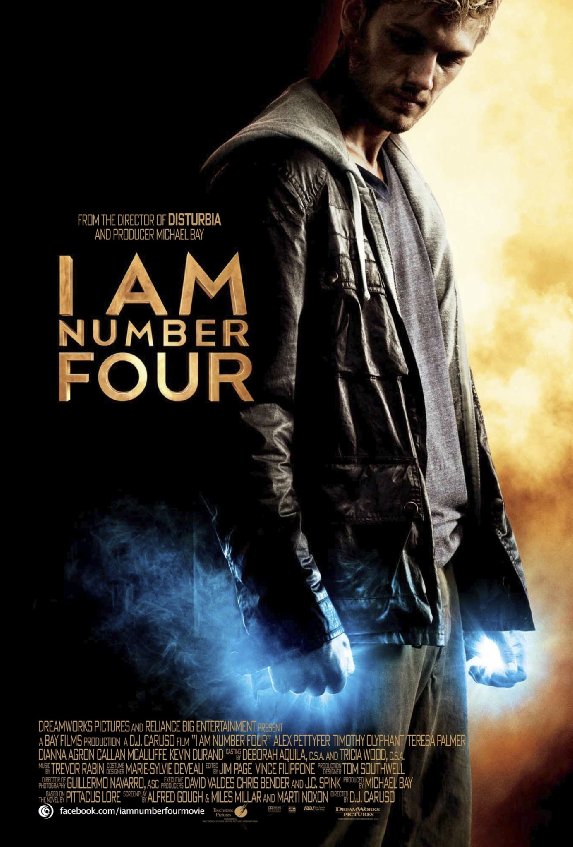
I Am Number Four

MV5BMjI0NDI1MTMyM15BMl5BanBnXkFtZTcwMDMzMTcyNA@@._V1__SX1859_SY847_Let me say off the bat, the CGI was a little bit terrible. I’m not sure how good expensive CGI can get, either because I haven’t seen it or don’t remember, but cheap CGI[1] just can’t do mammals at all. It can do reptiles okay, but fur is just a complete show-stopper. The reason for that disclaimer, as you may otherwise have been asking, is that I Am Number Four was mostly enjoyable, contrary to what expectations I had been given. And that’s always pretty cool, right?

Plus, it had what I believe is a unique premise in the annals of Hollywood history. Well, no, that’s not true at all, but I think this particular combination of two premises is unique[4]:  prince on the run from alien assassins combined with high school angst. It sounds a lot more like a TV show, right? But I think it would have been too angsty to work on TV; the forced speed of the movie format made up for a lot of what might otherwise have been annoying digressions, and it only barely gave me a chance to think about the worst, most teenaged part of the plot. And corollary to those improvements via limited screentime, I hope it doesn’t do well enough for people to pick up the pie-sized bread crumbs of sequel bait and start running with them.[5]

I won’t say much more about the plot beyond acknowledging the premise, both halves of which are visible within ten minutes of screen time anyway, but I should say a bit about the acting. Dianna Agron from Glee (who has a broader résumé than I’d have guessed) did a nice job as the outcast shutterbug love interest, and I suspect that someday soon she might be able to get herself a role that isn’t defined by another member of a cast. And Timothy Olyphant[6], easily the best of the bunch as the aforementioned prince’s guardian, manages to maintain the amusedly-detached-with-flashes-of-intensity hyper-competence I’m used to from his characters without ever giving the impression that he’s above either the cast or the angsty half of the plot, despite that he so clearly is.

Anyway, I dug it. Except for the mammalian CGI. Just saying, that was a bad idea, way worse than the angst or a sequel would be. (Probably not worse than a TV show, though.)

[1] My premise may be wrong, and all CGI has this problem? But I’m guessing not. (Or hoping not.)
[2][3] It must be a problem with all CGI, though, since obviously Michael Bay can afford the good shit.
[3] I know what you’re thinking, and you’re wrong. Consider it an easter egg hunt.
[4] Not the practice of mashing-up, clearly.
[5] I also hope I stop with the metaphors, because, wow. I am so, so sorry.
[6] If you are not familiar with his work in Deadwood and Justified, you’re doing it wrong.

Assassin’s Creed

71233_frontTo be clear, this is a pretty old game. I remember reading about Assassin’s Creed in Gamestop’s magazine sometime in 2006 and being really excited about what they were doing with the cities full of random people and the ways you could run and climb and otherwise interact seamlessly with the environment, and without a lot of weird button combinations and things. Plus also the plot, which pits historical Assassins against the Knights Templar in the Crusades setting; it seemed to have a lot to offer on both the very pretty and the very cool scales. The framing story, which has a faceless but clearly very wealthy corporation essentially kidnapping a man who is a descendant of one of these assassins, because they can put him in their cool sci-fi device and use the blood link to pull genetic memories from him, seemed like it may also have been cool, but I really didn’t get far enough into the game to form a valid opinion.[1]
So, right, that part is probably relevant. Despite all of the real coolness inherent in the gameplay and plot in concept, in practice I found it absolutely unplayable. Part of this, I realize now after the fact, is that the introduction was weak and did not provide as much direction as I think I needed to latch onto the plot. The other part, that caused me to stop playing out of pure frustration, was mechanical in nature. Without a clear set of roadsigns to pull me quickly into the plot, I was still enamored of the beautiful countryside, and on top of that there were collectible items and very tall towers with expansive views to enjoy, so I started poking around into that, still perfectly happy with what was going on around me. Until I learned that any time I ran (or ran my horse) past a soldier, I would be targeted for death. It’s not like I had started murdering people yet, and it’s equally not like it was based on some recognition of me, as obviously a walking person is easier to look at. No, the designers just made a terrible decision in which any person who is running must be evil and in need of capture. And once I had to enjoy the expansive open world at a snail’s pace always instead of slowing down at the parts I wanted to explore in greater detail, or else I’d have to fight all the time? And I still didn’t really have a feel for the actual main game on top of that? It was rendered unplayable.

In the meantime, people have sung the praises of its sequels, and while nobody seemed to hate the one game-breaking aspect of the first game the way I did, everyone seemed to claim that the sequels fix a lot of other small problems that I never really saw for myself, and the whole is a massive improvement. My completionism still left me believing I might try to pick up the original again someday, but having played a few hours of its first sequel (review forthcoming, though likely not anytime very soon) and seeing that on top of my complaint, it really does feel a lot more polished and playable in ways I can’t even explain the differences for, it has become clear to me that I would only be punishing myself by going backward.[2]

Anyway, this right here? Kind of a horrible game that thankfully got another chance at life. Because the concept I loved so much? It works every bit as well as I had imagined.

[1] The wikipedia summary that I recently read tells me it probably would have been very interesting, though.
[2] Hence the wikipedia summary.

The Honor of the Queen

I do not wish to be too sick to write a review, as what if I fall behind in my reviewings? But contrariwise, what if I write a useless review to which people respond, “Hey, stop writing reviews while you’re sick, Sicky!” And then… well, I haven’t really been able to define the bad thing that happens next, probably because my head is too simultaneously congested and medicine-floaty to concentrate that long. But clearly, consequences will abound. All the same, I’ve written way too much to back down now, even if none of it has anything to do with Honor Harrington just yet.

Which, yeah, I finally read the second book of that series, The Honor of the Queen. In a lot of ways, it is a clone of the previous book. Well, sort of. At least, the setting is unchanged.[1] That setting being some 1700 years in the future, where mankind has long since spread forth from Earth, discovered the means for faster-than-light travel, only of course politics are always basically the same and now there’s a cold war between the honorable, if occasionally too doveish, Manticoran system and the wily, expansionistic and probably pinko commie Republic of Haven. You may recall (or may not, depending on how much I mentioned any of this last time) that our plucky heroine Honor Harrington got caught up in the apparent beginnings of that cold war while On Basilisk Station, with the results that she proved her pluck to herself, her subordinates, and her Queen’s military chain of command.

Now it is some years later[2], and Honor has been picked to command a task force on a diplomatic mission to a pair of backwards religious worlds that rejected all technology[3], with the result that they are insular and range from sexist to incredibly misogynistic, all of which would be good reasons to continue ignoring them and leaving them to their petty internecine religious warfare, except that they make a good buffer (or forward base, depending on whose team you are rooting for) between Manticore and Haven, much like Basilisk Station did last time. If you think this means that we’re about to be treated to another display of extreme competence in the face of insurmountable odds, during which Honor will impress allies, enemies, and neutral third parties alike with her capability and her, well, honor, then you are clearly reading the correct series. It’s interesting, because even without knowing that there are a whole bunch of books left to read, I would have known after reading the first one that there’s really no chance whatsoever that she’ll fail at what she sets her goals to, but the pacing is so much improved[4] over the first book that I was able to wring almost as much excitement out of wondering how the success would occur as I would normally spend on wondering whether it would.

Things I am looking forward to in future books: whether the revealed personality “flaw”[5] will cause her any future problems; the outbreak into an actual war of some kind between the two rival, uh, nations I guess? That’s the closest analogue, anyway. Oh, and whether the hyper-intelligent empathic cat creature will stop seeming weird eventually. At least it no longer seems tacked on.

[1] I really feel like there’s a distinction I’m about to draw here, in which I define the setting more precisely instead of just saying the most uselessly inane piece of information ever presented in a review by anyone, ever. Nevertheless, the fact of my aforementioned sickness is definitely rearing its head, if only in my head.
[2] These years are not very relevant since most everyone in the developed parts of the galaxy has access to life extension technology. Yay, the future!
[3] I know. Believe me, I know. So do all of the characters. Weber’s penchant for straw men may start to grate on me, I reckon, unless he gets a little more circumspect about them.
[4] Seriously, from about the midpoint of the book on, there was very little action that did not feel climactic. Which makes up for quite a fair amount of previous political strawmanship, let me tell you.
[5] Scare quotes because of how certain I am that Weber doesn’t really consider it a flaw at all, despite that he acknowledged why it could be troublesome.

Moon

Since I didn’t get Moon through Netflix, I really should have taken my opportunity to skip this review. I mean, it’s the kind of movie where knowing as little as possible is the best, and that makes it hard for me to mention the pure highlight that elevates it above other similarly-constructed movies that we’ve seen in the past, of which 2001 is certainly the most obvious. And yet, it’s a movie that I first heard about on Thursday, and managed to see on Sunday through no great expansion of effort, while gathering that basically every other person on the planet had not only heard of it but really liked it. (Well, almost everyone for that last point.) And so I feel obligated to say something about it, just because it was such a common thread of my weekend.

So, what happens is this: an energy corporation is strip-mining the dark side of the moon for a hydrogen isotope that can power over 75% of the world’s energy needs. (Or it might have been helium, but hydrogen makes a lot more sense, and really we’d have the same story if it had been unobtanon, so stop being so damn picky!) And they’ve got this moon base built that mostly runs itself, including the harvesters roaming around, and all that really needs doing is minor outdoor repair work and also the collection and launching of the hydrogen tubes once they’ve gotten full, for which they have hired Sam Bell for a three year tour of duty. The part where he’s alone except for GERTY, the helpful base computer/tethered robot, wouldn’t be too bad except that satellite links for live relay to earth are down, so he only gets communication with his bosses and family at about the rate of USPS letters. But he fills his time with old television[1] and craft-work and other such pursuits, and anyway, it’s only two more weeks until his tour ends and he gets to go home. Too bad he’s started to hallucinate. …or has he???

And anything after that, even the part I want to praise, even a discussion of theme beyond my willingness to say I think they did a good job there, would be way too much spoiler. So I’ll stop here and only recommend that if you’ve got a lazy Sunday afternoon and a craving for humanist sci-fi, this is a good place to go. (The movie, not the actual moon, which has been strip-mined something ugly, let me tell you.)

[1] If I wanted to pick a part of the movie that was kind of horrible, it’s that the two TV shows that made it on screen were Bewitched and The Mary Tyler Moore Show, both of which took me right out of the moment by triggering the realization that they picked their shows based on what would be cheap to get the rights to from TV Land or whoever owns them now, instead of what someone in a near-future setting would likely be interested in. I mean, geeze, at least Cheers or Cosby or Friends, guys!

Skyline (2010)

Sometimes, when a movie is universally panned, there’s a reason for it.

Skyline is another in a recent series of alien invasion stories that are told at the personal ground level, rather than with sweeping majesty like Independence Day was back when it re-opened the genre for public consumption. If you imagine War of the Worlds or Cloverfield, you are definitely on the right track. Aside from incidental plot and character arc divergences, these are all three (along with several others I could probably think of if I paused to do so) basically the same movie. So, what makes Skyline stand out? The first thing is the characters; every single one of these ranges between (at the high end) uninteresting and seedily unlikeable.[1] The second thing is the plot, which, after establishing that the Aliens are Here! and People are in Danger!, effectively goes nowhere at all for the rest of the movie, up to and including a conclusion that I can only presume was meant to by heart-warmingly thought-provoking, or perhaps vice versa. The third thing is… well, look, if you need a third thing, it’s because you are more forgiving of badness in movies than I am, and I’m pretty sure I’ve never met the person that fits this description.

[1] I should say that David Zayas, who I hope you will recognize as Angel Batista on Dexter, really wanted his character to be likable, but the script simply wouldn’t allow it.

The Steerswoman

The thing is, I finished this book days ago, and by that, I mean too many days ago. I’ve had tons of entertainments and about two-thirds of the next book since then, and I’m more sad at myself for failing to come to here than I’d normally be just for running behind. And that is because I liked it a lot better than the quality of this review will reflect. Still, this is the reality I’ve got, so I’ll do what I can.

The Steerswoman is the first book in a series about, y’know, steerswomen. (Mostly, though there are a few steersmen.) And the steerswomen are dedicated to knowledge. Gathering it, using it, disseminating it freely. And… but that right there is the thing. I started the book following Rowan’s adventures without any idea how the world worked, what the blue gemstones she was researching meant, or even why the wizards and the steerswomen are so strongly at odds. Truth be told, I still don’t know the answers to all of those questions. But watching the layers of the worldbuilding onion slowly peel back was every bit as entertaining as the unfolding of the actual plot. So I am forced to stop here, and add only that it’s a good book in a fantastic world that I want to excavate more thoroughly.

Best of all, I managed to not tell the story of why I finally started reading the series, which means I get to use it in a future review!