Tag Archives: Ultimate Series

Ultimate X-Men: Hellfire & Brimstone

By the time I finished the fourth X-Men book, I’d had it split up to read parts or all of two other books, plus it’s been more than a week since I finished it. And I’ve already denigrated the previous books in the series, to greater or lesser degree. So it will likely come as no surprise that I’m having a difficult time working out what to say about Hellfire & Brimstone, all things considered.

What is surprising is that despite still being a Mark Millar title, I really kind of liked it. The plots were a largely disconnected mishmash, about the introduction of Kitty Pryde[1], about a new evil growing underneath Magneto’s old island where the Brotherhood of Mutants used to hang out, about some rich people trying to summon a demon or an Old One or something to destroy the universe in exchange for limitless power, and about the evil mutants searching for new leadership. And it’s not just that they appear to be disconnected on the surface: they’re mostly just as disconnected by the end of the volume. But I guess each story was good enough on its own, or had sufficiently cool moments, that the entire thing was elevated as a result. However it worked, I’m relieved to have caught one that ended up being pretty darn good, for a change.

[1] That seems to be her real name, not her superhero name. Which: wow. (She can move freely through solid objects, if you care.)

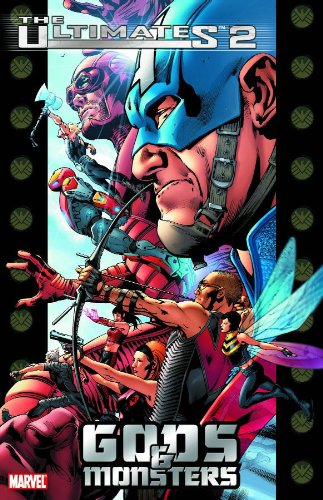
The Ultimates 2: Gods and Monsters

61rnRASuyiLFinally, something good out of the Ultimates universe again! I’m reading the four series, and Spider-Man has been great for the teen set while Fantastic Four has been okay, and X-Men feels adult even though they’re all teens too, but it’s been the not-that-good cousin to the clearly adult and clearly good Ultimates. My point in all of this, aside from the subtle recap, is to express my relief; the last few books I’ve read have been iffy.

Not so God and Monsters! I mean, it starts off all soap opera with a recap of how the various government-sponsored superheroes have been pairing off, and how the remaining unpopular heroes have been doing. (Giant-Man has been having the kinds of marriage problems that do not result in paparazzi wondering who you’re being frisky on the beach with, and the Hulk murdered a lot of people, so.) But after all the stage-setting is in place, it immediately turns into Schrödinger’s plot, wherein one of two possible things is happening. Either Thor really is the Norse god of thunder, and his brother Loki is altering reality to torment him and Midgard in general, or else Thor is a delusional Norwegian hippy who has become incredibly dangerous because of his unbalanced ratio of powerfulness to sanity, and meanwhile the Ultimates are being gradually turned into yet another military arm of the United States government. For my part, I’m honestly not sure which possibility is more dire for our heroes.

Also, there’s a downright hilarious sequence revolving around a group of second tier superheroes of the type you’d expect to start crawling out of the woodwork in this kind of world, looking to feel special without any pesky powers or skills getting in the way. And the Ultimates contain a secret traitor! Maybe! (Like I said, it has a lot of soap opera elements to it. But I am okay with that kind of thing.)

Ultimate Fantastic Four: Inhuman

The fourth entry in the Ultimate Fantastic Four series was mostly of the ungood. The first half of the surprisingly short book revolved around a character whose plot and disposal were both extremely predictable if you’re familiar with the Mad Thinker from the FF’s original run, but who appeared to be annoying and pointless if you aren’t. And the the second half was even more of the same, as though the only purpose of the series is to hit all the highlights from the 1960s version. And as much as I’ve complained about the Ultimate X-Men run, they’ve never once seemed blandly formulaic. On top of which, the art reminded me of someone who was not very talented trying to copy the character-style of Girls (which style you will no doubt recall I already found unsatisfactory) combined with repetitive backgrounds and heavy reliance on “characters in shadow”, as though the strain of cranking out such minimalistic-yet-bad art got to be too much, and only having to do shaded in outlines on some pages was a rest break from that.

On the bright side, none of the other books have seemed this bad, so there’s every chance that the quality will swing right back up again? (Plus, you know, the art may have unfairly lowered my overall opinion of the volume. If anything, I hope that’s true.)

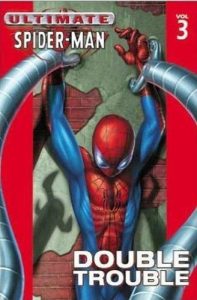
Ultimate Spider-Man: Double Trouble

For the most part, the third volume of Ultimate Spider-Man is more of the same. But when you consider what a high watermark that is, the phrase turns out to be praise rather than pejoration. Pete’s got a handle on his powers, he’s sort of got a handle on how to use them, and he has a solid ally in his corner. Naturally, therefore, the stakes get ratcheted up commensurately with his new stability. Not only is there a person at school who believes he’s seen though Spider-Man’s secret identity, not only is a philosophical, attractive, and anti-bully switch-blade wielding Gwen Stacy causing tension between Peter and Mary Jane; on top of these, one of the people who worked in the lab where Peter was bitten by the genetically-modified spider that started all the upheaval in his life has awakened from a coma with strange new powers and a grudge, and Australian Animal Planet personality Kraven the Hunter[1] has decided that a defeated Spider-Man would make an awesome trophy, not to mention bolster a flagging career.

As usual, though, it is Spider-Man’s gradual ascent towards genuine super-hero talent, Peter Parker’s lightning-quick banter, and Aunt May’s struggle to keep rein on a boy about whom she knows far less than she thinks (though far more than he thinks) that combine to steal the show. (I seriously cannot say enough good about May Parker in this series. With appearances in fewer than half of the twenty-one individual comics I’ve read over these three volumes, she has managed to redeem a character that I expected to dislike forever.)

[1] If this sounds kind of familiar, well, I expect it’s supposed to.

Ultimate Fantastic Four: N-Zone

As we rejoin the youthful, modern Fantastic Four, they are still trying to determine how to reverse the changes that have been wrought upon them.  Well, at least those who actually want to go back to normal, which number is shrinking as they begin to realize that the potential for the future outweighs whatever burden they may feel. Since I’m not that big a fan of the reluctant hero, this is pretty much fine by me. In any event, in this volume, they plan a trip back into the N-Zone that was the source of their new lives, for science!

The story was basically fine, with all the sci-fi trappings that attached to the original FF moreso than any other old-school Marvel comic, including a spooky extra-dimensional universe with inexplicably giant skeletons and a bad guy named (roughly) E-Vil. I don’t know if the problem lies with the objective quality or with my just having read a much superior Ultimate Spider-Man book, but this one left me mostly dry. The good news is that the character interactions among the four of them that have been the best aspect of every book so far are just as solid here and if anything continuing to grow in quality. There’s nothing worth skipping, but if it was what I had to recommend the series from, I probably wouldn’t bother to.

Ultimate Fantastic Four: Doom

I haven’t found any Ultimate X-Men yet, the upshot of which is that I’ve already looped around on these quick reads to volume 2 of something. I don’t mind so much: there’s a goodly pile of things available, and so far they’ve been uniformly entertaining. That is not, as they say, nothing. The second Ultimate Fantastic Four picks up essentially right where the first one left off. Fresh from their first victory, Reed Richards and company[1] are still working to find a way to become normal people again. And the key to that is discovering what happened to the fifth person affected, Victor Van Damme. He, after all, was the one who changed the experiment’s parameters that caused the accident in the first place. The downside to the plan is that he already knows where they are. Being under effective house-arrest courtesy of the United States in the same Baxter Building where all of their schooling and late night studies took place makes this kind of easy, you see.

I’m definitely still liking the series. The comedic timing is improved over an already funny previous run, and the elements of government control over what is not yet a famed superhero group, but just a quartet of college kids? That’s a story with a lot of depth behind it, if they choose that direction to go in. Plus, y’know, Doctor Doom is there now, and we all know he’s a great adversary.

[1] My historical knowledge of the group, predating any actual reading, leaves me with only his name at the tip of my tongue. So my instinct is to assume that the other names wouldn’t mean a lot to most people. However, I feel compelled to come out in praise of how Sue Storm has been handled thusfar. She’s a modern love interest, in that he seems as much like her prize as she seems like his. And on top of that, she’s a gifted biologist in her own right, every bit as skilled in her field as Reed is in his. It’s a very pleasant contrast with the 1960s version; and make no mistake, even then she was a pretty strong female character for her genre and time!

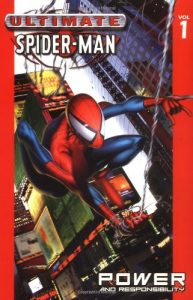
Ultimate Spider-Man: Power and Responsibility

A thing that is rapidly striking me as odd about the Ultimate Marvel universe is how unrelated the stories are, compared to 1960s Marvel. I mean, I’ve read three origin stories now, and all of them refer to events that are mutually exclusive of each other. As though they’re all actually set in mildly disparate realities from one another. This is not something that troubles me particularly, just an oddity. I mention it in part because it struck me last time and I never said, but also because it’s one of the many aspects informing my reading of the first Ultimate Spider-Man.

Other aspects include the initial Spider-Man movie, which appears to have been heavily influenced by this volume, my readings of the first 31 issues of the Amazing Spider-Man comic[1], and my expectations relative to the other Ultimate series in which I’ve dabbled that this one would be the most kid-oriented. And indeed, our Peter Parker is a mere 15 years old, with a fair bit of modern angst to him. So, on the whole, it really feels like I should be feeling a little meh about the whole thing. Instead, I enjoyed myself a lot. My guesses about this are that I’m even more of a sucker for high school angst than I thought (and, come on, get over it already, man), or that lowered expectations were just right for the book, or that the original story Stan Lee put together in 1963 has such a heaping helping of mythic resonance that any given retelling will affect me just as much as the first time I saw it. I think there’s a pretty good chance it’s that last one.

[1] I’ll be reading #32 pretty immediately after this review posts, in point of fact. Mary Jane Watson has been the elephant in the corner for at least 25 issues now, which is kind of hilarious to me, given my knowledge of what the future holds. I have to believe that Stan Lee had her in mind as the real deal all along; the set-up is too perfect to be coincidence.

Ultimate Fantastic Four: The Fantastic

As I believe I have mentioned from time to time, I’ve been reading a lot of Marvel Comics from the 1960s. The Ultimate series of Marvel Comics (a reimagining of the best-known characters from that period as though they had never been created and only appeared in the last 5 years or so instead) is not, alas, on DVD. However, I can find large swathes of the serieses in graphic novel form at my local used bookstore, and hey, why not? I’ve read enough of the original titles to know that I like the characters and the world, and enough to catch at least a substantial number of the references. Plus, I could conceivably catch up on this some day and read it sort of live, which is something that will never happen with the regular Marvel universe and its 45 years of bloat. That’s pretty cool, I guess.

So, anyway, The Fantastic provides the origin story and first major enemy faced by the Fantastic Four, who you’ve possibly heard of before, here if nowhere else. In this version of the story, the team is formed largely of precocious students who have been gathered together at a magnet school with government funding to invent the future, and the accident that provides their powers is the result of a teleportation experiment rather than flying through cosmic rays in space. In fact, my one complaint about the story is that the ‘What caused this?’ subplot was left unresolved in an unsatisfying way. I’m assuming they’ll make up for it by continuing to search for answers in future volumes. But the problems and personalities are spot on, the Moleman is far better realized than he ever was in the original comics (at least as far forward as I’ve read), the in-jokes were occasionally hysterical, and the art…

Well, I know it’s probably heresy, but I’m a lot more fond of the current art than the original stuff, and for a couple of reasons. The really heretical part is that I’m just not that big a fan of Jack Kirby. His backgrounds are great, yes, but his people have always left me cold. The other part is that the big, full-page art is very nice. It admittedly slows the story way down, explaining why what took FF #1 in 1962 about 20 pages to tell took the modern people 100 or more; but I don’t mind that the story slows down a bit, as continuity between issues is far tighter even than it was then. (And one of my most consistent praises of old era Marvel is how continuity-minded they were, and how high above my expectations the writing has been as a result.)

My point in all of this, I guess, is that I certainly liked what they’ve done with the reboot, and anticipate liking the other Ultimate titles as well. But since in a roundabout way I’ve been reviewing the old comics and the reboot concept more than this particular story, it’s probably fair to say that any future Ultimate reviews will be shorter than this. I mean, if that’s the kind of thing that worries you. (Which it probably would me; it’s a short graphic novel in the scheme of things, and not chock full of symbolism and enigma like most of the non-superhero comics I tend to read more often.)