Tag Archives: superheroes

Marvel Zombies 4

This sequel to Marvel Zombies 3 (as opposed to the series in general, because the third volume went off in an entirely new direction, you see) is interesting not for being a good zombie story (it was not bad, but it was also not good), but for being an archaeological study of the period of Marvel that I’m reading right now. The main characters are chock-full of the Marvel horror experiment: Morbius the Living Vampire![1], Jack Russell, the Werewolf by Night, Simon Garth, the [voodoo type of] zombie, Man-Thing, Daimon Hellstrom, Son of Satan, and, okay, some witch chick that I haven’t yet heard of. But my point is, these characters are wandering in and out of all kinds of crossovers with the comics I am reading (June 1976, now), and have titles of their own that all started since 1974. I am honestly surprised at how many of them have stuck around, though there are certainly changes, as I think there would have to have been. ‘Cause, really.

Alas, after all the interesting set-up that I speculated might be coming from the previous volume, Marvel Zombies 4 was a pretty straightforward fight to avert apocalypse. That certainly has its place in comics, unquestionably, but after setting up the MZ continuity to relate to horror and destruction and the existential angst of wanting to be a good guy but virally failing, watching some world fight off an incursion without any examination of the deeper causes of things and without… well, okay, in their defense, the book where we lose is already written, so putting that scenario on a new world is redundant. But I still say that using the MZ world as a springboard for “look, an apocalypse to avert!” is too, and I guess that’s why I was disappointed. Man, I wish they’d used the space to explain what the fuck is actually going on instead. Particularly if they’re going to insist on giving it religious overtones in the first place. Religious overtones = “there is a responsible party”, not “random happenstance in the universe, what are you gonna do?” So use that, Marvel Zombie authors!

On the bright side, the end of the book contained black&white issue 1 of Tales of the Zombie, which was a lot grimmer and a lot more nudity-filled than I expected a Marvel title to have ever been. Plus, it was pretty decent, even without its own more direct version of well-timed archaeology. I still won’t mind just watching these characters interact with my superhero continuity instead of actually reading about them too, but I’m at least getting a clearer picture of why people would have.

[1] I mean, they don’t themselves use the exclamation point as part of the name, but I cannot see how to say that without planning on being excited about it, and so.

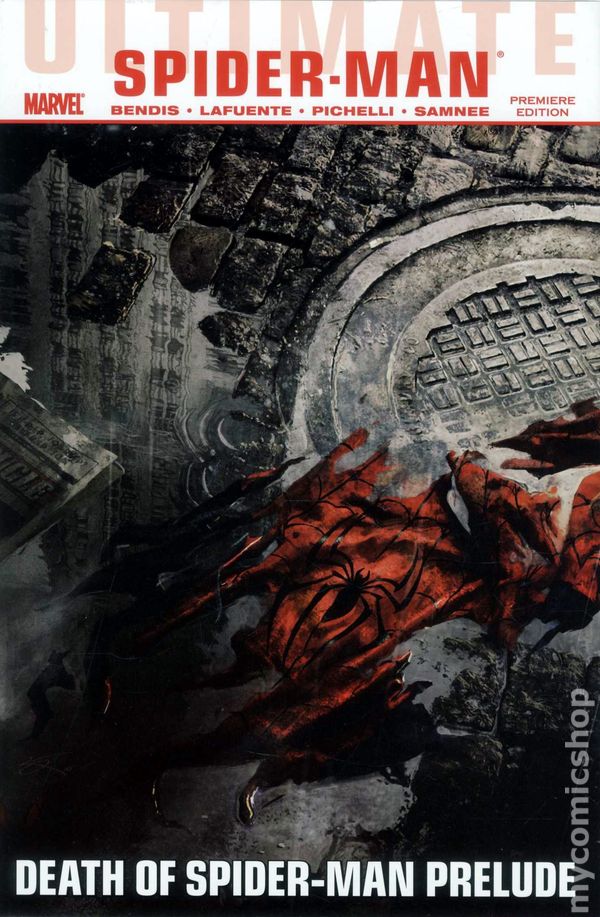
Ultimate Spider-Man: Death of Spider-Man Prelude

1160287They certainly don’t pull any punches on the spoilers when they have a big event coming up, do they? That said, I’m not going to go into any of the future spoilers (of which I know somewhere between one and two) in this review; all I’m going to do is take them at their [notoriously untrustworthy where death is concerned] word that the title is accurate, and go from there. Because, while the story in the Ultimate line’s prelude to Death of Spider-Man was good[1], it’s hard to get very worked up about it with such a huge shadow looming over the future landscape. But I shouldn’t sell it short, because it was a really great book, pulling together just about every extant plot thread and weaving them all together seamlessly. More about Mysterio, Spider-Man’s biggest foe since the Green Goblin? Check.[2] Fallout from… I mean, whatever you want to say about the way Stan Lee created the first superhero with human problems, and that being what made Peter Parker special, sometimes that boy has problems that nobody else has, because he’s a superhero. So, as I was saying, fallout from the most literal form of identity theft I’ve ever seen? Check. When the Ultimates hold a coffee klatch about whether you and/or your image can be reformed, you know things are serious. And that’s leaving the girls out of it entirely. My point is, Pete just had a really bad week, and this week wouldn’t be looking so great either, even without Mysterio’s latest gambit or the newest and arguably most dangerous holder of his secret identity.

There. Review out of the way. Now, let’s talk.

I’ve been thinking about this upcoming “death of” storyline for a couple of months now, basically since I received this book and then moreso a few weeks later when spoilers erupted in the media based on the release of a relevant comic (to be portrayed in a graphic novel somewhere down the line, I reckon), but the thoughts didn’t coalesce until after I read this one. We have this guy, Spider-Man, right? He is freakishly strong, although not much stronger than the strongest man without special powers. He has designed a web fluid that lets him swing around to get places faster[3] and that makes it easier to trap / blind / distract opponents or make a safety net for himself / bystanders. He can stick to walls. And he has a danger sense that tells him if something bad is about to happen. Not a bad little list of powers, and he makes good use of them. But all in all, if Spider-Man died, what would change? The Ultimates still take care of alien threats, large-scale terrorist activity, the really high-powered villains, that type of thing. And the Fantastic Four still takes care of random dimensional incursions, or would if they had ever gotten back together. But at least they used to, and their being missing now doesn’t really mean Spider-Man could take up that slack. More inventors with delusions of evil grandeur would get away with their initial schemes, until they got rich and powerful enough to attract the attention of the big boys, at which point it all ends up in the same place, just with a few more people hurt along the way. I’m not saying that’s nothing, but new superheroes come along all the time. It honestly isn’t a whole lot, you know?

But then we have this guy Peter Parker. Pete’s done a lot of things. He’s received random powers for no apparent reason, and even though he’s one of the smartest people on the planet, the freak genetic accident didn’t turn him into a super-villain. How many people can say that in any Marvel universe? Answer: few indeed! When New York was underwater, and most people were either trying to track down the perpetrators or else just get to safety, he was the only hero I remember who was actually running towards the devastation (well, diving towards it) and trying to pull people out. Over the past year or so of comic continuity, his aunt has changed from an angry and somewhat resentful aging widow to a strong mother figure to a lot of other heroes in the teen set, who can and will stand up to S.H.I.E.L.D.’s top agent if it will help her kids. He’s taken Nick “it’s the one that says Bad Motherfucker on the handle” Fury to task over poor ethical decisions, and even more amazingly, been successful at it. Pretty much every superhero he comes across respects him, and the exception (Captain America) is the very one whose place I see him as taking in the Ultimate universe, even if Cap almost never lives up to those aspirations in Marvel’s main continuity either. (Well, at least not as of 1976.) I see some arguments that Superman does this in a few of his movies and perhaps in limited comic runs, and Captain America in the recent movie did exactly what I’m talking about. But in long-form comics, the only character I’ve ever seen that makes everyone he comes in contact with a better person, who basically makes the world better with his every action and makes it worse with virtually none of them, is barely sixteen year-old Ultimate Peter Parker.

On the one hand, death is a very fleeting even in superhero comics. Always has been, probably always will be. But on the other hand, I’ve seen only a bare handful of people in this particular continuity come back from death, and most of them were via special cheats written into the original Marvel storylines the authors were covering. So I don’t really know what to expect, and I give you my ironclad guarantee that I have no special knowledge of what is to come, beyond the aforementioned one or two spoilers that I’m avoiding here. What I do know is this. If Spider-Man dies, as they are so strongly implying, I’ll miss a cool character, but it won’t be a big deal in the scheme of things. If Peter Parker dies, as he would nearly have to for Spider-Man to do the same, his world will be the worse for it. I’m invested in the Ultimate universe, pretty obviously to you who have read me review every last one of their releases. I’m not going to stop just because they make a choice I’m not okay with, at least not right away. But it could be that before this time next year, I’ll really want to. Why would I keep forcing myself to go back to a darker, sadder place?

[1] Isn’t it always, though? I was wondering recently whether there has ever been a 160 issue run by the same author for a shared superhero character like this.
[2] And let me tell you, I am impressed at how well they’ve rehabilitated a mostly lame smoke-and-mirrors guy from the original run.
[3] Though once he leaves or before he gets to Manhattan, what are his web-lines attached to? He’s always way too high outside the City, you know? I have no point here, it’s just always bugged me.
Powers: Anarchy

The thing that is sad about my review of Anarchy is that it will sound like I didn’t like it, when the worst I have to say about it is that I didn’t love it. The characters are still top-notch, or I should probably pass that through my filter of liking things too strongly and say instead that I continue to find them compelling. But the plot of this particular issue was really just forgettable. It was tasty forgettable, don’t get me wrong, but like when you eat light popcorn and then later you suddenly want actual food? It’s like that. I know that there were some superhero murders that tied back into the comic’s earlier days and that may well become very important later for that matter, but in the moment, it was just a glimpse of places we’d been before with people I’m happy to accompany, sure; and restoring the status quo (which had been really strongly upset by the end of the last book) was probably a good idea, but I could wish it had been more exciting to get there.

On the bright side, the book isn’t a thousand pages long and I didn’t have to wait two or more years to read it, so the standard complaints really don’t apply.

Ultimate Captain America

It’s funny[1] that I was just talking about the clever storyline from the Marvel universe where they explained how Captain America could have been both frozen in the Arctic Ocean after World War II and also fighting Communists in the 1950s. Because Ultimate Captain America tells an analogous story, albeit without the need to justify the continuity issue the original guys had. Only, you know, quite a bit darker, as Ultimate Cap has always been. I shan’t say any more, because there isn’t a whole lot of story in there. But I definitely liked what there was well enough, and I’m still definitely in the mood for short-form fiction right at the moment.

[1] Although not that surprising, since it was during my review of the character’s recent movie.

Captain America: The First Avenger

[1] You know what made this movie better than it had any right to be? It was the Captain America they wrote into it. I know that sounds painfully trite, but stay with me for a second here. I’ve read the ultra-patriotic Captain America of the 1950s[2], the reflective, uncertain, self-consciously apolitical Captain of the 1970s, and the hyper-capable, overly superior (in thought, word, and deed) Ultimate Captain of this past decade. There are things to like and dislike about each of them, but none of them made it into the movie. This guy, from his abortive attempts to enlist during World War II as an asthmatic, archetypal 98-pound weakling through his confrontation with the chillingly and somehow never cartoonishly villainous Red Skull, and at every moment in between, is just an all around average joe who happens to be the nicest guy you’d ever want to meet. That he’s brave, intelligent, and acquires super-powers is almost beside the point. The heroism, explosions, and cool stunts were certainly worthwhile too, don’t get me wrong. But mainly, it’s how damn likable Steve Rogers is that carried me through the movie. Everyone has shades of grey these days, and they should, because that’s the real world. But it’s refreshing to know that sometimes the good guy really can just be, y’know, the best guy.
It’s not fair to compare him with the Captain America who was frozen in the Arctic Circle for a variable number of decades since World War II and wakes up with his whole life left behind him in the blink of an eye. Of course that guy is going to have a harder time of it than the one who asked for a chance to fight and was given everything. But it really is going to be hard to go back to angsty and/or superior Cap after liking this one so very, very much.

[1] Just to get it out of the way, my intent was not to see the movie in 3D, but events conspired against me. It’s, y’know, fine?
[2] This is true from a certain point of view, at least.

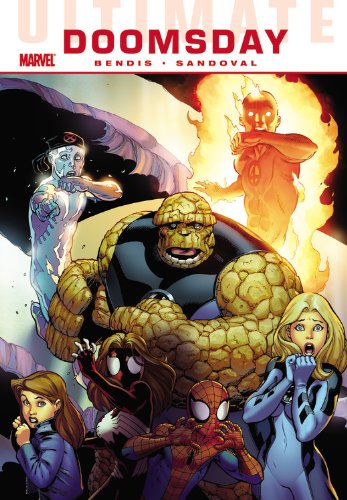
Ultimate Doomsday

51iy4c9sUqLSomething like a year ago (in graphic novel time; longer ago in single issue time, you understand, but I bet that the ratios work out about the same), the Ultimate universe came to a crashing halt or I suppose more appropriately was swept away on a tidal wave. I may have mentioned it. And then new stories began to trickle in, from Spider-Man, the Ultimates, and their black ops cousins the Avengers. Notably missing were the Fantastic Four and the X-Men, though in the latter case the fact of worldwide mutant hatred due to their ongoing terrorism made sense of that part at least. So, in the meantime, Amazon had this link to a book called Enemy that was meant to be coming out last fall, and it was the next big event in the Ultimate universe. I pre-ordered it, as you do, and then watched in dismay as it was pushed back further and further and further still.

Then, sometime in May or June while I was waist-deep in both ice and fire, suddenly I get a shipping date. Only, now the book is selling for $40 list under a new name, even though my cost never changed from $13 or so. So that was weird. Then Doomsday arrived, and it turns out to be a collection of three separate never-published graphic novels making up the entire story of which Enemy was to be the first third. I appreciate your commitment to low prices on pre-orders, amazon.com! And now, months after that, I have finally come up for air long enough to read something new. Which is nice.

So, anyway, the Fantastic Four are back, more or less, although they’re by no means the only people around. This is one of those stories like the Ultimatum or the big Galactus trilogy a number of years earlier where just about everyone gets a piece of the action. The story starts with a bang, almost moreso literally than metaphorically, when many different heroes and also, somewhat inexplicably, the occasionally nefarious Roxxon corporation are all targeted for destruction on the same day at the same time, with varying degrees of success. Then the survivors must come together to solve the mystery of who is out to get them and what to do about it.

I shan’t say more, except to allow as how I’m really suspicious of the outcome being the real end of the story. We’ll see, though! Eventually.

Green Lantern

Going into Green Lantern, I knew very few things about the character. He does stuff in space, and he can do anything at all with his magic ring, unless what he is opposing is yellow, in which case he’s completely powerless. (DC, you know, about which I know little enough except for their very majorest characters.) My point is: yellow? Really? High budget effects or not, I wasn’t very hopeful. Yellow.

I’m not sure, but I think that may have been the movie’s saving grace. It had a lot of “gee, whiz” coolness going for it, don’t get me wrong, but the plot was really quite predictable, and the origin story fell flat for me when they spent half the movie establishing that Hal Jordan isn’t reliable and needs to grow up to realize his potential, and then had the turn-around occur on a dime for the flimsiest of reasons. So while I can’t say that it was one of the great comic book movies, it easily surpassed my tragically low expectations.

I mean, yellow!? I’m not saying yellow lameness was absent from the movie, but either they fixed whatever made it especially horrible in the comic, or else I’ve had a misguided notion of how things worked all these years. Either way, really. What’s important is nobody painted a baseball bat yellow to defeat the otherwise cosmically powerful good guy.

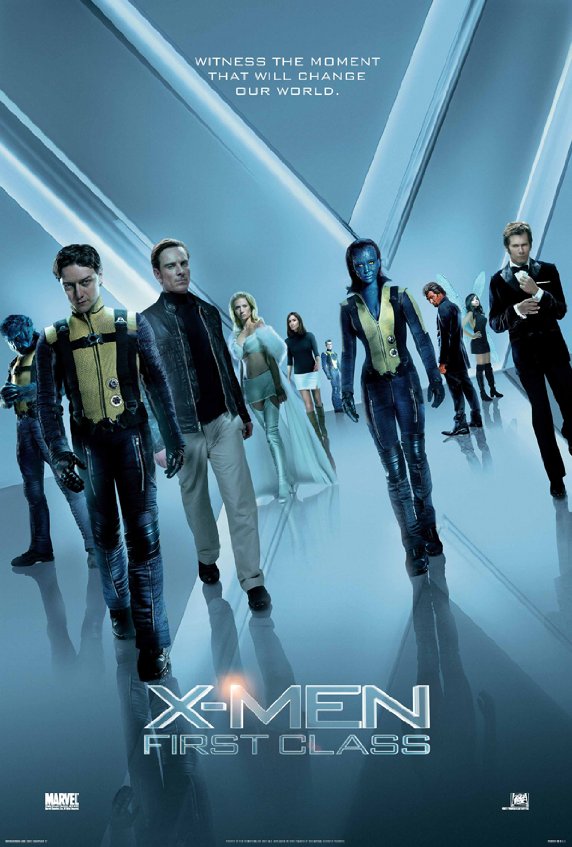
X-Men: First Class

MV5BMTg5OTMxNzk4Nl5BMl5BanBnXkFtZTcwOTk1MjAwNQ@@._V1__SX1859_SY847_Do you know what is embarrassing? When you get about halfway through a review and then realize you forgot one that should have come first. And it’s all the worse in this specific case, because you-the-reader will now inevitably think that my forgetting is a knock against X-Men: First Class rather than a reflection of the truly massive amount of overtime that is happening to me and the correlatively massive lack of sleep that is also happening to me. But my point is, while I only finished that book last night, I saw the X-Men movie on Saturday, aka 40 hours of work ago. And you know, I liked it.

The tricky part is figuring out how to say why I liked it. I’ve seen several one-line reviews, some positive, some negative, some thoroughly tangential, and every single one of them is correct. January Jones either made no attempt to inhabit the character of Emma Frost, was incapable, or the character was flatly written[1]. Some of the mutant powers are really pretty stupid. That was unquestionably the funniest f-bomb in superhero history. And this was very likely the best X-Men movie, or at worst tied with the one about Weapon X. If you can ignore the fact that the villain and his Hellfire Club failed to ever really make it clear what was the underlying purpose behind their efforts to drive Kennedy and Kruschev to World War III, the spectacle of the thing alone will carry you through most of the movie. And when you are able to add to that the interrelationships between the characters who are not quite yet Professor X and Magneto and Mystique, and especially the tragic relationship between humans and mutants that has led to some of Marvel’s best collective writing over the decades, I guess you’ll be able to see why it is so easy for me to say I liked it.

[1] I haven’t gotten to Emma Frost in Marvel continuity, and in the Ultimate continuity, like in this movie, the character is too much of a cipher, relying on what people “already know” about her to flesh out the missing pieces. (Or January Jones was indeed terrible. Beats me!) My point, anyway, is that I have no way of knowing the cause; maybe Emma Frost is just a terrible character and that’s why nobody seems to be able to make me get it, instead?

Ultimate Avengers: Blade Vs. the Avengers

Taken by itself, Blade Vs. the Avengers was actually a pretty cool story, with mostly logical twists (one unmentionable massive spoiler aside), convenient clearing away of what I at least considered to be a good deal of chaff, solid character interactions (if basically no development), and one hell of a cliffhanger. Where it fails is in context, and I feel bad saying much more, depending on how spoiler-allergic you are. So, now’s your chance to stop.

Okay? Okay.

So, one of my two problems with it is that a vampire invasion (’cause, see, Blade, and his name in the title is why I don’t feel like this is a big enough spoiler to just avoid talking about it entirely) is entirely too much like a zombie invasion, which has been done  too recently (and also better) in Marvel. That it mostly stays clear of the Ultimate universe is really beside my point, here. The other problem is with Captain America. He’s really cool and all, and I like a lot of what they’ve done with him as a character, but I’m getting a little tired of their over-frequent choice to use him as a plot device. Particularly in the Avengers line, when he is explicitly not a member of the Avengers and doesn’t fall under Nick Fury’s purview anymore. Here’s all I’m saying: enough with the deus ex dux, already.

Thor

I’ve been reading old Marvel comics for, well, a few years now. And also the Marvel Ultimate reboot series, for about the same number of years. In that time, I’ve gotten through 10 or so years of the newer version and 13 years now of the older version. Over those “years”, I’ve had characters I’ve liked and characters I’ve disliked, as you do. For instance, I will read as little about the Submariner as humanly possible, and I’ll be glad of it. Anyway, my point is this: I’ve seen a great deal about Thor as an ensemble character, and only a very little of him as a main character in his own stories. Everything I’ve seen of the latter (except for a few Loki-centric stories in the Ultimate version) has led me to be bored at the idea of picking them up, even when virtually every other major Marvel character has eventually won me over.

All of this to explain that I had pretty low expectations when I heard that they had a Thor movie in the works as part of the build-up to the Avengers franchise. Often, of course, correctly lowered expectations are the key to enjoying something that you otherwise might have rolled your eyes at or even actively hated. But the thing is, I don’t think that’s the deal here. The opening narration doesn’t give the slightest amount of delay in explaining that these aren’t really Norse gods, they’re just really advanced aliens who happened to choose Earth as a battleground, naturally confusing the natives. (Arthur C. Clarke is referenced so many times you’d think he got royalties.) And once that’s out of the way and we’re caught up to modern times, the story they’re telling is pretty much exactly the story I wanted to hear, without any of Thor’s old-school enemies who bore me so, without more than a smattering of his over the top formality that bores me even more; instead, it’s a sibling squabble between Thor and Loki, of exactly the type that has so enthralled me in all the new Ultimate stories. Except, you know, with cosmic implications and a few interesting earth people involved.

But other than the Loki thing, and I have decided over the past couple of years that in the hands of a capable writer, I could happily read or watch him doing just about anything, the main draw versus the comics that I was so leery of is that they took an overly formal prig with a stick wedged so solidly up his ass that it made Mjollnir look about as unmovable as an empty plastic bag in an independent film about existentialism and turned him into a jovial, likable, and best of all, overly rash hero among men. If someone tries to convince me that the Thor in the (non-Ultimate) comics eventually turns into that guy, I’d probably be willing to pick up his stories. Not until then, mind you, because I just don’t care enough about the backstory. Not this time.