Tag Archives: graphic novel

Marvel 1602

51vtf1JzwOLYou know what I hadn’t done in an exceptionally long time? Read a comic authored by Neil Gaiman! Luckily, Marvel 1602 exists to fill that precise gap, and now I’ve done so again. (But I am not convinced any other new ones exist, so that may have just been the end of that. Alas!, if so.) Imagine, if you will, the waning days of the reign of Elizabeth I of England. Only, over the past 50 or so years, important people are being born, people you would expect to be born almost half a millennium later, if you were familiar with the “Marvel Age of Comics”. So there you are in 1602, reading about the Queen’s personal physician and naturalist, one Doctor Stephen Strange, and her spymaster, Sir Nicholas Fury, and a school for certain gifted young people run by a Carlos Javier, and, well, really a lot of other names you’d recognize from the 1960s, if you had been reading these comics then, like me.[1] In fact, what few names there are missing would be spoilers to reveal by their very absence.

Into that unexpected cauldron, we need only add mysterious weather harbinging the end of the world, and Virginia Dare, the first English immigrant born on American soil, lost in our history along with the rest of the Roanoke colony but somehow alive in this apparently altered timeline; and voila, instant Gaiman mythology, complete with meditations on predestination and sacrifice. It was interesting to learn that Virginia Dare is a highly mythologized character in her own right; I remember in the vaguest way learning about her existence in school, but not that she had drawn much focus in American folklore since. I wish to learn more, and particularly welcome any recommendations; my only source of book recommendations right now is to poke through the Wikipedia article.

Other than to approve of and recommend 1602, though, there’s not much else I want to say. There are lots of good twists, and not knowing about them in advance was a lot of my fun. But I will say that Gaiman’s use of spiders in and around Peter Parquagh constituted one of the largest literary teases it has ever been my pleasure to witness. There are a handful of sequels, none by Gaiman of course, and I own / will read one of them soon. I hope they are at least pretty okay, because I do want to know what happens next, yo. I just also want what happens next to be non-lame.

[1] Okay, but’s it’s a close approximation of true!
Chew: Taster’s Choice

Aside from Unwritten, the other new first-graphic-novel-in-a-series that I have been loaned is Chew, about a police detective afflicted with cibopathy. In the extremely likely event that this term means nothing to you, I’ll tell you something similar to what the second page of the first issue tells you: apparently, there are people who place food (or whatever) in their mouths, and the act of ingesting gives them psychic information from whatever it was they ate. Like, if it’s an apple, they’ll know things about the harvest grove and the local pesticides, or if it’s a burger, they’ll know things about the cow’s life and probably its violent demise, or, well, if it’s a person… you could learn all kinds of things, couldn’t you?

Against this potentially cannibalistic premise[1], we have the life of poor, sad Tony Chu, who to add insult to injury can only eat beets if he wants to avoid getting psychic backwash. He is a cop, tasked with enforcing the federal edict outlawing chicken. And trust me, the drug war metaphors are so thinly veiled that I spent the first couple of issues feeling insulted that someone would choose so facile a soapbox to preach from. But then things got more and more bizarre, and while I can, as of the end of the first book (Taster’s Choice), accept that there’s actually something going on behind the whole bird flu / outlawed chickens thing[2], I also can’t make up my mind if I care. It looks like everything that has happened is important, but almost none of it seemed connected, each piece to another, in this particular book. And when my main character hates his life this much and the plot is this disjointed, it’s hard to find something to grasp onto to bring me back for a second book.

We’ll see, I guess?

[1] Spoiler alert: yep.
[2] Not to mention some justification for it, instead of just “not drugs, lol, chickens” like I really believed was going on at first.

The Unwritten: Tommy Taylor and the Bogus Identity

The first thing to say about Tommy Taylor and the Bogus Identity is that it is undeniably a rip-off of Harry Potter. The second, more important thing to say about it is that while the first thing I said is not particularly true, I do have the sense that Mike Carey was trying[1] to pull off a comfortable homage before he yanked the carpet out from beneath the reader’s feet, in much the same way that The Wheel of Time rips off Tolkien for about 100 pages. Which is to say, I have started (and more importantly, will be continuing) a new graphic novel series, this time on loan to me instead of on loan from me. Still, I may well buy them too, ’cause, they’re good.

Unfortunately[2], I don’t really know enough to say where The Unwritten is going as a series. I know it is playing with the role of literature in life, in a mysterious and (to me, but I’m a sucker for lit-as-pop-culture) exciting way. I know that the main character is a little boring right now, in the way that characters who stand in for the audience always are, but I am extremely interested in two of the secondary characters and also I trust that Tom Taylor will coalesce into a real person once he gets his feet back under him[3], so that doesn’t bother me right now. And I know above all that I want to know more. Plus, perfectly satisfactory art if you care about that kind of thing. The introduction by Bill Willingham of Fables fame (while overselling the book to the point that I got halfway through it before I was sure if I was in or not) indicated I should know who Peter Gross is, but I don’t. Possibly you do?

[1] and I daresay succeeding
[2] at least in one sense, completely awesomely in another
[3] After all, Carey pulled the rug out on his audience-stand-in at the same time he did the audience, pretty much by definition.

Ultimate Hawkeye

Like Ultimate X and Ultimate Fallout, Ultimate Hawkeye is serving as a bridge to the latest realignment of comics in the Ultimate universe. I don’t think of it as a reboot precisely, although perhaps I should, because no continuity has been jettisoned. (Well, that’s not entirely true, I should reserve judgment on the Spider-Man question.) Plus there’s just a whiff of backstory on Clint Barton, who really hasn’t had much happen to him (besides be a consistently reliable superhero) since his family was murdered one of the times the Ultimates were betrayed from within. Although I think I have been underrating this Hawkeye up ’til now, simply because it’s easy to do that to someone who isn’t flashy or wearing a weird purple costume in favor of just being predictably competent. Which is to say, I found a new appreciation for him in the book, and what more do you need?

But, and here’s where the bridge thing comes up. Because Hawkeye (along with some assistance in the second half of the story, but I won’t spoil things by saying from whom) is sent to a fictional alliance of southeast Asian countries who are being attacked by superhumans. You know, like happens kind of all the time these days. Of course, before you’re halfway through the first issue, he has uncovered a conspiracy to remove the X mutation from humanity and simultaneously create an army of similar folks (probably stronger if no less predictably powered) with a secret formula, only it blew up in basically everyone’s faces and is quickly turning into a big, world-changing event. And Nick Fury explains to him that (save the forthcoming assistance), Hawkeye is on his own, because there are two other, much bigger and more important, problems that he, the Ultimates, and the Avengers have to deal with instead of helping out with this thing. Details to come in upcoming Ultimate Marvel books, it is implied, but seriously? This is the sideshow nobody cares about? I fear I may be in for some major-league exhaustion from these stories, if they’re as all-action and no-time-for-character-development as I am reading in, between the lines!

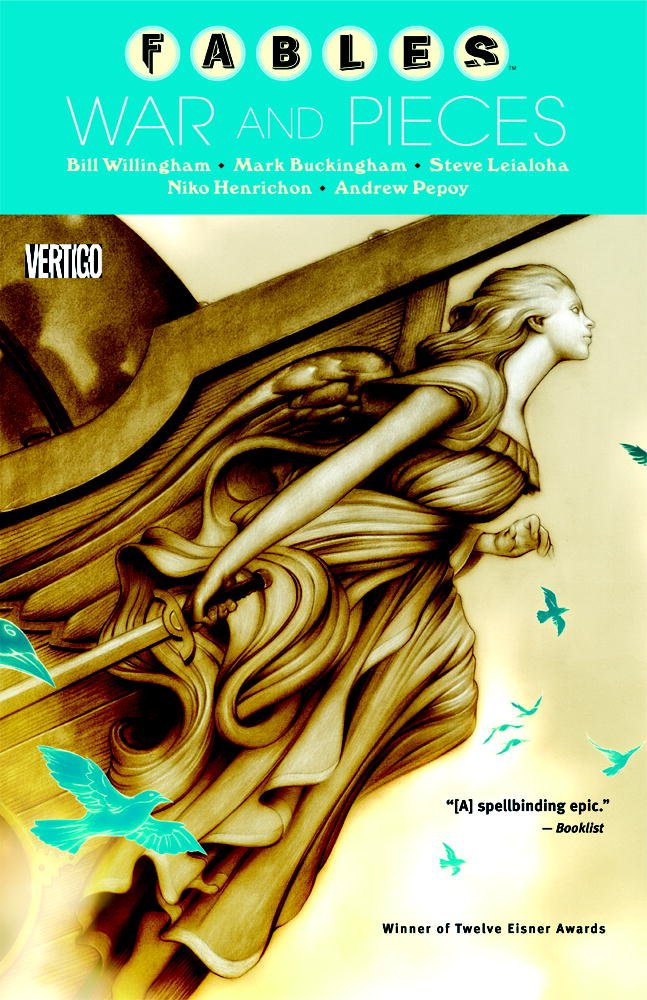
Fables: War and Pieces

717LwHDwIOLA little bit hard to believe: I am still more than three years behind on the Fables series. There are just a lot of these, you know? It’s not that I mind being behind, especially when I compare with having to wait six months for every new Walking Dead. It just caught me by surprise that it’s as far as all that. I suppose it caught me even more by surprise when twinned with the realization that this book marks the climax the stories have been building towards since basically the very beginning.

Yep, true story. The Fables of Fabletown, around a brief spy-heavy interlude that I kind of loved, have launched their long-planned war against the Empire that drove them out of their homelands lo these many centuries past. And as you can probably see from the title, War and Pieces, that is the main focus of the entire book. Which is as it should be. So I guess what really surprises me about being three years behind is that this is the kind of war where it’s hard to envision what comes next. Either Fabletown loses, its back broken and our mundy world now ripe for plunder while the survivors fight a desperate holding action and things get really grim, or else Fabletown wins, and, well… this is what they’ve been working for all along. What comes next? Apparently, three more years’ worth of stories, minimum, either way. When I figure out more, I suppose I’ll let you know.

Kick-Ass

I gotta say, that movie Kick-Ass? Was an extremely faithful adaptation of the comic that spawned it. I can’t even think of much new to say. Ultra-violent? Check. Extremely funny? Also check, and probably often at the same time, which I suppose says something about me.[1] While it was not nearly as much of a meditation on the place of costumed heroes in the world, I do not know if that’s because the movie actually did something overt on the topic or because, having already had the thought, it wouldn’t make any sense to think of it again for exactly the same reason. The art was cartoonish, which both softened and emphasized the massive quantities of blood and also gore.

Yeah, sorry, I even tried talking about art, but that never gets me very far, and the truth is, they really are this much the same on story/character. So I can either cut and paste or else leave you here. But to be clear, I would recommend either unreservedly (there’s the violence, but I already mentioned it and now trust you to take it into account your own damn self), and I am looking forward to the sequel! (To the book for sure; I think there’s a movie sequel coming too, though?)

[1] Not anything new, but still.

The Walking Dead: We Find Ourselves

When I saw the cover to the most recent Walking Dead collection, I came to what is perhaps an ironic realization.[1] I think that maybe the title of the series does not actually refer to zombies! (Not that there was any particular thing on the cover, especially a particular thing about the story in question; it just happened.) I really have nowhere else to go with this point, it just struck me and seemed relevant to share.

As for the irony, though: this is the book in which real steps are taken toward moving from survival toward a higher step on Maslow’s ladder[2]. On the one hand, I am excited to see the few surviving characters I still care about finally seeming on the verge of a happy ending. But on the other hand, it really does feel like things are edging toward an ending, and speaking of ironies, now that it’s upon me, I’m not so sure I wanted it after all.

That said, I’m objectively wrong, and all stories should end while they’re still at least somewhat good. That said, this is obviously not the last volume and there are still stories left to resolve. But it really does feel like the home stretch, and as much as I don’t want to give my characters up, I also don’t really want to see them forced into an implausible new flight from an implausible new disaster. I’m pretty sure I want that one more, and I know for a fact that I should.

[1] Also, as with all literary analysis, I may be full of crap.
[2] Yes. I know. Shush.

The Eye of the World: The Graphic Novel, Volume 1

Skwid, in a stunning reversal, loaned me a graphic novel last week. While I was reading it, Brandon Sanderson announced the completion of the Wheel of Time series, which in turn reminded me that I’ve got this Kindle full of the series and have not read half of it but once nor in many years. (Well, a third of it, for sure.) And I might just have enough time to get the whole thing done (and still read a few other things) before the final book is published. The upshot of which is I cannot tell if I read the first (or so) of the Wheel of Time graphic novels at the best or worst possible time. At the very least, I’m pretty sure I could have safely skipped ahead to the chapter where this story leaves off even if I hadn’t just read it in visual form. Y’know, if I were / turn out to be so inclined.

So anyway, I’m not going to talk about the plot; what would be the point? The art is interesting. The people are not quite well enough differentiated for me, in many cases, though I was getting better at it by the end. There is very offputting scene in which Moiraine looks like a happy anime chick, if anime had never developed stylizations for “happy”. (But then, I think to myself, the book described her in that moment as clapping in girlish delight, if I am remembering the scene right. So maybe the art is right and the rest of my Moiraine perceptions are coloring me in the wrong direction?) By and large, I think they did justice to the story, both in terms of certain panel experiments[1] and in terms of the general look of things / people. Pacing is going to destroy the project long before it comes to fruition, though.

(Then again, the source project was completed despite pacing issues so profound that the author was completed years sooner, so what do I know?)

[1] Particularly the story of Manetheren, with which I have a certain resonance.

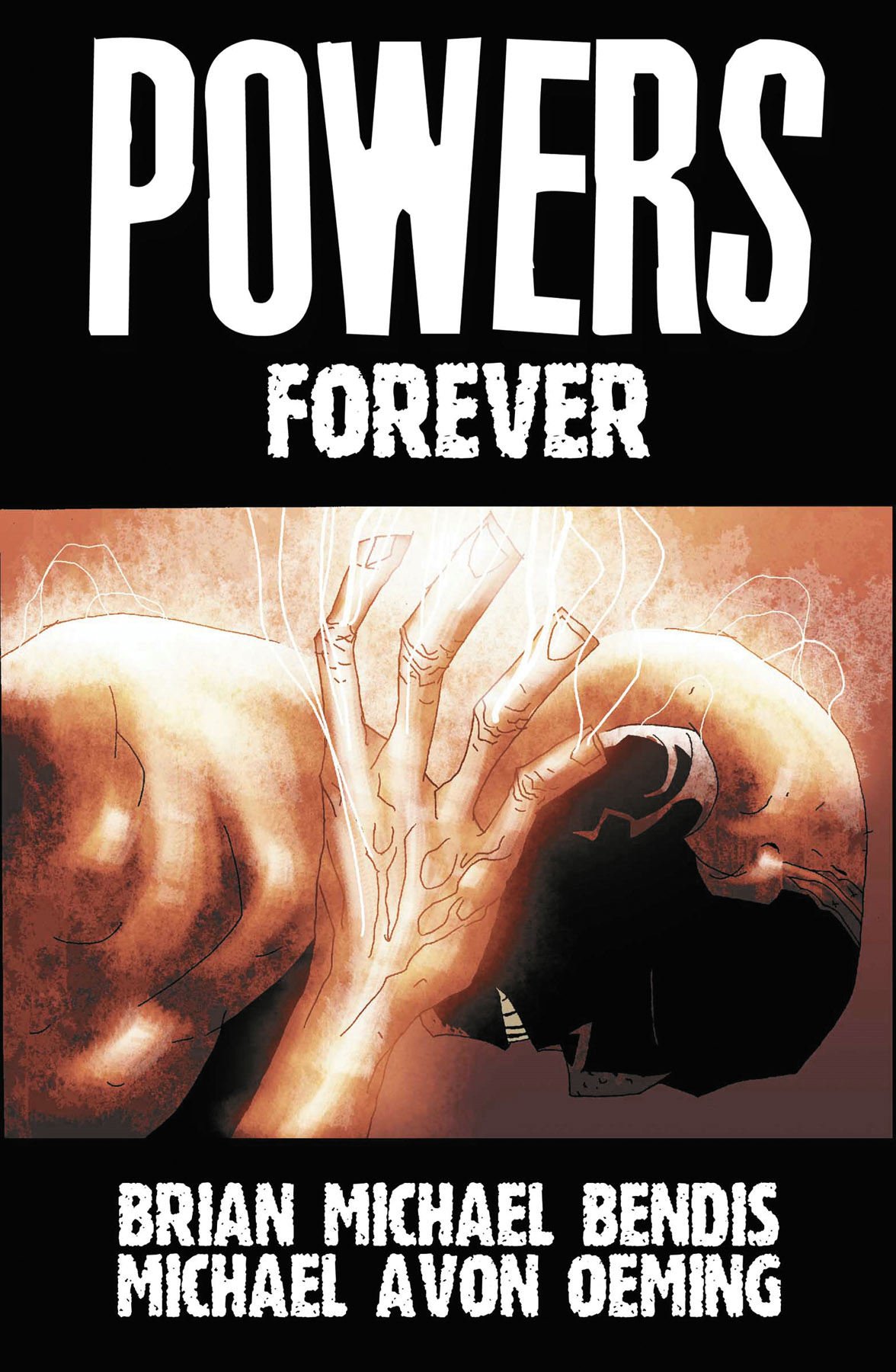
Powers: Forever

81rp8fcRC7LIf I remember correctly, the previous volume of Powers marked a major shift in the way things work, with said Powers being basically outlawed altogether. (Which only makes a limited kind of sense in a world with supervillains, but roll with it.) Naturally, therefore, Forever picks up… at the beginning of time. What?!

No, actually, it’s pretty cool. If you’ve ever wondered about the origins of superheroism in the world, or also about the secret history of now-police detective Christian Walker, and if you haven’t wondered about that last bit by now we aren’t reading the same books, then this is a can’t miss entry in the series.[1] Except to warn you that it’s a historical interlude with no apparent bearing on the future, there’s almost nothing else I can say. No, not true, I can say that it’s good. And that it has really unexpected monkey vagina. (Is there another kind? …if you’re not a monkey?)

[1] Someday, I will probably still not understand people being able to skip a book in a series.

Resident Evil: Fire and Ice

71B5eejlZsLSo you want to read a bad graphic novel? Allow to recommend Fire and Ice, a book that makes me look longingly back on the manga-style of the last few Resident Evil comics I’ve read. (Which, to be fair, is more a comment on my dislike of manga than on the quality of this book’s art. The troubles, as you will see, lie elsewhere.) So, it starts with some random characters that the authors seem confident I should be attached to despite them being uninteresting, overly soap-operaish in their equally uninteresting interrelationships, and never having been introduced before. The never-mentioned Charlie Team of S.T.A.R.S.[1] is off on missions to Mexico and Alaska to stop Umbrella from blah blah blah zombie-cakes. And yes, that’s the entire source of the title, is that some people went somewhere hot and set a fire while some other people went somewhere cold and I guess there was an avalanche maybe? Also a giant flying zombie penguin, because they live in the Arctic Circle now, apparently. Probably for the candy.[2] And then, after that series was over, I still had half the book left, in which possibly the characters could be developed a bit more and I could decide that, okay, there was a point after all.

Yeah, no. Instead, there were a lot of very short (short enough that if they were sold as individual comics at today’s prices, I predict that a lot of punching occurred later) stories set between and before Resident Evil 1 and 2, mostly traveling backward through time, but not because of a cool literary trick that reveals more detail with each step backward, no, they’re just arranged oddly for no good reason. Some of them were slightly amusing, some of them were shitty retreads of stories told better by the actual game, item-collecting and steps-retracing[3] and all. Some of them were just not any good at all. In the only original story to which I attached any interest, the characters were anonymously killed at the end in a wry twist reveal that this particular outbreak predated all the games, which is why nobody ever heard about it. To be fair, I think that last one would have bothered me less if I had not been looking for a character to care about for the entire damn book.

I mean, aside from the flying zombie penguin.

[1] They were the folks who exposed the Umbrella conspiracy in the first game, and were basically all dead by the end, the few individual survivors working together under their own recognizance with no leadership structure anymore, so on top of the rest, there’s a pretty massive canon violation.
[2] I’ll take really, really obscure internet jokes for $600, Alex.
[3] “Hey, look, I should grab another part of this bomb that I haven’t mentioned needing to find, in case I want to set off a bomb later!” “Ooooo, I should take this key and go back to that locked door on the other side of the mansion from  before!”