Ultimate X-Men: Apocalypse

If it wasn’t for the fact that I know the Ultimate Marvel universe has a sort of a time limit to it[1], I would be impressed by the new directions that have opened up as of the closing panels of the apparently appropriately named Apocalypse. The book closed up three separate Ultimate X-Men storylines in just five short issues. This has got to be some kind of record, I think.

First off, it closed down a Storm story that has thusfar been too anemic for me to mention, and in such an abrupt way that even if I had managed to care about it before, I would not now do so. (Thankfully, that was the bad part of the book; had the rest been even half as terrible, I would have had to work very hard to finish up.) After the lameness, though, the main event started, and it was a pretty decent main event, I must say. Remember a couple of books ago when that guy Cable came from a terrible future to stop it from ever happening? And so he hunted the streets of Los Angeles for Sarah Connor, until… okay, that’s not right at all. Anyway, he did what he did, and then over the next book, the differently-configured X-Men continued to work toward preventing that dark future. And now, finally, it all comes to a head! There are not so many revelations[2] as you might expect out of an eponymously apocalyptic event, but there are enough knock-down drag-out fights and casualties to make up for their lack. Plus, there’s also the conclusion of that third ongoing arc to deal with, which I will pretend not to explicitly reveal by saying only that it involves Jean Grey.

All of which goes back to what I was saying in the first place. If I did not know that there were only 1.5 books of Ultimate X-Men left, and then a giant question mark as to whether more will come afterwards, I would currently be very very excited by both the fact that so many old plotlines have been cleared away and especially by the manner in which it was done. It at least seems like there are really big things ahead for Marvel’s mutant populace.

[1] And, man, why is it consistently only the X-Men that make me think of this?
[2] haha

Dead Beat

In retrospect, this has been happening for a little while; I just didn’t notice until it smacked me in the face. The Dresden Files series has been changing, is what I mean. The prose has improved on a pretty steady incline, sure, but I’m more talking about plot and character. The series is darker, more dramatic, perhaps a bit more romantic, but above all ever broader in scope. In the first book, Harry Dresden’s case files were affecting, at most, small elements of Chicagoan life, whereas by the advent of Dead Beat, he is involved not only with the current and future status of the White Council[1] and the hierarchy of all three kinds of vampires[2], but with the actual fate of the world. (And I think this book wasn’t the first time.)

This time out, the names of the game are blackmail and necromancy. In short… you know, the problem here is that I hardly want to talk about anything that happened in the book, because each moment held so much weight. But in short, a quest to retrieve misleading photographic evidence otherwise destined to destroy his friend Murphy’s career leads Harry into a race with three powerful necromancers to find their bible, The Word of Kemmler.The journey takes him from magical bookshops to burned out high-rise tenements, from the limousine of Chicago’s most powerful mobster to the shadow of its most famous skeleton, from the secret corners of his own mind to the heights of the White Council, with stops along the way for the toughest magical duels yet, for what may turn out to be the biggest mistake of Harry’s life, and, just possibly, for redemption.

[1] Which is to say, the world’s non-evil magical community.
[2] It’s not entirely worth going into for the purposes of this particular summary; the important part is he doesn’t spend the entire book fucking them.

Youth in Revolt

Hello there, movies. I know it’s been a while, but I haven’t forgotten about you. I even wanted to see some of you, despite how it has looked. Soon, I will be back onto a schedule you can trust, and it will be like we’d never been apart. I would never give you up, nor let you down, and I would certainly never run around and hurt you.[1]

The movie I spent some time with last night was Youth in Revolt, based on a generally positive review from Fresh Air and my ongoing amusement with Michael Cera. It tells the highly episodic story of a sixteen year-old boy with a probably average and certainly miserable life, a downright horrible name (Nick Twisp), and a nagging virginity. After meeting the girl of his dreams in a northern California lake’s adjacent trailer park[2] and determining that she must surely take said virginity lest he die miserable and alone, he develops a split persona with an ironically wispy mustache and an endless supply of cigarillos that he names Francois Dillinger. With that character finally on screen at the end of the first act, the movie finally lurches out of its snail-paced romantic comedy first gear, rife with ubiquitous excessively cultured and vocabularied teens[3], and putts into black comedy at a stately second gear. This pacing issue, really, is its only serious problem. The laughs are sincere and sometimes side-splitting while they’re happening, but the flick is so very, very slow in between. Well, and there’s also the problem of Justin Long’s character, in that he seems to exist for no other purpose than to fulfill the deus ex marijuana role. Long story short? Probably not a movie worth seeing in the theater, but it was pretty funny if you’ve got an otherwise slow night and a DVD player somewhere in your future.

[1] Look, I… it happened so fast! I don’t know how to explain it.
[2] Although Sheeni manages to occasionally rise above that, it really is as intentionally trashy as it sounds.
[3] Likely in a (differently from the film’s main theme) rebellious response to their trashy or overly religious parents.

Ex Machina: Dirty Tricks

My understanding is that Dirty Tricks is the penultimate Ex Machina collection. Which leaves me all the more puzzled by how meaningless it was. Don’t get me wrong, none of the stories was in any way bad, nor did any of them leave me feeling less than entertained. All the same, when I think them over (unburied slaves ghost story, daredevil protester with a crush on the Great Machine, 2004 Republican national convention), I am left with a sense that there was no amount of plot progression or character growth. Sure, Mayor Hundred is planning for his political future, and sure, his old friend Kremlin is still working on a plot against Hundred in the hopes of forcing him to abandon politics and return to superheroism, but each of these plots is advanced so incrementally that I find it hard to credit the story can be validly concluded in only one more book.

I guess I’ll find out in May?

Ultimate Spider-Man: Death of a Goblin

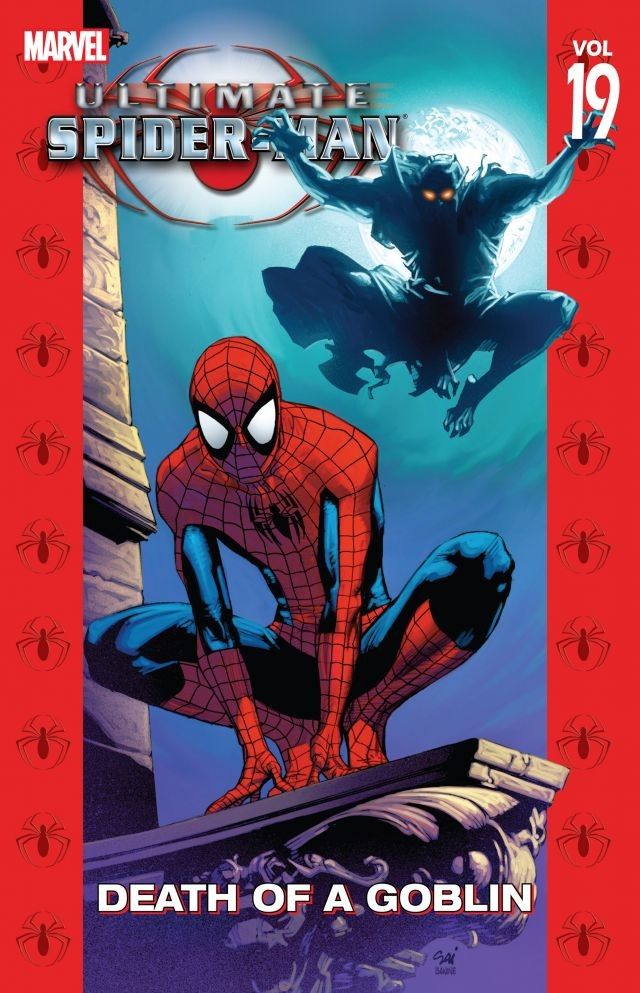
DIG008685_1Blah blah blah goodcakes. I know, I know. But since it continues to rate, I can hardly not continue to say it, right? As is by now usually the case this far into the series, it’s time for another familiar old villain to rear his head:  as the title indicates, Norman Osborn’s Green Goblin has broken out of S.H.I.E.L.D. custody to once more torment Peter Parker and friends. What continues to impress is how there’s always a new take; this time, it’s the mysterious absence of Nick Fury, Osborn’s devious scheme to discredit the missing Fury, and a dire hint about S.H.I.E.L.D.’s [in]ability to control the Oz formula that transforms Osborn into the Green Goblin and has also affected others of Peter’s friends over the past year. I definitely like how most new Ultimate titles I read these days tie that universe closer and closer together. Not unlike a spider’s web, you can hardly touch one strand without consequences being sensed in each of the others.

But enough about all this, I can hardly convince you of the goodness of the story by now if I haven’t already done so long since. Rather, I feel it necessary to comment on the change of artist for the first time in over 100 issues. Newcomer Stuart Immomen[1] definitely has a different style, and it will take me a little time to get used to it. I mean, I’ve seen his art in Ultimate Fantastic Four as well, and it’s not at all bad. It’s just that Bagley’s weight on the series is a lot stronger than any other artist/series combo in the Ultimate universe, and probably in most of Marvel’s history. That said, Immomen has a few quirks. For one thing (and I cannot get over the fact that I hold this opinion at all; apparently I’ve been reading a lot of comics over the past 2-3 years?), his lines are really heavy. Generally if I notice them as distinct from the figure they contain, that is too heavy for me. For another thing, he seems to work from a limited pool of facial expressions. At least, annoyed Peter Parker is the same as annoyed Reed Richards. Also, the eye on the Spider-Man mask has gotten vast. I mean, seriously frakking huge, like a full third of the mask’s surface area per side. However, none of the art is stylized or overly focused on experimentation; all of the people look like people. So I will get used to it, no worries. It’s just a lot of change to take in at once.

[1] I cannot help but think of him as a girl unless I’m really trying not to, because his name reminds me of Imoen from Baldur’s Gate and Baldur’s Gate II. This is not something you actually needed to know.

Ultimate Vision

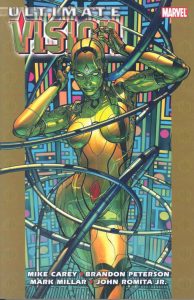
After the earth was saved at the end of the Ultimate Galactus trilogy[1], things pretty much went back to normal I guess. Except, some editor and Golden Age and/or Silver Age android fan decided that there ought to be a few more consequences. As a result, we have Ultimate Vision, in which the robot that came to earth to warn of Gah Lak Tus’ approach and document our doomed civilization rebuilds itself a female body with implausibly proportioned hips and tangles with the scientists of a criminal organization called A.I.M.[2] (whose presence I have not previously detected in the Ultimate continuity) over the disposal of a spare Gah Lak Tus drone that was damaged and left behind as the swarm retreated in defeat. And yeah, that’s pretty much the whole thing. It’s not that it was a bad story; it was actually pretty okay. It’s that it was tragically irrelevant to anything else going on.

[1] Spoiler alert
[2] Advanced Idea Mechanics, if you were curious

Iorich

What I think I like best about the Vlad Taltos novels is the voice, just as it has been what I liked best about the Paarfi novels that comprise most of the rest of Steven Brust’s Dragaeren world. Although, mind you, I’ve read other books by him where the voice was not the primary feature, so it’s not like voice is his only skill. (In these, it is pretty clearly a stronger skill than plotting just lately, but even then, I wonder how much of that is really the author, and how much of that is Vlad’s voice coming through more strongly than ever, with his own interest in the plot (read: events occurring in his life) taking a backseat to his interest in how those events are affecting his physical/mental/emotional wellbeing. Our Vlad is definitely… but I get at least a little ahead of myself.)

Iorich documents the furthest step forward in his life to date. Still on the run from Jhereg assassins[1], Vlad’s life seems to consist of, well, not very much, though as usual he implies there are chapters to it we have not yet been told about. This latest interlude of not very much is rudely interrupted when his friend Aliera is accused of practicing Elder sorcery, which she does all the time as a matter of common knowledge even though there is a good reason for it to be so heavily illegal. As most of his friends that would otherwise take care of such a problem are constrained by matters of honor, Vlad immediately sets himself to the task of untangling the odd political situation that has resulted in this common event suddenly being taken seriously for the first time. Which would be basically fine, except for those Jhereg assassins that in case I didn’t mention it intend to not so much kill him as destroy his soul. No question, it’s a bit of a sticky situation.

Here’s what I liked about the book, though. I was down on the plot a few moments ago, but reading over that muddled mess in the previous paragraph that I am pretty sure I have nevertheless described succinctly, it’s a plot that interests me. In practice, it’s a little slower than it should be, but the central questions are really compelling, and Brust dumps all manner of politics[2] into the mix along the way, even including an eventual explanation of what’s been going on. But what really grabbed me was Vlad’s ongoing metamorphosis as a character. He has long been my definitive example of an unreliable narrator, and that’s still true. But I have the sense that he has a much clearer picture of who he is than he has had in previous of his stories. (For one thing, there are at least a couple of mocking references to his own unreliability as a narrator, which I’m confident he was not aware of in, for example, Jhereg or Teckla.[3]) Like I said before, his lack of reliability comes more from what he chooses to care about, these days. And that metamorphosis of character is… well, it’s not what Vlad cares about, that’s not true. But it’s what Brust cares about, and Vlad’s voice is showing it more and more with each book since Phoenix, whether Vlad intends for it to or not. There will come a time, before this series is over, when the man will be an actual human being. He’s not there yet, but I and my psychology degree look forward to it with almost childlike glee.

[1] Look, this is like the 12th or so book in a series. You should ought to read that series, if you haven’t, but if you haven’t, nothing much of this brief summary will make sense. Just trust me that Vlad’s voice is worth your time.
[2] Not just politicking, which is a usual ingredient of a Vlad novel, whether at the personal, professional, national, or even ontological level. But in this case, actual politics. It has been observed that Brust was reading Adam Smith’s The Wealth of Nations during the period in which this book and the next one were/are being written. There’s not a direct line to that fact, at least in this book, but it’s reasonable to assume his political self could have been pushed to the front as a result of it.
[3] If you think it is odd to so frankly discuss a literary character’s self-awareness, well, you’re not wrong about that. But it exists all the same, and without breaking any fourth wall. That’s a pretty neat trick in itself.
Lucifer: Exodus

I wonder if I should ought to break out of my rhythm and read the Lucifer books more concurrently with each other than I have done. After this most recent four month gap, I’m starting to feel more and more like the narrative has grown too complex for me to not keep the series more firmly in mind as I read each new story. Exodus, just for example, took me fully two-thirds of the book to get much of a handle on. The exodus in question is ordered by Lucifer himself, who, having seen the way that the various immortal/ancient beings in Yahweh’s universe of his birth have variously conspired against their God and now seek to replace Him in His absence, decides to rid his own universe of such backstabbing treachery. I suppose there’s no small amount of irony in that goal. And so the main part of the book is a series of stories about various immortals in each universe and how they have responded to both the originating event and the subsequent edict.

What struck me as interesting is how this is the first book in the series that has shared a structural hook with the Sandman series that gave it birth. Although many Sandman books followed a main plotline in which the Lord of Dreams reached certain conclusions about the nature of his existence, many were only stage-dressing in which Gaiman got a chance to tell various unrelated short stories through the lens of bit players that briefly or tangentially touched upon the lives of one or more of the Endless. And Exodus, you see, was like that, mostly told through the prism of Lucifer’s trusted[1] lieutenants (Mazikeen the Lilim, Michael’s daughter Elaine Belloc, the cherub Gaudium, and others) on their quest to enforce the, you know, exodus of the immortals. Of course, there’s only one place to send them, and in His absence, it appears that Yahweh’s universe may be experiencing a shelf-life.

[1] Well. Reasonably well trusted, for all of the unlikelihood of that claim.

Ultimate X-Men: Sentinels

I have observed with some degree of interest how I have changed the way I interact with shorter types of external stimuli, such as movies and graphic novels. By no means is it that they have fewer themes, nor ones that are necessarily smaller in scope; just that with the limited amount of time and space for presentation, the themes are usually more compact and immediate, which means that I not only have to be prepared to pay closer attention finding them, but that they also can require more ability to read between the lines. Like, with a 20-50 hour game or a 300-1000 page book, I can just let my mind wander and see what bubbles to the surface as I go, but in the couple of hours I spend on these shorter media, sometimes not treating it like a treasure hunt for nougaty thematic goodness means I won’t have anything to say when I get here.

And then there are stories like Sentinels, which are simultaneously so muddled and so scattered that I have no idea what just happened, try though I might. There are two and a half plots in progress, at least two timelines to keep track of, an inexplicably large number of drive-by characters who show up for one scene or issue only to vanish forever, and far more needless overt sexualization than I’ve seen anywhere in the Ultimate line before now.[1] In what I’m going to assume is the plot that matters, a new group of X-Men has formed in the wake of the original group’s disbandment to focus on the “school” aspect of Charles Xavier’s school for mutants in upstate New York, that disbandment coming in the wake of the events of the previous book. And said new group fights off the return of the mutant-hunting robot Sentinels, while the people at the school go off in search of underground mole mutants and deal with the ever-present portentous foreshadowing about Jean Grey’s fated transformation into the Phoenix. I think if they’d used the same amount of space to tell either story individually, it wouldn’t have felt rushed and full of annoyingly fast cuts between scenes that weren’t related by plot, theme, irony, or even art. I can’t help but feel like, in response to my recent thoughts that a series-level climax is drawing near, they suddenly found themselves out of time to tell the stories they had left and were forced to rush.[2]

Still, I shouldn’t complain too much. The use of a new artist for each of the 2.5 storylines means that at least I wasn’t stuck with the horrible first guy during any of the needless sexualization scenes.

[1] I mean, I’m kind of a fan of needless sexualization, but not when it takes me out of what ought by rights to be a good story.
[2] If so, I have no sympathy, because they could have used the space taken up by the worthless Magician storyline to tell these ones right.

Avatar (2009)

Avatar has been an interesting phenomenon to me. Because I watch the previews of it, and it of course looks really pretty, plus I know James Cameron makes good sci-fi[1]. But then again, I watch previews of it and it makes me think it will be Dances with Wolves in space.[3] And I didn’t hate that movie the first time, but it grows more awful with each subsequent viewing, and eventually it has retroactively become the moment at which Kevin Costner stopped being a respectable human being actor.

So, after all of that spinning around in my head for a month, I expected it to be pretty, yes, but still mostly terrible. I didn’t see it in the IMAX that the tagline suggests, though it was in 3D. I suppose I’ll get to that before too terribly long, though. Because, IMAX or not, expectations or not, Dances with Wolves and all? It was still really good. (And, yes, very pretty.) And if the message was perhaps bludgeoned in, it is not a message with which I have no sympathy. I guess I should ought to find a hardcore conservative and find out just how much they hated it. But really, even if you are allergic to hippie granola, I think the prettiness of the film will get you past most of the relevantly crunchy scenes.

What impressed me most, though, was the uncanny valley effect. Or, rather, it’s lack. Far short of the giant blue Na’vi people looking just subtly wrong enough to hurt my eye, the time rapidly came when it was the actual actors who started to look slightly wrong, and every scene back among humans had me itching to get back to the part of the movie I cared about. Which, okay, the whole point of Dances with Wolves is to throw off the trappings of the Western World, so it makes sense this movie would want me to be there. But when he can manage it even on a physical CGI level? Kudos, Mr. Cameron. I daresay you deserved the full theater and applause you got on even this third weekend of theatrical release.

[1] Seriously, that’s kind of his Thing, blips on the radar like Titanic[2] notwithstanding.
[2] Hey, now there’s a piece of irony.
[3] And then I watch South Park, and they point out that in fact it will be Dances with Smurfs, and Giovanni Ribisi will be an unobtanium-hungry Gargamel, but really that’s still Dances with Wolves.