Batman: The Killing Joke

I wish DC would rip off the Marvel Ultimate universe idea and perform their own reboot for new readers. Alternately, I wish that someone would tell me this has already occurred, and what I should be looking for. I know that the constantly renewing TV shows serve approximately the same purpose, but still, something in the original format would be nice to have around. This is certainly one reason why I have found Marvel so much more accommodating than DC since I decided that superhero comics were pretty sweet after all. (The much broader availability of original run comics as data files was the larger reason, despite how much more Ultimate universe I’ve actually read.)

The upshot of this lack is that there are all kinds of DC storylines that I’ve heard people talk about but never gotten around to, while I’m coasting along quite nicely on the other side of the fence. But I did recall that one of the biggest deal stories I hadn’t read was Alan Moore’s The Killing Joke, about the relationship between Batman and the Joker. Much to my surprise, it is a story that has consequences I’ve actually seen play out in one of those TV series I mentioned earlier, the short-lived Birds of Prey. So, in addition to my actual reaction to the story, there was that bonus feeling of getting to catch on to an underpinning moment that has defined the DC universe. I dig that kind of stuff, in exactly the unfortunately punning sense that makes me sometimes wish I had gotten my degree in archaeology.

But as to the story itself? First of all, it’s very short, only about the size of a standard annual comic. No run of issues here like you’d expect to find in an “important” story. It’s also very simple: Batman has decided that it’s time to really talk to the Joker, who is unique among the Batman’s adversaries in that nobody has any idea who he is; he is simply an enigma sowing chaos in the world. All Bruce Wayne does know is that they hate each other, and sooner or later one of them will die as a result of it, and being that he is a fundamentally good man despite his anger issues, he wants to try to solve it. Whereas the Joker… in his own words, he wants “[t]o prove a point.” To prove that he’s not really sowing chaos, or at least that any chaos sown is just a side effect. He wants to prove that his reaction to the world is not only normal, but inevitable. And the ensuing clash between these two conversations is dire, bloody, repercussive, and entirely horrible. And it sums up, in only about forty pages, the entire history and future of the relationship between the two characters.

Every voice was perfectly realized, every expression and motion had economy to it. Except for the unfortunate refrigeration of Barbara Gordon, there is really nothing about the story that is not concisely perfect. It should ought to be read by anyone that enjoys either lead character. And also? The joke was pretty good.
Ultimate Origins

I kind of feel like Ultimate Origins was a risk. Okay, the continuity had only existed for about nine years at that point, plus I think they already knew that they were headed towards an ending of sorts. But still, taking even a mere nine years of continuity and then going back and finding a way to tie it all together in meaningful and unexpected ways, without accidentally being ridiculous? It’s a fine line to walk.

But what am I talking about? It turns out that the Ultimate universe, about which I talk from time to time, has some important and unrevealed information from the World War II era that spawned the original super soldier project and ultimately Captain America, and also from the generation that precedes modern times / the current crop of superheroes and mutants. Information that has strong relevance to mutantkind and its imminent war on humanity. Information of particular interest to one Peter Parker on the topic of his dead parents, if only he knew it.

All the same, I’m pretty sure that, if it hadn’t been written by Brian Michael Bendis, it would have been ridiculous after all. So yay for the author they chose!

Red Holocaust

It is clear to me, in retrospect, that I waited too long between these books. (Of course, that’s true of most of my books, but it’s more true when the books are so very light as this, and also I’m facing a quarter-century backlog for the series.) But I have finally read the second book of the Deathlands series, Red Holocaust. When last we saw the one-eyed Ryan Cawdor, pleasantly mutated Krysty Wroth, gun enthusiast J.B. Dix, and the man of mystery known only as Doc, they had escaped vengeful danger of some kind or other into one of many Redoubts, hardened chambers scattered around America that are filled with guns, supplies, and most importantly for our purposes, teleportation rooms.

This new book starts what I expect to be a long-term trend, in which the Trader’s crew will teleport randomly from place to place, find something horribly wrong, and go about fixing it. In this particular instance, the main wrong thing is that the Bering Strait has frozen over again[1], allowing both marauders and an apparently somewhat cohesive Soviet pursuit to cross into Alaska. Since the first teleport destination is also in Alaska, you can imagine that some kind of militaristic event is about to ensue. And I think that is what I am expecting to be the most common path for the series as it unfolds: party teleports somewhere randomly, comes out to discover a situation in need of caretaking, does so, probably loses some members while gaining others, returns, and teleports randomly once more. The draw, therefore, will be the gradual unfolding of the geopolitical situation[2], revelations of character histories, and of course fragment by fragment of the secret of the Doctor, who can’t keep track of a stream of consciousness for more than a few moments, yet who has all manner of pre-war knowledge, both trivial and sublime. Most recently, for example, he revealed that the matter transporters have also been used in time travel experimentation! Dating back to 1930s!

I don’t know exactly why I lap this stuff up, but really, it’s not that big of an investment. A day or two to read a book that would work equally well as a single or two-part episode of a television series, and then onto something else? It’s more than fun enough to pay that price, and thusly I do.

[1] Thanks, nuclear winter!
[2] For example, who knew that Russia would manage to be visibly more together than the United States, a hundred years after World War III? I mean, besides doomsday scenario authors, who I believe were certain of this fact throughout the duration of the Cold War.

Hot Tub Time Machine

I’ve said it before, and I will inevitably say it again: I really like sneak previews of movies. Like, a lot. They’re free, which doesn’t hurt, and I get to see them before other people, which is nice for this whole ‘review’ gig I have going. But they’re usually only a day or two before release and if I’m at all busy, I still fail to get the review out in time. So I guess what I like best of all are the rare previews that are weeks in advance, wherein I get to feel like I’m sitting on some kind of secret.

Yesterday, I got to do that again for the first time in a year or so, at least that I can remember. (If only there were documentation!) After sitting in line for a goodly while and having one of the most surreal stranger-conversations of my life between my friends and the dude in front of us in the line[1], after having all electronic devices stripped from us by the local constabulary[2] lest we make a shitty recording of the film to dump onto youtube, after eating pizza and drinking a milkshake to combat the effects of surreality and douchebaggery, we finally settled down to watch Hot Tub Time Machine, a movie about… well, I think you can tell from the title, right? But, okay, there are specifics, and they are as follows: three high school friends that have drifted apart (and also John Cusack’s nephew) decide to return to a ski resort that was the prime destination of their party days, to reconnect. Except the town is dead, the resort is falling apart, and things generally suck about as much as their lives do. But one drunken night in the hot tub later, they wake up at Winterfest 1986 in their teenage bodies. And then hijinx, as they say, ensue!

It really is a direct port of an ’80s teen sex comedy, except with a nostalgia filter and focus on adult friendships. And there’s also a cute hipster girl for Cusack who really doesn’t fit into the rest of the picture, but John Cusack [contractually] cannot be in a movie without a romantic interest. That’s just how things work. All in all, though? Pretty good stuff and definitely funny, with an excellent mixture of zany, raunchy, and sweet.

[1] I’d explain, but the explanation would I think actually be longer than the review if I did. I can’t even figure out how to sum it up in a snappy one-liner. It was just… bizarre.
[2] And, speaking of true stories: the constable guy actually said this, and my paraphrase is in no way misleading: “If I see you with a cellphone that you’ve snuck in here anyway, I have handcuffs and I’m empowered to march you out of the theater. … Let’s all try to have fun tonight!”

Hack/Slash: In Revenge and in Love

I’m reading five (or six? but probably five) graphic novel series right now, not counting the Ultimate Marvel stuff. As of my completion of the sixth Hack/Slash volume, I am caught up with three of them. Plausibly, that means it’s time to start a new one, next time I get to an empty gap in my rotation. Which will be kind of weird, what with my not having started a new series in a really long while now. (Then again, I’m also supposed to reread the four volumes of the Ultimates as I’ve been threatening to do for probably six months now, and yet, nothing on that front. Also, I’ve caught up enough that I think it’s time to slow down on my Marvel Ultimate reread and intersperse something else in one of those two slots.[1])

None of that matters, though. What matters is that Cassie Hack is experiencing a crisis of faith. In herself, in her role in the universe, in her fate. After the dramatic events of the previous book, she’s decided to put away her baseball bat, build that white picket fence, and settle down with her long-time stripper crush, Georgia Peaches. The list of people who are unhappy with this plan is extensive, and includes enemies from another dimension, an evil rock icon, police around the country who have been led to believe by a psychic that Cassie is responsible for most of the murders that were committed by the slashers she has put down, and perhaps most dangerously of all, her neglected companion Vlad who seems to have no place in her new plans. Life is hard for a gothy, slightly emo, and confused teen slayer of supernatural evildoers.

I think my two favorite bits were a) the one-shot with the possibly autistic Encyclopedia Brown chick, investigating the soon-to-be-important new bad guy, Samhain, and b) really any scene with the skinless alien dog-thing; it is quickly becoming my second-favorite character! Due to hilarity, you see.

[1] I honestly don’t know why you have to hear about this stuff.

Cop Out

What I found strangest about Cop Out was the wide disparity between its previews and its actuality. Instead of a zany comedy with cops as the main characters, it was exactly the same buddy action movie you’ve seen dozens of times before. I mean, sure, there were the differences in buddy: Bruce Willis is an inspired choice of straight man because he has long-standing comedic acting chops that possibly a lot of people have forgotten about, while Tracy Morgan is… well, I don’t know how to describe it, but how are you not already watching 30 Rock to know exactly what I mean? But the film itself? There is no newly unearthed buddy-flick arcana here; in fact, there are probably no surprises here at all.[1] But if you aren’t allergic to the genre and like things that are funny, this is a good way to spend an afternoon.

Also, and I say this with no trace of approbation, but there were multiple points throughout the movie where it really did seem like the lead actors had no script at all and were just directed to perform a skit about being cops. “Hey, guys, for this scene, we’re going to do a skit about an interrogation room. Now, for this one, let’s do a skit about a stake-out.” I do not know which of the script-writer or the actors (or possibly the director) I should be complimenting for the way those scenes turned out, but someone is getting a metaphorical basket of flowers right now. And, since it’s only 6 AM on the left coast, they’re probably a little pissed about it.

[1] I lie. The Brooklyn homeowner defending her property? I don’t think I’ve ever seen that before, and it was a little bit amazing.

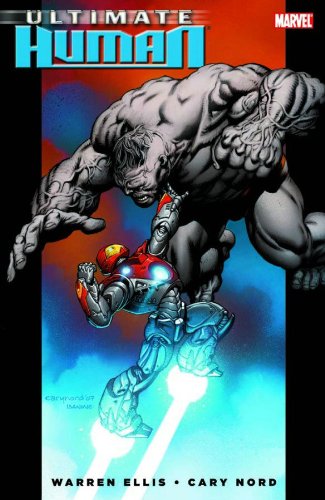
Ultimate Hulk vs. Iron Man: Ultimate Human

51uXRhTRrhLThe majority of one-shots in the Ultimate universe have not been all that good. Of course, the majority of them have been about Daredevil and/or Elektra, and while those stories may be good spread out over years, I have yet to see the short term version do them justice, even though both characters work just fine as guest stars to Spider-Man. Ultimate Human, however, is an exception to that one-shot rule. Card’s Tony Stark retcon has finally taken hold, and the world’s smartest man seems like the best person for Bruce Banner to turn to in finally beating this Hulk thing once and for all. Over the course of four issues, the two men finally change the Ultimate version of Bruce Banner from caricature into a genuine character, while clashing with each other mentally and physically. And because one foe is never enough, a giant-brained person that you may remember as the Leader is waiting in the wings.

Oh, and incidentally? With an entire issue given to origin and backstory, the Ultimate Leader is exactly the kind of character reintroduction that the Ultimate universe does so poorly in general and should have been doing this way all along. I wish people who are not named Brian Michael Bendis could do a better job of accomplishing this on characters that I haven’t already seen elsewhere.

Ultimate X-Men: Absolute Power

A tried and true way to annoy fans of a series is with a drug metaphor. There you’ll be watching [spoiler elided] perform magic, getting better season after season, even earning a girlfriend out of it, and then suddenly in the sixth season, it turns out that [spoiler elided] has an addiction to magic that must be stopped any any cost, lest lives be destroyed. Or in the Ultimate X-Men, say, there’s Colossus, this big steel guy, but it turns out he’s been doing drugs all along to be strong enough to support his impenetrable skin. And now all of his friends are addicted too, and the ones who aren’t had better step in and save the day! Oh, and also, it’s time to introduce another half-dozen Marvel characters that you won’t be able to care about unless you already know who they are, because heaven knows we certainly don’t have enough time to actually introduce them and find out if they make any sense or should be cared about, before they’re gone again.[1]

It’s too bad, too, because without the rush job, well… I mean, the drug thing still would have annoyed me. Ongoing series of every flavor really need to stop with that shit, because it is never done well. Ever. But, without the rush job and the drug-story allergy, the last couple of pages of climax, dramatic revelation, and cliffhanger would probably have been pretty cool. Instead of feeling excited about what comes next, though, I’m mostly glad that Absolute Power is the last Ultimate X-Men book I have to read.

[1] That right there is the biggest problem with the Ultimate line of comics, in a nutshell. If you’re going to pretend to be shedding forty years of continuity so that new readers can join the fun, then stop letting your stable of writers add in old characters unless they promise to tell me who they are and why I care. Or, better yet, make me care within the confines of the plot. I know that’s not that hard to do.

Naamah’s Kiss

Jacqueline Carey returns to the world of Terre d’Ange in Naamah’s Kiss, set a century after the events of her previous books. The magically modified historical Europe has progressed into the 16th Century, with tales of a new world away west across the sea, but not-France seems content to rest upon her laurels as a center of love and decadence. Into this more superficial version of a country already obsessed with beauty and fame is thrust Moirin, a half-Alban[1] girl with a capital-d Destiny, descended from the same magical small folk that gave Prince Imriel such trouble during the previous trilogy. Of course, as the other half of her descent is a d’Angeline priest of Naamah, the goddess of Love, it can be no surprise that her parentage and uncivilized mien make her an instant success. Unfortunately, she spends the first two thirds of the book on that, laying groundwork for events in future unwritten books before actually engaging in the plot of this one.

On the bright side, once that plot gets a move on, it’s really quite pleasant, racing to the far corner of the world to rescue a not-Chinese princess from a demon. If you can leave aside the iffy pacing, the book has a lot of things to like. A circle of demon-summoners, ancient Ch’in wisdom, cliff-diving, an implausible amount of lipstick lesbianism, chases, escapes, true love… y’know. Stuff a sick kid would want his grandfather to read to him. But, okay, even if it’s clearly not that funny, it did feel like something out of a storybook. If that sounds ridiculous, take it as me having accepted the characters that thoroughly, by the end. Pacing issues or not, I care about these characters and want to know what happens to them next.

[1] not-England, don’t you know

The Wolfman

The longer I wait to write this review, the sadder it gets. And what’s funny is, I wasn’t avoiding it at first, I was just busy. But then later, I got to a point where I didn’t want to write anything at all, and I don’t know if that was valid and on me or if it was due to review dread. And then later still, I realized that it kept getting sadder the longer I waited, which of course did not do anything to encourage me to get a move on. But then I finished a book last night, and if there’s one thing I cannot abide, it’s a log jam. Resultantly, you get this horribly explanatory paragraph because at least it gives my fingers something to do while my brain is still warming up.[1]

As you have no doubt worked out for yourself by now, I saw The Wolfman last Wednesday. In 19th Century England, an Americanized actor returns to his ancestral home when he receives word from his brother’s fiancée that the brother has gone missing. By the time he arrives, his brother’s badly mauled body has been found, but of course before all of the affairs are concluded and he could leave, events conspire to leave him bitten by a werewolf, and then we’re off to the races. Here’s what I can say about the movie: it got a lot of things right. The brooding moors, the equally brooding London town, the yet again equally brooding characters, both bit and primary, I guess what I’m saying is that there was atmosphere thick enough to choke upon. And the wolfman himself? It was simultaneously a perfect callback to Lon Chaney Jr’s original look and a special effects updatestravaganza. What I’m saying is, this was a very moody, very pretty film, and it was cast to match.

If only they had saved some money and / or creative energy for use upon the script. Or even, if they couldn’t afford dialogue, then at least for the plot. ‘Cause, man.

Man.

[1] If I were smarter, I would edit out these process pieces after I’d had time to write something actually good instead.