Lucifer: The Wolf Beneath the Tree

I have realized that I am more impressed by the Lucifer series the further into it I get. Although it does not have the ambitious scope of Gaiman’s Sandman series that was its genesis, the scope it has is ambitious indeed, and the depth is all but equivalent. Or maybe it just depends on what you mean by scope. Where Sandman traipsed all over the field, from myth to human nature to family, all interleaved, Lucifer keeps its focus pretty narrow. But considering that the focus is on the end of the world with heavy dollops of religious controversy for flavor, you can’t exactly argue that scope is a problem here either.

The Wolf Beneath the Tree is the culmination of months of planning. Lucifer has paid his debts and cleaned his house, and has no particular plans beyond sitting on his metaphorical back porch and watching the sun set on God’s creation. But of course things never work out that simply, do they? Not when there’s a Norse wolf-god out to destroy all of existence and Destiny is either meddling in events or fated to do so, depending mostly on whether you believe in free will. (Lucifer, unsurprisingly, does.) I could be wrong, but I feel like the series has reached the point of no return, events spiraling out of control, explosive climax and all that. It’s gonna be hard to convince myself not to just go ahead and finish up now.

Also, the first story about Lilith and her countless offspring and especially about the earliest part of Mazikeen’s backstory? I would like more of that, please!

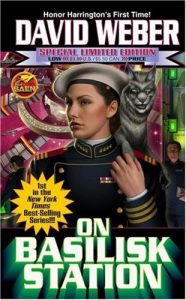
On Basilisk Station

I’m having a hard time writing a cold review of On Basilisk Station, because I myself did not come to it cold; instead, a string of reviews by Mike Kozlowski has colored my perceptions of the entire series for the whole time I’ve been aware of its existence. It is like being in your twenties and finally watching this Star Wars movie you’ve heard so much about from the thirty-somethings you hang out with. And so I’ve got the simultaneous experience of the book itself intertwined with various snickerings as I note the exact kinds of things about the books that he had previously said that are just so ridiculous, and I have to wonder if they’d have struck me as forcibly, at least in this first book, if I hadn’t already known what was coming.

In any event, a rundown for you: a couple of thousand years from now, give or take a century, mankind has spread throughout the stars, only with none of that Earth-That-Was nostalgia for a vanished planet. In fact, the Solarian League (or something like that) is one of the biggest players in galactic politics, though they play no particular role in this first book of the series. And the aliens, such as they are, all appear to be way behind mankind. But that’s because this is a very 18th-19th Century setting, only with spaceships instead of boats, and of course all the European countries were the most advanced, with the native tribes there only to be enlightened or used as catspaws, depending on whether you (like our plucky heroine, Honor Harrington) are a member of the Royal Manticoran system of planets or are one of the socialist and expansionistic bad guys, such as the Republic of Haven are mostly peopled by. Because this isn’t actually 19th C. European politics and warfare, you understand. It’s the future, and we’re in space!

All you really need to know about Honor Harrington is that she’s very very smart, both as a manager of people and as a military tactician. Possibly as a strategist too, but for now she is only the captain of one fast-response warship, the HMS Fearless, so we don’t get to see her conducting a full-scale war like Luke Skywalker does sometimes. At least, not yet, and it’s good we’re in the future, because the Force would not do Luke much good against Honor. Anyway, I may be drifting a bit afield here. The point is, Honor has lots to overcome. For example, she did a bad job in a military exercise because her old reliable weapons were traded in for new technology that only works at close range if the enemy doesn’t expect you to have it, and for some reason everyone expected her to have it in the second through twentieth runs of the exercise. Thanks to this embarrassment of the weaponry and strategic thinking behind it, she and her ship get sent out to the middle of nowhere (on Basilisk Station, you are no doubt shocked to learn) for a pointless picket duty, inspecting merchant cargo for contraband. Also, her crew is angry at her, her executive officer doesn’t respect her (even though he constantly berates himself for it, since he knows she deserves his full support, for being as awesome as she is), and her doctor is a slacker. And this career failure in the making doesn’t even take into account the Republic of Haven and their expansionism that I mentioned earlier.

I think I have never read more escapist fiction, is my point here. I will not speed through them, but I am looking forward to the next one despite myself. Because no matter how bad things get, she’ll be an impressive genius. If you dropped her naked into the middle of the Australian Outback, she would not walk out alive three weeks later. She and her Aboriginal Air Force would have already conquered Sydney by then and be making plans for how to take on China. (I mean, she wouldn’t do those things for the hell of it; we can take it as read that Sydney and China are bad guys, because otherwise they would already be plying her with fresh accolades instead of resisting.)

Also, for some reason, she has an empathic six-legged cat. The book is… well, “good” is not the correct word here. The book is entertaining despite said cat. My understanding is that it is exactly the same as reading Horatio Hornblower stories, but I have never done this thing. So if you like those, or like over-the-top awesomeness that cannot be prevented by any government-built levee, or probably if you like empathic six-legged cats for some reason, then this right here is the book (and probably the series) for you. I know I’ll read more, because even if she is too awesome for me on paper[1], it is impossible to deny the holy-shit face-splitting grins that occurred several times over the course of the last few chapters of the book.

[1] Yes, yes, but I mean it metaphorically.
Clash of the Titans (2010)

I’ll say first what most everybody else is saying first, which is that the Clash of the Titans remake is actually more of a reimagining, in which there are a lot of visual elements that match the original film, but its plot and characters are really its own, with as little overlap as can reasonably be imagined considering the sheer number of visual milestones that are reached as the film progresses. Or, in shorter monkey speak: looks about the same, feels very different. And at the beginning, I was preparing in my head to put together a reasonably clever riff on how the movie was making a sincerely bold and certainly rare stand against the gods in our society. It would have inevitably been flavored with Battlestar Galactica, of course; you can’t mention Greek gods in a modern setting for a few years yet without that being an automatic comparison. But, y’know, good company and all. I even think I might have been able to conceal for a few sentences the reveal that I was talking about Greek religion in modern times rather than Judeo-Christian religion. It would have merited at least a chuckle.

The problem, you see, is that I can’t really do that because despite scripted grumblings over 75 percent of its length, the movie actually didn’t have the courage of its convictions; when push came to shove, it completely stopped being a diatribe against man’s reliance upon his gods and a paean to man’s ability to care well for himself, even with the gods ranged against him, and far more so if they would just leave us all alone. And that is the disappointment of the movie. If it had been content to be sound and fury, I would have been content to enjoy it on its own merits. But to, all sly references aside, start that diatribe which I think we all know validly works as a modern metaphor once you disregard that the gods being impotently raged against are Greek, and then right at the turning point of the movie when things are the darkest to unnecessarily cave in and undermine what had apparently been your entire message? It doesn’t make the movie any less loud, or pretty, or by-the-numbers humorous, but it makes it a lot less satisfying than mere popcorn would have been.

Warbreaker

It is hard to start a review when you are afraid of saying too much. It is harder still when you are both afraid of saying too much and also have very little idea about what to say. I can say that I’m glad I came to Warbreaker almost completely cold[1], and that this is exactly why I’m afraid of saying too much. I can say that Sanderson has created a third completely new magic system, and that it is really hard to explain even though it was not all that hard to understand. It has to do with an amalgam of color and life-force transference, anyway.

But what I can mainly say is that the story is fantastic. So many different viewpoint characters, each with wholly realized and differing viewpoints[2], failing to communicate the way that Jordan’s characters do but for completely understandable reasons and with real and immediate consequences that aren’t four books of mounting irritation from now. (To be clear, Warbreaker is standalone.) And they exist in a world rife with religious and political conflict that has no easy answers. Best of all, every important character out of at least six is in the midst of a crisis of identity whose solutions are poised to cut to the heart of generations of barely constrained turmoil. Also, there is a talking sword that I am prepared to say is the best talking sword character I’ve ever witnessed in the genre. In short: if you think Brandon Sanderson has been doing a good job with his career to date, this book is guaranteed not to suddenly make you change your mind.

[1] There is an unfortunate spoiler in one of the reviews on the back cover, all the more insidious because it’s not obviously a spoiler until you’re mostly through the book and realize that it hasn’t been revealed anywhere else.
[2] Which sounds redundant, but I dispute that it is.

The Ultimates 3: Who Killed the Scarlet Witch?

I’m torn on this book, unlike the rest of the internet. (They seem to despise it, and I think it is only fair to calibrate expectations in that way.) But first things first: Who Killed the Scarlet Witch? is simultaneously the straight-forward murder mystery that its title implies and also a means of setting the stage for the upcoming Ultimatum that, so far as I know, I am only two books away from. I can’t think of a good way to add more to my plot summary that wouldn’t be extensively spoilerish, so I’ll move on to the controversy.

On the one hand, I really did enjoy the actual storyline. Both the pacing of the mystery’s unraveling and its ultimate denouement were satisfactory to me. And honestly I think even that, my enjoyment thusfar of the build toward this crossover event thingy they’ve decided they had to do, is a bit controversial. But so be it, some days I am an easy audience. Still, there’s that other hand, wherein a lot of the details went wrong. Like, wasn’t Juggernaut dead the last time I saw him? And was it absolutely necessary to drop in a Ka-Zar[1] cameo this many years into the Ultimate run, and this close to its end? And, seriously, the use of the Black Panther seemed racially insensitive at best. And none of those missteps was necessary to create the plot that I was happy with! So frustrating.

[1] He’s a Tarzan rip-off from the mid ’60s. Not bad as characters go, just untimely.

The Ultimates Omnibus

Note: I did not actually read The Ultimates Omnibus as my title and link might otherwise indicate; I just re-read the four volumes of The Ultimates and The Ultimates 2 that I have mentioned previously, but this seemed like the easiest way to get away with treating it as one project, so soon after I had read them individually. And in short, I want to say that I was right to go back and reread them, as seeing the Ultimates in their proper context over the evolution of that universe would have made a lot more sense than seeing everything at once right when I started, and then going back in time to see them interact with the rest of the series in progress as I variously caught up to “current”.

As for the books themselves, though? Still good, and they certainly do stand alone, if you wanted to ditch the rest of the universe to just read these. They’re by far the most adult books, both in theme and in prose. And certainly in plotting, where they occasionally seem to go above and beyond the adult theme cut-off just to show they can. But since almost every other main character in the Ultimate universe is mid-late teen in age, it makes sense for the one adult group to make a point of doing adult things. Anyway, it rarely seems to actually pander, which I guess is close enough for me. Also, the art is always good, though it strikes me funny that both the Wasp and the Scarlet Witch have violet eyes. The odds just seem implausible, is all I’m saying. So, like I’ve doubtless said in previous reviews that I don’t feel like digging up: if you like adult-oriented[1] globe-spanning events with real emotional and physical consequences, this is the place to get them. (Because Wolverine can’t be the star of every X-Men comic, and really, who else is there besides him and these guys to count as adult?)

[1] For the most part, non-pornographic.

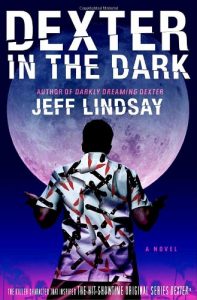
Dexter in the Dark

51VvbZNbVsLIn a sense, one of the reasons I have been trying to read so many short, breezy, comfortingly familiar and above all known-quality books is that I’m girding my loins for literary battle; in other words, it’s about time for me to read another Anita Blake novel, and I’m by turns looking forward to the review and dreading the book itself. But also there are a stack of giant books I’ve been peering at, and then I think, nah, I’d rather read a lot of short books instead of that. I suppose once I finally catch up with the Ultimate Comics line from Marvel, I’ll feel better about long gaps in my books-reading too. None of which exactly explains how I pick what my next novel will be; I kind of just do it by feel, as opposed to the very structured method I have of graphic novel selection. All I really know is that my to-read pile is at least a hundred books deep right now, and that’s kind of unsustainable since it has consistently grown rather than shrunk, and so lots of authors but especially lots of series suffer delays as a result.

One such delayed bit of work that I chose out as randomly as you’d expect from my previous paragraph is Dexter in the Dark, a book that I had been looking forward to eagerly for months, after certain revelations about Rita’s children from the previous book. (Rita, of course, is Dexter’s girlfriend, and Dexter is the perpetually eponymous, ethical serial killer who stalks far less ethical murderers with a quip in every narrative hook and disdain for human emotions in every interpersonal encounter.)  And although those revelations played out very much to my satisfaction, the rest of the book was… it was not bad; Dexter’s voice has grown on me a little more with each book, straddling the line between sincerity and parody without ever straying into ridiculousness or a breaking of the fourth wall. Dexter is very fond of himself, and of pointing out the many differences between himself and the rest of the teeming humanity through which he strides, and even though he misreads himself unwittingly as often as he very knowingly misreads others, it does always straddle that line of sincerity in such a way that he’s obviously not having the audience on. He’s the least reliable Reliable Narrator I’ve ever read, and I enjoy that about him. So, like I say, the stuff for which I read these books has not gone away at all, and by no means would I like to say it was bad.

But it was entirely inexplicable, plotwise. I don’t want to say it’s gone off the rails, though the common Amazon reviewer seems very convinced to the contrary on this point. Anyway, here’s what happened. Dexter has this Dark Passenger that he refers to on a regular basis, the voice inside him that requires his violence. He has channeled it down useful pathways thanks to the help of his foster-father Harry, but it’s the Passenger that keeps him alert, drives him in his purpose, helps him to never get caught in the moment, even as Harry helps him to never get caught after the moment has passed. And okay, it’s not exactly the same as an annoyed dog telling him to go kill people, but it’s not all that dissimilar; basically, it works as a seed to explain why he would have been a serial killer, no matter what. Except… this book starts off by making the Dark Passenger a literal separate entity, that can be terrified and abandon Dexter to his fate and that has, in one form or other, apparently been stalking the world looking for hosts since before the world had any life to be a host. And I can honestly maintain, as I’ve already stated once, that it didn’t conspire to make the character in any way less entertaining. But all the same, what a bizarre plot turn! I didn’t hate it, but I can understand why people would. And I really hope it fades to the background with little or no future relevance, as I’ll be more than happy to pretend it never happened, even if references to Moloch in modern literature are few and far between.

The Blind Side

I have, I am sure, mentioned that I see a lot of Wednesday afternoon movies, in an effort to avoid adding a random 60 miles to my weekly drive schedule. I may also have mentioned that I welcome attendees, because that is a lot of filmage to see by oneself. The upshot is that I will sometimes see something that isn’t at the top of my personal list, or even something I didn’t really want to. In this particular case, the movie I didn’t much wanna see was The Blind Side, by virtue of it being one of those “feel-good picture[s] of the year” that is pretty much guaranteed via that descriptor to be twee and annoying.

But, y’know, I’m a big enough person to admit when I’m wrong, and right here? I was wrong. Through an unlikely (but not unthinkable) series of events, a white Memphis socialite family meets and takes in a black teenaged ward of the state, and they each learn a lot about the ways the world works; also there is football. And it still sounds pretty twee, plus I don’t know how to say only a little bit about it; it’s either keep adding details until I’ve told the whole story, or the probably better option of knowing only that much or even slightly less than what I wrote above, as I did. The important part is, it was a genuinely sweet, sincere movie about how people are only different if we insist that they are, and about whether opportunity can triumph over fate. And no matter how twee this review may be, the movie really wasn’t.

I’m honestly not sure if I’ve ever watched this genre of movie in my adult life without rolling my eyes. I hope I’m reporting accurately, instead of having somehow changed internally to become a sucker. That would be embarrassing.

Death: The Time of Your Life

There may be more Death-based graphic novels; the existence of an Absolute mega-edition like was created for Sandman and some other DC titles suggests so, but I’ve only ever seen two. And as of today, I’ve read the second one, so I guess I’ll just have to see what else pops up or else not worry about it. Which is not unlike how the pale gothy girl wearing the ankh expects me to live my life, I think; after all, it’s what I’ve got.

I kind of wish, though, that I either read Sandman more often than I have or else that I had eidetic memory, or that I had been obsessed with the series the way I was with the Wheel of Time during the ’90s, or really anything that would lead me to have good recall about the characters of Foxglove and… Jesus, I’ve forgotten her girlfriend’s name in the time it took me to start this review after finishing the book earlier today. That’s just sad, though unfortunately illustrative of my point. Because, you see, The Time of Your Life is mostly about the two of them and their son Alvie who has a suspicious anagram in his name, and also of course about the pale gothy girl with the ankh, who you may better know as Death.

It was a sad and sweet but probably more sad story about relationships and fame and sacrifice and of course death, and I liked it on its own merits, but I didn’t really like it on the merits of being a story about Death. She felt shoehorned in to provide a… well, deus ex machina can hardly apply if the being providing it is pretty well at a higher level of existence than gods are. But all the same, her only real point in the story was that she worked as a lever to break the logjam between waify singer/songwriter Foxglove and that girlfriend whose name I can’t remember, so that they can proceed with their lives (or not) one way or another, instead of continuing to circle around and around the same static relationship they were stuck in on page one. And even worse, Death provided this lever by way of an action so implausible that she even commented in the dialog that it’s the kind of thing she never does, right before doing it anyway, for no apparent reason. That could be a hint that she has taken more interest in the two characters than I apparently managed (her name is Hazel, if you are itching to know), but I couldn’t bring myself to take that hint. Instead, it was just an inexplicable oddity in, like I said, what could have been a pretty interesting story about a few side characters without ever including her.

Although, I admit it does seem like some member of the Endless should have probably been involved for it to really fit in the universe, familiar characters or not. It’s just, it’s plausible that if a character is going to behave inexplicably, Gaiman already wrote one who has that exact modus operandi. Y’know?

[1] It’s weird, or serendipitous, or merely coincidental, but I’m positive not ironic in any sense, that I’m listening to Who Killed Amanda Palmer? on vinyl as I write this. See, I bought it a few weeks ago while browsing a local record store for a few pickups, and finally unwrapped it right before I started on this. I had been going to write it anyway, just over Jon Stewart from last night instead, but the whim struck me, and there you go. And after I’d gotten about a sentence deep into the review, a line from the third track played out: “Nobody deserves to die, but you were awful adamant that if I didn’t love you, then you had just one alternative.” And the thing is, I feel like there might be a way to tease out a very close parallel between that line and the book, but only with spoilers, and anyway, it really would be coincidental, almost certainly nothing more. Even though I’m pretty sure Amanda Palmer wrote the introduction to that giant updated Death collection I mentioned, and Neil Gaiman wrote the copy on the back of Amanda Palmer’s album, and they’re engaged, and all of that. Sometimes, despite everything, it really is just a coincidence.
[2] How weird is it that there are two unreferenced footnotes in this entry?

Alice in Wonderland (2010)

Unless you live at the bottom of a very deep hole, you will no doubt have heard that Tim Burton is remaking Alice in Wonderland. Well, was remaking, I should say, as it came out last weekend. And I am here to tell you that it is a gorgeous movie. As usual, modern 3D is good even when it’s not particularly serving any purpose, and IMAX always looks and sounds about as good as you can imagine, but I’m not just talking about that, of course. Burton has a stylized signature art style that suffuses every movie he has made since at least Edward Scissorhands. It is slightly dark, in an almost proto-goth kind of way, even though he has sometimes made it darker than others. It is cartoonish without being cartoony. Basically, every world he creates looks like a fairy tale world; in this case, Wonderland already being a fairy tale world in its own right, Burton has pushed it through a glass darkly. Which, of course, is appropriate.

In addition to being so very pretty[1], the casting was consistently spot on. I mean, obviously the focus will be on Johnny Depp as the Mad Hatter, and I kind of thought he alternated between acceptable and annoying. But everyone else was pretty great. Crispin Glover as a gawkily tall bad guy, Alan Rickman as the snide caterpillar, Anne Hathaway as the ethereal White Queen, and then lots more. Perhaps best of all was Alice herself, though; in addition to managing to have girlish innocence despite now being 19 and looking really nice despite unreasonable ongoing damage to her wardrobe, she was a delight throughout the framing story (in which she is blindsided with a marriage proposal from some British lord or other), portraying the uncertainty, the yearning against the bonds the society was placing upon her, and so on. It would not have been Alice in Wonderland by any means, but I think I could have watched an entire movie built from that framing story.

Which is a pity, because the main story? Also was not quite Alice in Wonderland. The March Hare was as mad as… er, he was entirely crazy. And the Cheshire Cat was approximately perfect, plus all the casting I’ve already mentioned above. But the story… after complaining about Depp annoying me, I feel bad to say this, but the story was entirely too sane. It was linear, and standard, and about nothing much more than a hero needing to decide to be heroic. Which in itself is a movie I’ve watched many times before and will watch many times again, but placing characters from Lewis Carroll’s works into a movie does not make the movie suddenly about Wonderland. So I think I was ultimately more disappointed than it deserved, due to the misrepresentation, yes, but also because of how everything that was not the script[2] was so very well done.

[1] I should note that bloodhounds hit the uncanny valley of dogs for me; they looked perfect, but moved all wrong. Still, it’s nice that the technology keeps getting better.
[2] Well, except the dogs. And about 30% of Depp’s performance.