Salt (2010)

I saw Salt on Wednesday, but between my punishing workload and the unexpected discovery of lots of new spam here, I have been too busy to actually talk about it. Which is sad, as it was a pretty entertaining film that seems to have flown under everyone’s radar. See, there’s this CIA agent, Veruca Salt, and she is interrogating a Russian walk-in when he names her as the lynchpin of an unlikely plot to assassinate a visiting foreign dignitary. This sets off an action-filled sequence of events designed primarily to keep the audience guessing about what’s actually going on and who is on what side. I’m not ashamed to admit that my early guesses about who was for sure a bad guy, based mostly on the company he kept, were not accurate. Because the plot was convoluted enough to keep secrets from start to finish, without ever being entirely ridiculous.[1]

There was, I should note, one particularly bad scene. I wasn’t looking for a Bechdel moment, because, action movie, right? So when Ms. Salt climbs through a window into an apartment occupied by a school-aged girl (during some escape or other, you understand) and they have a brief conversation, I was duly impressed, above and beyond Angelina Jolie[2]’s asskickery in general. Up until the substance of that conversation turned out to be about the girl’s homework and Salt’s response of “I hate math.” At which point I cringed way, way more than if the test had not been passed in the first place. Or, for that matter, if she had not otherwise been such a strong, self-reliant character.

But gender politics aside, awesome movie!

[1] I mean, there was one coincidence that stretched the bounds of likelihood, but the flick moved fast enough to keep me from thinking about it at the time.
[2] She plays Salt, you see.
The Walking Dead: Life Among Them

Unexpected event: reading two books in a row by Robert Kirkman. And both with zombies, at that, despite the fact that he apparently writes lots of non-zombie scripts as well? (I have some small evidence of this, at least.) So the main difference is that I started off kind of angry about this book; the first few moments contained a bait-and-switch that made me pretty confident the series will in fact never end and not-at-all confident about my willingness to be dragged along for the next 72 issues. But then, over the course of the rest of the book, Kirkman reminded me why I’m still on this ride in the first place, which is that he really is good at the psychology of the zombie apocalypse, not to mention good at tension.

Life Among Them raises a new question that has not been asked before in the series: is it possible to go back to the old life? And although watching various familiar characters trying to adapt to the hope and possible fact of new safety, among people who claim to have held it for some time, is interesting enough on its own merits, I was most taken with my own reactions so similar to the characters. Constantly looking for something out of place, latching onto to anything strange, and unwilling to let my own guard down. If that’s how I feel about it, it must be only the very tip of how tense they feel. And by the end of the book, other new questions are being raised, questions that leave me squirming uncomfortably and yet still completely sold on at least one more volume, just to see where he goes next. Considering I started off angry, that’s a pretty neat trick.

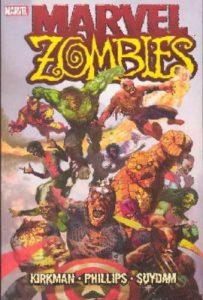
Marvel Zombies

I’ve been sitting on this book for over two years, apparently. As has often been the case in my various Marvel readings, it’s worked out really well for me, the delay. Sure, there are things I haven’t read yet and things that haven’t happened yet and so on, but the very fact of making it all the way through Stan Lee’s era as chief editor of Marvel (which ended just this month, basically, where this month is September of 1972) means that I have seen at least most of what any given Marvel homage is going to make reference to. And boy howdy does Marvel Zombies assume you are familiar with most of the characters and at least a couple of the plot lines their universe has spawned over the past 50 years.

The very concept seems ludicrous at first blush. Take all the Marvel super-powered characters, infect them with a zombie virus, let them destroy humanity in a matter of hours, and then leave them doomed to eternal hunger while figuring out what to do next? But it works, partly because this particular earth has missed a key event in the Marvel mythology, but mostly because, zombie or not, they’re all the same characters when they’ve had enough food to clear their heads for a moment. Hank Pym is still a colossal jackass; Tony Stark is still entirely full of himself; Peter Parker is still wracked with guilt and uncertainty. It’s not a classic zombie story where the zombie thing is just a backdrop against which some social theme is highlighted, but it is pretty damned funny. And I think I’m glad; if they’d played up the existential angst of heroes sworn to defend humanity having been its extinction, and with hardly a pause for thought until after the fact? That just would’ve been depressing.

Proven Guilty

The only problem I have with the Dresden Files series, at least for right now, is the pretense that there is a broader world beyond the bounds of Chicago in which things are happening over which our wizarding hero Harry (no, not that one; the cool one, Harry Dresden) has no influence and can only react to when odds and ends of it affect his city and the lives of his nearest and dearest. I mean, that’s factually true, which I suppose makes some kind of case for it not being a pretense at all and me just filling a paragraph with lies for the sake of volume. But the thing is, we all know that sooner or later these world-shaking events will drop onto Harry’s doorstep and he’ll be forced to deal with them[1], and while that will make for an exciting plotline, it’s still somewhat disappointing that the depth of world will be proven a bit of a pretense after all and it really was all about Harry Dresden, start to finish.

On the bright side, Proven Guilty is yet another entry in a long and seemingly unstoppable series of books designed solely to justify making it all about Harry by presenting a cool, funny hero who is always clawing his way out of the hole with equal parts style, honor, and romantic frustration.[2] In this case, much to my delight, he’s doing all of that at a horror convention that is being stalked by exactly the kinds of horror icons the fans are there to see, more or less. Stir in a new practitioner of the dark arts on the loose and Harry’s new duties to take care of that kind of problem, plus all the usual suspects (good and bad), and you have, well, a book of the Dresden Files, which alone is enough to pretty much guarantee a good time.

[1] In fact, this has already happened at least once.
[2] The many, many series of urban fantasy with female protagonists seem to have as a common thread how irresistible said protagonists are and how much sex they either could or do have, depending on whether they’re co-filed into the paranormal romance section of the bookstore. The Dresden Files, in addition to being just about the only one with a male protagonist in the first place, also seems to be about the only one without any supernatural powers of sexiness for the protagonist. This leads me to no particular conclusion, but what with my psychology hobbyism, I can’t help forming questions.

Killers (2010)

Dollar theaters, as I have surely said before, are awesome because they give you a chance to fill in gaps in your summer movie experience that would otherwise be relegated to Netflix or cable channels, both of which I am largely terrible at. Also, I suppose, if you are poor (or temporarily jobless for four months), they would then be awesome for different reasons. Of course, another factor is that these gaps occurred because you try to see the best stuff first, and the ones that slip through the cracks, you probably feel better only having paid a buck or two to see. Which is not to imply that Killers is a bad movie! It had several pretty funny moments, and the action was decent without resorting to any kind of fireballs-per-minute equation that some producers do when they ran out of budget for a script doctor[1]. It’s just the kind of movie that benefits from lowered expectations and, yeah, a smaller hit on the wallet.

Another upside to it, though, it that the premise was very, very simple. It’s exactly the same kind of family drama you saw all over the place back in the early ’80s, when Hollywood was beginning to admit that sometimes marriages end and people get angry with each other and have to deal with a big mess and see if they can put their lives back together[2]. Which is not to say that Ashton Kutcher is going to fail to have the manly wherewithal to convince Katherine Heigl that their relationship is worth saving, or for that matter to say the opposite; my point is, the topic of the movie is the impending dissolution of a marriage. But then they cleverly did the thing where they increase their audience share by putting that movie in a blender with a completely different movie; in this case, it’s about spies. To hilarious result? Y’know, maybe; like I said, it was pretty funny. But there’s something funnier to me about the pitch meeting where some guy was telling Ashton Kutcher’s manager, “No, no, it’ll be great, it’s a relationship drama, but with guns!”

[1] I know this makes no sense; I can only speculate that something about the oxygen/pollution ratios in Los Angeles make explosions cost far less to accomplish there than anywhere else, or else that nobody told them most writers don’t make anything approaching a living wage from their craft. Or both?
[2] But before the late ’90s when this genre lamentably metamorphosed into the celebration of relationships ending so that the girl could clear the way for the fairytale guy that was obviously right around the corner. (I suspect I’ve made this complaint this before, though.)

Hack/Slash: New Blood, Old Wounds

The downside of the many brief glimpses of plot lines that are not yet quite relevant to Cassandra Hack’s current circumstances is that, not reading the entire storyline in one huge gulp[1], it’s easy to get lost and not quite remember people when they do finally take center stage. The upsides more than make up for that, though; not only is there a sense of a world that matters out there, a world that is moving and changing and preparing to hand nubile slasher-killer Cassie her next big emotional or physical face-plant, but a quick glance at my previous review is usually more than enough to remind me of what was going on. I mean, these are really good T&A horror-films-presented-as-comics, but they’re still T&A horror stories, and only so much depth of plot or theme can be accommodated between panels of girls naked in bathtubs or disrobing prior to exactly the kind of sexual shenanigans that rile up slashers so much in the first place.

In this particular case, the depth of plot that is permissible revolves mostly around revelations about the cult that has made the world the way it is, which is to say: full of dead and yet unkillable slashers that mindlessly stamp out “sin”, by which we tend to mean underage drinking, drug use, or pre-marital sex. Mix that with a handful of those hints about what else is going on that I previously mentioned, a few scenes of light angst for  Cassie and her comrade-in-arms Vlad, and probably an only four-to-one ratio of regular panels to titillating ones, and there’s not really room for anything else in the latest such volume, New Blood, Old Wounds. I know I’m making these sound like a guilty pleasure kind of read, but even if I were guilty about reading them, the truth is, they’re a little bit higher rent than the connotation behind that phrase. Not a lot higher, but a little bit.

[1] I mean, I wouldn’t anyway, but the incomplete nature of the series would make it impossible even were I so inclined.

Ultimate Avengers: The Next Generation

With my completion of The Next Generation, there are no longer any Ultimate Comics for me to read, and I have to wait for new ones to be published. That’s just weird, is all I’m saying. As for the story itself, well, that was pretty good, albeit with a healthy dose of the darkness that the Ultimates have been known for in the past. That said, my ongoing read of old Marvel comics[1] has served me well in caring much about this story, because if I was not aware of the long-standing rivalry between Captain America and the Red Skull, it would have been a lot harder to swallow the idea of this giant terrorist threat that’s been around for decades, only we never mentioned him before now because of how he retired prior to the current wave of genetic superheroism.

Anyway, though that’s the main focus of the story, the stuff going on in the background as set-up for future stories is entirely intriguing, and that’s what I want out of another first volume of a re-reboot: lots of groundwork for awesome futureness. And I guess I’m done, because the plot part of the story is more than good enough for me to not want to carelessly reveal anything that actually happens, and yet the themes are not really all that deep the way they have been in previous Millar Ultimates stories. The weird (and sad) part is that there’s some pretty fertile thematic ground available, if they had chosen to exploit it.

Oh, and I will complain about one thing, which is the random insertion of a ton of new characters that seem unnecessary when there are old characters already sitting there, in some cases filling identical roles. I trust there will be some kind of payoff in future volumes, when these new folk become awesome? Except for the random new Stark brother, as that is just a downright stupid retcon that violates every other published story with Ultimate Tony Stark present, and as far as I know violates all the main continuity stories. (At least, the ones through the spring of ’72.)

[1] I am up to April of 1972!

Eric

If all the Discworld books had been like Eric, well, okay, probably most people that I know would still have read them. They are, after all, competently written comedic fantasy. But they wouldn’t talk about them nearly as much as they do, at the least. I mean, as a representation of the kinds of things that tend to happen in Discworld, it is a top notch book. The problem is that, even as short a distance into the series as I am, I’ve come to expect a fair amount more incisive literary and social depth, and never mind the amount I expect from all the buzz that surrounds later books in the series. By contrast to that experience/buzz, this book was a merely[1] funny series of vignettes strung together as a parody of Faust with a horny thirteen-year old in the eponymous role and resident failure (as a wizard, too, but I more meant it with a capital F) Rincewind as the wish-granting demon. If that doesn’t make a lot of sense, well, that’s what the plot is for, yeah?

The sad thing is, I’m totally not joking about it being funny or a really good sample of the kind of thing that happens every day on the Disc. If there’s a moral to my story, it’s this: expectations are a fickle bitch. And as for great expectations, well, they were written by Dickens, which I think tells you everything you need to know.

[1] he says, as though that’s not a reasonably tough accomplishment on its own

Powers: Roleplay

The upside of the second Powers book is that I’m continuing to enjoy the slow reveal of Bendis’ created superhero world, which is chock full of history, dark secrets from the past, and ongoing plots that are heating up in the background toward what I trust will be a violent boil. The downside of Roleplay is that its plot, in which a number of college students in illegal superhero costumes run afoul of the law and a powerful supervillain, was slightly easier to wrap up than any given episode of Law and Order, and mildly disinteresting besides.

Which is not to say the book was bad: all the bits that aren’t essential to this particular current plot were, as I said, fascinating. It just concerns me that if the story arc and history mines are ever played out, what is left will be a disappointment, and it concerns me more that an overly slow reveal of those elements might make equally iffy immediate plots become intolerable before I reach that other point.

All that said, I’m glad I read the first of these books before I read Astro City. Because Bendis’ created superhero world is good, but it wouldn’t stand up very well if I’d had to compare it from the start, and then I’d be depriving myself of what I still assume will be a good story.

Ultimate Spider-Man: The World According to Peter Parker

The only particular problem with The World According to Peter Parker[1] is the name. I mean, it’s not a terrible name, and if it felt as much like the first entry in a series as the name implies, I might well have no complaints. But it’s obvious that there’s some amount of continuity that the reader is behind, regardless of the new imprint[2] the series is being published under. Maybe it’s not obvious that there are twenty-two volumes of continuity, but some amount is definitely detectable.

Everything not the title, though? Good stuff. Six months have passed since the Ultimatum event, which indicates some decent passage since Tony Stark’s one-man war against his stolen technology, and things are kind of getting back to normal. Well, unless you’re Peter Parker, whose life has changed in all manner of unpredictable ways. But that’s what I’m digging the most about this brave new world, is that with so few titles as yet launched in the Ultimate Comics line, Bendis is at least for the moment at the helm of the whole Ultimate universe. So we get to see the fates of some other familiar heroes[3], the violent rise of a new nemesis[4], and generally see the lay of the land, all while leaving room for a very gradual reveal of the changes (and underlying causes thereof) in Peter’s non-hero life. And, okay, I’m willing to admit that for the most part, this actually does work as Volume 1 after all, not just of the new series but of the whole new shebang, even if it was the second story to be told in this recovering universe. Which really is why I’m glad Bendis is the one mostly in charge right now, until more titles have launched.

All that said, the art is surprisingly manga-like. It’s not bad, other than in the case of one character that it might be spoilerish to even mention, but it’s a little jarring in this context. Still, yay for not being bad!

[1] And it may be a Garp [or some other] reference that I’m just not getting?
[2] Is that the right terminology?
[3] And, predictably, more of the awesomeness that is May Parker.
[4] True story: the end of the first issue? Total “Holy shit!” moment.