Jack of Fables: Jack of Hearts

The brilliance of splitting the Fables series by giving Jack Horner his own spin-off is that the mainstream series is free to switch to an all serious, all continuity focus while giving fans of lighter fare a place to go for that. I like both, don’t get me wrong, but all the same, I like them better separately than together, because now I know what to expect from each storyline, instead of guessing whether the next book will matter to the plot or not. (This theory probably falls apart entirely for people who read the individual comics instead of the collections, but I’ve got to say that I’m really glad the graphic novel format exists; as much as I’ve enjoyed my Marvel readings over the last years[1], the modern trend toward extended storylines fits my pleasure a lot better than changing focus every issue or three. Whether the graphic novel format led to or from extended storylines is a question for historians.[2]

The downside of reviewing a book in which you already know that the plot will be played for light comedy (nevermind how brutal or violent individual moments might be) is that probably nothing will really change, and there’s not a whole lot you can say about it except for spoiling the plot. So, to the minimal extent that I’m willing to do that, Jack of Hearts follows immediately from the events of the previous story, where Jack takes the time to tell his fellow escapees the possibly true story of how he became Jack Frost and the heads off to the warmer climes of Las Vegas, in pursuit of the two things it has in the most abundance, love and money.

On the bright side, though, the potentially very interesting story of Mr. Revise, the guy from the last book who has been capturing fables in order to remove them from pubic memory? It is not only not over, but figures to be the main arc of the Jack of Fables series, much as the war against the Adversary is the main arc of Fables. I really look forward to seeing where all it goes, though I trust Jack will stay for the most part light and comedic. Otherwise, it’s just a new series entirely, which defeats the purpose. Well, the one I laid out for it, anyway. Oh, and unrelated to almost anything else I’ve said about the book, I really hope to see more of Alice in future volumes.

[1] I’m in 1974, except that I went back to catch up on Daredevil, where I’m trapped in 1968.
[2] So, Fresh Air has a rock historian, right? I wonder how long until a show on NPR has a comic historian, and I also wonder why it cannot be me.[3]
[3] So, okay, there are a lot of really good reasons why. But still, what a cool job. If it existed, I mean.
Resident Evil – Code: Veronica – Book Two

Remember that time when I was reading a manga-as-walkthrough graphic novel of a Resident Evil game I never finished, because at least I’d get to know how the game ended this way? And it actually spent more time showing where to find the next emblem or key or blue herb than examining the story being told, and it was pretty much terrible, but hey, end of the story without having to plug in a Dreamcast, right?

So, yeah, it turns out that while the second book is the last book I have, it is not the last book in the series.

So. That was pretty sad.

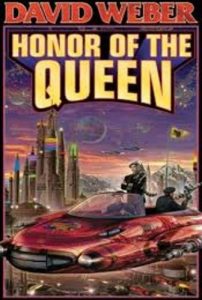
The Honor of the Queen

I do not wish to be too sick to write a review, as what if I fall behind in my reviewings? But contrariwise, what if I write a useless review to which people respond, “Hey, stop writing reviews while you’re sick, Sicky!” And then… well, I haven’t really been able to define the bad thing that happens next, probably because my head is too simultaneously congested and medicine-floaty to concentrate that long. But clearly, consequences will abound. All the same, I’ve written way too much to back down now, even if none of it has anything to do with Honor Harrington just yet.
Which, yeah, I finally read the second book of that series, The Honor of the Queen. In a lot of ways, it is a clone of the previous book. Well, sort of. At least, the setting is unchanged.[1] That setting being some 1700 years in the future, where mankind has long since spread forth from Earth, discovered the means for faster-than-light travel, only of course politics are always basically the same and now there’s a cold war between the honorable, if occasionally too doveish, Manticoran system and the wily, expansionistic and probably pinko commie Republic of Haven. You may recall (or may not, depending on how much I mentioned any of this last time) that our plucky heroine Honor Harrington got caught up in the apparent beginnings of that cold war while On Basilisk Station, with the results that she proved her pluck to herself, her subordinates, and her Queen’s military chain of command.

Now it is some years later[2], and Honor has been picked to command a task force on a diplomatic mission to a pair of backwards religious worlds that rejected all technology[3], with the result that they are insular and range from sexist to incredibly misogynistic, all of which would be good reasons to continue ignoring them and leaving them to their petty internecine religious warfare, except that they make a good buffer (or forward base, depending on whose team you are rooting for) between Manticore and Haven, much like Basilisk Station did last time. If you think this means that we’re about to be treated to another display of extreme competence in the face of insurmountable odds, during which Honor will impress allies, enemies, and neutral third parties alike with her capability and her, well, honor, then you are clearly reading the correct series. It’s interesting, because even without knowing that there are a whole bunch of books left to read, I would have known after reading the first one that there’s really no chance whatsoever that she’ll fail at what she sets her goals to, but the pacing is so much improved[4] over the first book that I was able to wring almost as much excitement out of wondering how the success would occur as I would normally spend on wondering whether it would.

Things I am looking forward to in future books: whether the revealed personality “flaw”[5] will cause her any future problems; the outbreak into an actual war of some kind between the two rival, uh, nations I guess? That’s the closest analogue, anyway. Oh, and whether the hyper-intelligent empathic cat creature will stop seeming weird eventually. At least it no longer seems tacked on.

[1] I really feel like there’s a distinction I’m about to draw here, in which I define the setting more precisely instead of just saying the most uselessly inane piece of information ever presented in a review by anyone, ever. Nevertheless, the fact of my aforementioned sickness is definitely rearing its head, if only in my head.
[2] These years are not very relevant since most everyone in the developed parts of the galaxy has access to life extension technology. Yay, the future!
[3] I know. Believe me, I know. So do all of the characters. Weber’s penchant for straw men may start to grate on me, I reckon, unless he gets a little more circumspect about them.
[4] Seriously, from about the midpoint of the book on, there was very little action that did not feel climactic. Which makes up for quite a fair amount of previous political strawmanship, let me tell you.
[5] Scare quotes because of how certain I am that Weber doesn’t really consider it a flaw at all, despite that he acknowledged why it could be troublesome.

True Grit (2010)

I should say at the outset that I never saw John Wayne’s version of True Grit. It is perhaps looked upon fondly? All I really know of it is that he got an Oscar for it, but it was one of those times where he deserved it for other movies and not this one but the Academy had missed its better opportunities and only finally got around to it now. Which as you can imagine is not a very strong selling point. Either way, I haven’t, and I’m not very strongly inclined to now, since I think it would be a pretty huge let-down after watching the Coens’ version.

The plot of True Grit is a very simple one, and I guess that’s true of all westerns? Either way, it fits quite well and I think something more complicated wouldn’t have been that good at all. A teenage girl’s father is murdered[1], and she hires a one-eyed U.S. Marshal because she has been told he is a man with true grit, so that they can hunt down the coward Tom Chaney who perpetrated the foul deed. And, yeah, that’s the whole plot. Which is nice, because it leaves you with another 75 percent of the movie to wander through beautiful vistas while spending time with compelling and compellingly likable characters. And when you consider that a decent portion  of those characters are bad guys, it’s all the more impressive just how likable they are.

Since I’m still thinking about the way I relate to endings, I should note that I really didn’t much like this one; it was essentially the opposite of what I would choose to look for in one, in that I felt like I’d been explicitly told there was a great deal of things left to be done with these characters and I didn’t get to know what, all in exchange for a statement of theme that didn’t really match the rest of the movie. On the whole, that’s the one downside to filming something as close to the book as possible: the book isn’t always right.

[1] This is, after all, the Old West. (Sort of, it’s really Arkansas and Oklahoma, but these were on the frontier in the 1870s.)

Little Fockers

I think the most misleading thing about Little Fockers is the title, in that, while present, the Focker children are never quite the focus of the story like you might expect. It’s like… okay, you know how Anton Chekhov[1] said that if you see a gun on the mantel in act one of a play, it had better be fired by act three? This is like that play, in that there the children are on the metaphorical mantel, and in fact they get used in all sorts of ways. But, and here is my point, Anton Chekhov was not talking about a play named The Gun. See? They are a means to several different ends, but never once an actual focus. Maybe lots of movie titles work this way, and I just generally disregard them?

Anyway, though, the plot: a couple of movies ago, Ben Stiller married a blonde chick that I’ve only really seen in these movies, the result of which is that Robert De Niro and Dustin Hoffman get to be in-laws, and Stiller and De Niro have formed an uneasy truce. But all kinds of small troubles (child-raising, finances, sex lives, home renovations) lead to a renewal of the same hostilities between the two leading men that have been the theme of the entire series, and it’s impossible to avoid an unpleasant sense of déjà vu[2].  Especially when the flick itself is only mildly chuckle-worthy for the first two acts. Still, it eventually does get to be pretty amusing, though whether this was because my defenses were gradually worn down or they really did save the best for last is highly debatable.

Jessica Alba’s by now ubiquitous lingerie shot isn’t worth the price of admission, but it at least lets you convince yourself it was worth the time spent. …and if you know it won’t let you do that, I can safely say this is not the movie for you.

[1] Probably, but maybe someone else; in any event, not Samuel Clemens.
[2] Will they form a new uneasy truce by the end of this one? At what point does the terminology get downgraded to détente?

Lucifer: Evensong

The fundamental story being told in the Lucifer series was over at the conclusion of the previous book, which is as it should be.  I have realized while reading Evensong and contemplating my review of it that how a story ends matters to me a great deal. I mean, certain series which I read for the sake of humor and masochism (and am probably overdue on another entry from) aside, the ongoing story will need to be good for me to care about it at all. But the dividing line between the merely competently entertaining and the sublime that will stay with me for years ahead? The strength of the ending will almost certainly be the surest tell.

All that to say that I feel like the strength of this ending is the closest Carey has come in his quest[1] to match Gaiman’s Sandman. It hit all the right notes of regret, yearning for more but acceptance that the wind has blown an ending, tying some loose ends while leaving others conspicuously unknotted… it was an end, is what I mean, and what I also mean is that I really don’t see one that satisfies me all that often.[2] I can tell when I dislike them, as evidenced by everything I’ve read by Dan Simmons, but the ability to recognize that I actively like one and it has really added to my opinion of the whole? That is a new gift that I’ll enjoy all the more for getting to talk about it. It also explains why I like ongoing series as well as I do. With no end in sight, the let down is all but impossible. And then there are some series that make a conscious choice not to end, which may work pretty well or not, depending on who you are. (It’s such a massive spoiler that I can’t even mention what series I’m talking about, though it wouldn’t be a spoiler to say I believe the Wheel of Time will head in the same direction. I mean, that spoiler is right in the name.)

Anyway, clever readers will note I’ve spent almost no time talking about this book, and that’s a feature since it being both a grand denouement and an eleventh volume makes it tricky to say anything that wouldn’t be a spoiler for, at the least, earlier books in the series. But I will reiterate again (once per paragraph, yo!) that it was entirely satisfying, and I don’t really regret that there won’t be more to come. Which is maybe the highest praise I can pay any series, even though in another context it could be the lowest insult. Still, the difference between the two is clear!

[1] I suppose I should not ascribe to him motivations that aren’t in evidence, but despite one of the points of the series being that filial obligations… chafe, I can’t believe he spent no time comparing his work to the one it sprang from.
[2] Did I just restate my topic sentence? MAYBE.

Resident Evil – Code: Veronica – Book One

Did you ever find yourself wishing that someone would write a manga-style graphic novel that comprised a blend of two parts recap to one part walkthrough of a game that was first released for the Sega Dreamcast? If so, your troublingly narrow desire has been granted in the Resident Evil – Code: Veronica series, which… well, I’ve pretty much said all that there is to say about it, haven’t I? Still, you may be wondering exactly why I’d have bothered to own and read such a thing my own self, to which I can only respond that a) I wasn’t aware of the strategy-guide-like feel of the book until I read it today[1] and b) I never did actually finish the game itself, one of the very few Resident Evil games for which that is the case (well, besides the last couple, but I was much better at it in The Past, is what I’m saying), so it will be nice to have the knowledge gap plugged in.
In case you’re wondering, the manga thing is, while largely distasteful, not a bar to entry.

[1] Seriously, it included a couple of the “take this crest to that recessed panel to unlock the next area” puzzles, not to mention an honest-to-god green herb.

Naamah’s Curse

Have I mentioned how frustrated I am by my inability to find the place on an Amazon product page where I can click that I own it and then rate it? It used to be invisible just from some browsers, but now it’s invisible from basically all of them[1] (unless it’s actually gone), and either way, I like them being able to take my ownership and tastes into account when recommending things, and how can they take them into account if they will not let me show said tastes and ownerships them?[2] Not, tragically, that I would be giving Naamah’s Curse a particularly high rating.

I mean, throughout the long life of the series, it has been exactly the kind of thing I go for. Travelogue fantasy in which the heroes go from place to place, exploring new cultures and solving new puzzles: I’ve been reading it since David Eddings first launched the quest for a blue rock, and despite intra-authorial repetitiveness and the increasingly rare inter-authorial ability to provide a unique new take on the genre, I’ve never not enjoyed myself. Which, lest you take me the wrong way, applies here too. It’s just getting harder to enjoy myself in this particular case when it feels less like travelogue fantasy and more like authorial insertion in order to decry the evils of fundamentalist Christianity and the Hindi caste system. Still, it’s not entirely bad by any means, and none of the bad parts were screed-like; the anvils were just a little too heavy as they landed upon my head, is all. Still, I think Moirin may go to America in the next book, and maybe that will be pretty cool?

[1] I have admittedly not checked Opera or, um, the text-based one whose name I forget.
[2] Oh LOL-cat constructed speech, why must you be so awkward to adapt to conversational English?

Moon

Since I didn’t get Moon through Netflix, I really should have taken my opportunity to skip this review. I mean, it’s the kind of movie where knowing as little as possible is the best, and that makes it hard for me to mention the pure highlight that elevates it above other similarly-constructed movies that we’ve seen in the past, of which 2001 is certainly the most obvious. And yet, it’s a movie that I first heard about on Thursday, and managed to see on Sunday through no great expansion of effort, while gathering that basically every other person on the planet had not only heard of it but really liked it. (Well, almost everyone for that last point.) And so I feel obligated to say something about it, just because it was such a common thread of my weekend.

So, what happens is this: an energy corporation is strip-mining the dark side of the moon for a hydrogen isotope that can power over 75% of the world’s energy needs. (Or it might have been helium, but hydrogen makes a lot more sense, and really we’d have the same story if it had been unobtanon, so stop being so damn picky!) And they’ve got this moon base built that mostly runs itself, including the harvesters roaming around, and all that really needs doing is minor outdoor repair work and also the collection and launching of the hydrogen tubes once they’ve gotten full, for which they have hired Sam Bell for a three year tour of duty. The part where he’s alone except for GERTY, the helpful base computer/tethered robot, wouldn’t be too bad except that satellite links for live relay to earth are down, so he only gets communication with his bosses and family at about the rate of USPS letters. But he fills his time with old television[1] and craft-work and other such pursuits, and anyway, it’s only two more weeks until his tour ends and he gets to go home. Too bad he’s started to hallucinate. …or has he???

And anything after that, even the part I want to praise, even a discussion of theme beyond my willingness to say I think they did a good job there, would be way too much spoiler. So I’ll stop here and only recommend that if you’ve got a lazy Sunday afternoon and a craving for humanist sci-fi, this is a good place to go. (The movie, not the actual moon, which has been strip-mined something ugly, let me tell you.)

[1] If I wanted to pick a part of the movie that was kind of horrible, it’s that the two TV shows that made it on screen were Bewitched and The Mary Tyler Moore Show, both of which took me right out of the moment by triggering the realization that they picked their shows based on what would be cheap to get the rights to from TV Land or whoever owns them now, instead of what someone in a near-future setting would likely be interested in. I mean, geeze, at least Cheers or Cosby or Friends, guys!

Skyline (2010)

Sometimes, when a movie is universally panned, there’s a reason for it.

Skyline is another in a recent series of alien invasion stories that are told at the personal ground level, rather than with sweeping majesty like Independence Day was back when it re-opened the genre for public consumption. If you imagine War of the Worlds or Cloverfield, you are definitely on the right track. Aside from incidental plot and character arc divergences, these are all three (along with several others I could probably think of if I paused to do so) basically the same movie. So, what makes Skyline stand out? The first thing is the characters; every single one of these ranges between (at the high end) uninteresting and seedily unlikeable.[1] The second thing is the plot, which, after establishing that the Aliens are Here! and People are in Danger!, effectively goes nowhere at all for the rest of the movie, up to and including a conclusion that I can only presume was meant to by heart-warmingly thought-provoking, or perhaps vice versa. The third thing is… well, look, if you need a third thing, it’s because you are more forgiving of badness in movies than I am, and I’m pretty sure I’ve never met the person that fits this description.

[1] I should say that David Zayas, who I hope you will recognize as Angel Batista on Dexter, really wanted his character to be likable, but the script simply wouldn’t allow it.