A Dance with Dragons

So, yeah. That was a long time coming. And boy do the internets ever reflect it. But anyway, I have come to a realization (that I may have already mentioned recently? I’m not sure) about myself and long-form storytelling, and also about other people and long-form storytelling. It is this: if you make a checklist of what details you expect to be addressed or wrapped up in a book of a series, you are doomed to disappointment. Because unless you happen to be the equivalent of that one chimp out of the infinite typewriter owners out there, your brain and the author’s are not telling the same story. This is not to say that there aren’t plenty of valid criticisms of the form and especially of specific presentations of it, but “the story is too slow” or “it has gone off the rails” are somewhere between barely valid and not valid at all. I know this is true for me, at the least, because I can find that I am disappointed a lot less in books that I thought had gone wrong the first time through when I was measuring from my expectations than I am upon a reread.

So, I have a new measurement now, as of A Dance with Dragons. (Technically, as of my reread of A Feast for Crows, the first book in this series that I had been disappointed in. But this is when I got to actually use the measurement, so you see.) In step one, I turn my brain off, watch for foreshadowing and decide what I think is cool, sure, but like I said to start with: no checklist. In step two, I only concern myself with when viewpoint characters bore me, as opposed to how cool or horrible or off-rails they are being. By that measure, I liked this book quite a bit. There’s a character that never did a lot for me, another that I have never liked and probably will never like, even though towards the end he was at least doing interesting things maybe, and a character I have historically liked that I did not care for until her final chapter this time around. Everyone else was entertaining all along, whether I was cheering for them, yelling at them, laughing, or just along for the ride. And that’s my real point, it is a ride, and it’s not my ride, so as long as I’m still enjoying the ride itself, why would I possibly complain about choice of routes or the occasional pause to slow down and look at the scenery? That gets saved for when my ass is starting to hurt and the roadsigns indicate we’re on the outskirts of Gary, Indiana.

As for the plot itself, well, you didn’t actually think I was going to talk about it, did you? Or mention the climactic event of the previous book just as though nobody could be running behind? (Not that I’m bitter about a massive spoiler I read yesterday for an unrelated series or anything.) But I will say that the title is a good stand-in for half the book, and the same kind of metaphorical dance without dragons covers the rest of it. There is still a part of me that will be unsurprised if the series ends with everyone dead and the planet encased in a permanent block of ice. And I cannot say I will find that outcome unsatisfying, in a “Decline and Fall of the…” kind of way, as long as the ride to get there maintains its general B to B+ quality. One piece of ambivalence I should report, though, is that Martin has a problem with the pacing of the ends of his books, or at least this one. ‘Cause you know how in a lot of long series[1], the last hundred pages or so turn into a downhill race where you couldn’t stop if you wanted to? Martin has a thing (sometimes close to the end, sometimes far enough a way from it that you think maybe he pulled a fast one and it’s not really true) where he likes to build a brick wall across that particular part of the road. It’s effective as hell whenever it happens, but man does it make me want to stop reading for a while. And since I really like that mad downhill rush, it’s a little off-putting. Whether the trade-off is fair is left as an exercise to the reader, I suppose.

[1] Jordan was a master at this.
The Social Network

First thing: I wonder if I am using this tag wrong. The Social Network was clearly not a documentary, but “drama” by itself implies fiction. Is there a classification for modern drama based on true events? ….that can fit into the tag of “$adjective drama”, I mean.

Anyway, though, I understand all the critical buzz this movie got last year. The script by Sorkin wasn’t as non-stop poppy as some of his previous efforts, but since the subject matter was less breezy than The American President and less smug than A Few Good Men, it definitely worked being a little heavier. And the acting, well, I can’t say for sure whether Jesse Eisenberg is kind of brilliant, but it doesn’t seem like it would be easy to make me dislike you and feel bad for you at the same time, no matter how good of a script you were handed. Anyway, though, not a lot to say about the plot of the movie, but if you were ever interested in the genesis of Facebook, this is where’d you’d go. And if you were not interested, it’s a good enough movie on its own merits that unless you are a shut-in who hates the internet and everything it stands for (like my great-uncle!), you’d probably like it anyway. It has so many good things, like genuine moral dilemmas, smart plot parallels, people who maybe actually learn from their mistakes, and like I already said, a lot of good acting. Well, I didn’t say that, but don’t let my singling-out of Eisenberg be seen to cast aspersions on anyone else. Good stuff, yo.

F.E.A.R. 2: Project Origin

I’ve played a lot of games this summer, you guys! And I’m seemingly not done yet, so, pretty cool. Anyway, this is a sequel to a game from back before the console revolution, F.E.A.R. The second entry, Project Origin covers the immediate aftermath of original game, from a new perspective and with some small degree of overlap. Basically, where the first game explored the mystery of how the creepy little girl was involved with Paxton Fettel and his army of psychically-controlled Replicant soldiers, the second game goes deeper into both the future and the past of the corporation that caused all of this to be as well as into the story of Alma herself, creepier than ever but no longer quite so little.

Of course, not much of the game by percentage follows that story, and what is revealed is on the whole unsatisfying by itself: this game has “middle of a trilogy” written all over it. And honestly I don’t think the enemy AI was as challenging as last time, though whether that says more about the game or me is impossible to determine. Luckily, it was still eminently playable and full of moody scares, which is really the number one reason I was here in the first place. At least as scary as I remember the first one being? So between that and the speed with which I breezed through it, I regret nothing and in fact still want to play the third (and final?) game in the series.

I should also admit that even though the whole game felt like a trap, the unavoidability of its execution reminded me quite a bit of a certain underwater allegory I played a few years ago, and I found the end of the game to be extremely satisfying. (The admission is due to my theory that most people won’t have cared for the ending, you see.)

Bad Teacher

It is hard to think about writing when you are reading all the time! Well, when you are reading with a purpose, and there are discussions to be had, and all that. But still, I’m two reviews behind right now, and things can only get worse from here, so it’s time to suck it up and not turn the page for the next ten minutes or so. (I mean, some of these reviews take a long time to write, don’t get me wrong, but the rewriting is never more than five minutes, and this one just doesn’t have the feel of difficulty or for that matter length, is all I’m saying.)

So anyway, I saw Bad Teacher last week. (I’ve been really good about the summer action epics, but falling a little behind on the comedies I guess? Anyway, only three movies I need to see right now, so it’s all good in any event.) First of all, it made me laugh, so that’s your answer to that question. Second of all, I’m pretty sure it didn’t have the troubling sexism in Hollywood’s comedy genre at large, making this a surprisingly good year if you’re into that kind of thing.[1] Third of all, you should avoid this movie if you have a problem with bad people, because the title is not lying. Cameron Diaz is shallow in the worst way, which is not enough I suppose to make for a bad person by itself, but when you watch the lengths to which she is willing to stoop in order to achieve her personal MacGuffin[2] while avoiding any amount of accountability toward the children she’s teaching, well… I suppose the part where we expect teachers to be better people than the common stripe is working against her, but be that as it may; she really, really is a bad teacher. Yet somehow, I ended up rooting for her. Script or charisma? Beats me! (Also, Jason Segel is awesome, as always.)

[1] Because, Bridesmaids, right? And I know, I know, how do two datapoints make for a good year? By comparing to the past, yo.
[2] Breast implants. Seriously.

A Feast for Crows revisited

Geeze, this took too long. Do you know that by the time I opened the new book I’ve been pushing towards all this time while not reading anything else at all (I even stopped the comics at the end of 1975, this is serious business is all I’m saying), it had been out for a full week? All the discussions are nearly finished! But at least I’m in it now, so that’s pretty cool. Back to the topic at hand, I should note that I remembered almost nothing of this book[1] except that I hadn’t liked it all that well. It wasn’t bad, but it was disappointing for the gap, and that had loomed larger in my mind over the intervening years awaiting another new one.

There’s a lesson in that, and the lesson is this: don’t read long doorstop series until they are completed! I know people say that a lot anyway, but my reasoning is potentially different? At the least, I’m definitely not talking about the fact that the author may suddenly die and you don’t get to find out what happened. It’s more that I have found that books I disliked in the middle of a series read a lot better when there’s no pressure on them to be “oh thank god, the new book”. This isn’t a panacaea by any means, but it’s happened often enough for me to take the hint. I mean, no, I won’t change my habits, but I’ll at least have a better idea of what just happened. The point is this: the parts that bored me were less bring than before, the parts that I liked okay were almost universally really good. But what was A Feast for Crows about, you ask? Memory, I think. Nearly every character in every arc spent some huge portion of their time considering the past and its influence on the present, to a really strong degree. Much moreso than in any other book (excepting Ned’s memories of Robert’s Rebellion and his intertwined personal stakes in the first book, which, well, I suppose there were good reasons to not save that part ’til this volume). Pity it wasn’t a feast for ravens, lest I should have been able to make a pretty cool Norse reference here.

And, that’s all I got.

[1] That review, I should warn you, is shockingly spoiler-laden if you have not read the rest of the series up to it.

Assassin’s Creed II

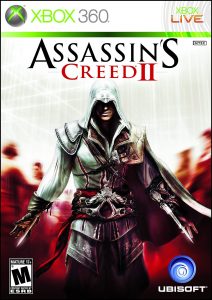
Assassins-Creed-2_X360_BXSHT_ESRBI’m always so happy when I finish a game! Though in this case, it was long enough that I may need to take a break (or at least a palate cleanser) before I start anything else serious. So, remember when I hated Assassin’s Creed? But I thought I would still love Assassin’s Creed II after a brief glance at it? So, yeah, that turned out to be true. It is the same as the other game in most important respects, only subtly better every time there’s a comparison to be made. Giant sandbox of a game, this time set in 15th Century Italy, where assassins must battle Templars for control of the hearts and minds of people, and, well, also the future. But that’s okay, because the future is in every bit as much evidence as the past; in fact, you’re not really in the past so much as your near-future guy is going into a cool machine that lets him live the memories of his ancestors (I think?) and learn from them, both skills and information. So while the game is open and sandboxy and actiony and jaw-droppingly beautiful, the plot is science-fictional and always interesting. Plus also, if you for some reason don’t care for the high-level plot, the plot on the street is of this kid first learning about his family’s secrets and then, when things take a wrong turn, setting about fixing everything, over 25 years of life. Good drama!

And if none of that does it for you, you also get to climb really tall buildings, wander around dusty tombs, and sometimes pounce on people from 40 feet above to stab them in the throat. And hang out with Leonardo da Vinci all the time. And learn a lot about regional history[1]. And… y’know, if you’re not persuaded by now, I really don’t know what I could add. Damn fine game, though, and I feel bad for you.

[1] I quickly decided the easiest thing to do would be to assume everything that happens in the past portion of the game is historically accurate. I’m pretty sure it was, anyway, so.

Harry Potter and the Deathly Hallows: Part 2

To the extent that there is a problem with the final Harry Potter movie, it is this: being split in two was a mildly unfortunate design choice. Because… I mean, okay, cool, this was an incredible summer movie, with non-stop action, split occasionally by tension-breaking humor or revelation after revelation, and I have no complaints about it for itself. (And for the record, I have a hard time imagining anyone, newcomer or longtime reader, being disappointed. Sure, the story gets a little weird at the end, but the only problem with the pair of films as adaptation is that it reminds the viewer how much better the fifth and sixth films (well, mainly the fifth) would have been served by an extra hour or two.)

It’s just that, when comparing it with the tight-focused character drama of Part 1, it’s impossible not to notice that what could have been an admittedly far-too-long movie that had just about everything any movie could need is instead two movies, one that interleaves magic and mystery with some of the best ensemble teen acting I’ve seen[1], and the other that interleaves magic and mystery with, y’know, loud summer explosions. I feel bad, because this makes the second movie sound worse as a standalone than it really is and also because it oversimplifies the situation and leaves some things out. But it’s still fundamentally true. Sorry it’s probably too late when you see this to get a double feature, as that’s clearly the way to go.

[1] It doesn’t matter that they were possibly early 20s by then, dammit.[2]
[2] Because, that’s why.

A Storm of Swords revisited

Last time, I said this book maybe didn’t have much of a theme. I’m not sure if that’s true, though it still seems possible. I certainly noticed a lot of music, where there was not so much of any in the previous books, and not any in the next one too, at least to my entirely faulty memory. (On the bright side, it won’t be terribly long until I correct that impression, if needed.) That said, I can’t really attach anything to the fact of this being the most musical book in the series. Well, that’s not entirely true, as there is certainly an air of fiddling while Rome burns to the whole affair.

And that’s the truth of the matter, because there cannot possibly be another book in the series that so casually disposes of so many resources, lest Westeros be well and truly emptied before the Others (the Other? I’m starting to wonder just how accurate Melisandre might be about all this; it’s not like being a terrible person stopped anyone else from winning in this series) make their way into full-blown war against the world of life.

I can’t think of anything to add that wouldn’t be a massive spoiler, but I still cannot get over just how very much I ended up liking… well, probably you know exactly who I mean if you’ve read it, and if not, ask me and I’ll answer.

The Wild and Wonderful Whites of West Virginia

I don’t have a ton to say about The Wild and Wonderful Whites of West Virginia, and actually to some extent because of spoilers, ridiculous as that sounds. Basically, it’s this: if you want to watch a documentary that simultaneously makes you feel a lot better about yourself and a lot worse about humanity than you did before, come no further. Well, except for the guilt when you laugh, which you will many, many times. (Hopefully that part won’t make you feel better.)

Also, it has multiple cameos by Hank Williams III, who sounds a great deal like his grandfather and looks a great deal like… well, like he was born to the wild and wonderful Whites of West Virginia. Which, to be clear, is not a compliment. (Also, spoiler alert, they are not wonderful.)

Transformers: Dark of the Moon

Giant robots? Explosions? Random people yelling “Optimus!” at regular intervals? Yep, it’s a valid live-action Transformers movie. I don’t want to say a lot about it, partly because we both know there’s not a lot to say, and partly because it doesn’t seem right to accidentally give away what threadbare moments of plot exist. But I was definitely impressed by the extent as well as the quality of the extended cast, I dug the new girlfriend (though I wish she’d had more to do besides look pretty and be in danger, but, y’know, Michael Bay), and I was pleasantly surprised by the lack of racist, moronic robots as “comedy relief”.

I can’t decide if it’s worth mentioning that the plot had a massive, glaring flaw or not. (‘Cause, again, Michael Bay. Right?) And despite how (glaring plot flaw aside) it was a largely good popcorn flick, I still don’t think I’ll ever get over the first impression I had, when I was watching an incredible sci-fi movie preview about how the moon landing was a cover-up for our exploration of a crashed alien spacecraft, and I really wanted to see what would happen next. And then what happened next was Transformers 3 instead of something new, gorgeous, and possibly amazing. Dark of the Moon was funny, cool, and chock full of exploding robots, and, okay, it was gorgeous; but it was by no means amazing, much less new.