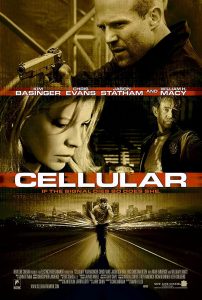
Cellular

I had a free afternoon and remembered I’d missed a couple of movies lately, so I took in a double feature this afternoon. (And for a change, I bought both tickets. Go, me.) One thing I don’t understand about movie-goers: what does it take to get them to laugh? I know you’ll hear laughter in a crowded theater when something funny happens, but once you’re down to twenty people or less, whether the movie is a comedy or a drama with tension-breaking dialogue, I find that typically only me and my rare company are the people who actually laugh at stuff. It’s very bizarre. All Village of the Damned-y.
Well, be that as it may, the first show of the day was Cellular. This is the heart-warming tale of Botox Barbie (played by Kim Basinger) who is kidnapped for the crimes of 1) owning a million dollar plus home in upscale Los Angeles on her high school science teacher salary and her husband’s real estate commissions, 2) Having a housekeeper and an alarm system on the same pair of salaries, but not having that alarm system go off if someone smashes the glass on one of the doors, 3) Despite having all of these perks on such tiny salaries, believing that the kidnappers have got the wrong person, and 4) Ensuring that her 11 year old son is the lamest kid in school by walking him to the bus stop every morning.

Luckily (well, for her), she hotwires a busted phone well enough to enlist the aid of beach bum Ryan, who has conveniently just set out to prove to his ex- that he can be responsible. He’s able to accomplish this in record time, running down the halls of a posh private school yelling for one of the kids to come out and trust the crazy man, carjacking $80k cars with alacrity rarely seen outside the Grand Theft Auto series, and line-cutting in phone stores at gunpoint.

Actually, as suspense flicks go, it’s pretty good. The plot holes are reasonably rare, the tension reasonably thick, and the gunplay/explosions reasonably compelling. Plus, you get William H. Macy for at least a good 1/6 of the film. This is a man who can bring gravitas to the act of wiping off a mud mask. Unfortunately for him, this role proves it.

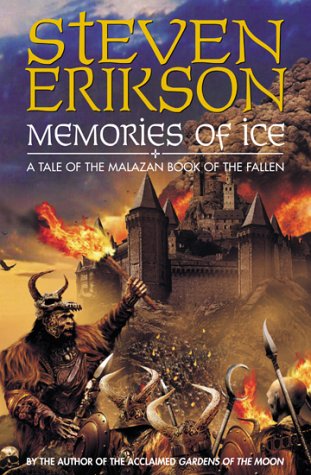
Memories of Ice

51B5H7HRP0LThe problem is, I’m about to gush here, and I don’t really want to, because who would take that seriously? Anyway, I decided to pick up Gardens of the Moon last year after seeing it praised so often on my Usenet hangout. And I gotta say, good book. I was confused for the first few hundred pages, and in some ways I still am, but it wasn’t a ‘story is incomprehensible’ confusion, just an ‘I know there’s a lot more here that I can’t see yet’ confusion. (The book is now being published by Tor, which means that it’s more available at a slightly cheaper price, but has worse cover art.)

I grabbed the next one a few months later, was a lot less confused, and by the end… wow. This Steven Erikson guy knows what he’s doing. I’m thinking that each of these books has its own enclosed theme, and that the theme of this one was sacrifice. Also, I’m thinking that he has, independently of whatever else he hopes to accomplish over the ten volume Malazan Book of the Fallen series, set out to become the definitive author of war imagery. There might be a better depiction of an army on the march through hostile territory, bereft of supply lines out there in the vast expanses of the written word. I know I haven’t found it, though.

And now, Memories of Ice. Both it and the second book, Deadhouse Gates, are sequels to Gardens of the Moon. As such, one could probably choose to read the pair in either order and not have the story spoiled. Of course, the reveal of his world’s secrets is linear, so a few parts of that aspect would be ruined. Most importantly, though, if book 2’s theme was sacrifice, book 3’s is redemption, and that’s not really the kind of thing that you’d want to get out of order, for fear of cognitive dissonance.

Although there are lot more familiar characters that have returned for this volume than for the previous, Erikson never stops introducing new ones. Characters that are almost instantly likeable and, more importantly to me, that are often instantly important to the overall story being woven. The problem is, characters die almost as often as characters are introduced. This is inevitable, though. The very title of the series demands a price in blood. What’s hard to distinguish, from an external perspective, is if the price is ever worth the gain. Don’t take that as a criticism, though. It’s almost always worth it from the perspective of the players, and that’s important. It’s only from my perspective, where characters that I like die to save faceless and often explicitly unworthy civilians, that the cost is high.

Speaking of war, Erikson’s grasp for the definitive this time is the siege. For about a hundred pages in the middle of the book, the city of Capustan is surrounded and assaulted by (of course) vastly superior forces. He put together a chapter that covers a straight 24 hours, in excruciating detail, while at the same time managing to convey the fog of war. And the horror of it; I will now digress for a moment. The soldiery is, for the most part throughout these first three books, very egalitarian regarding gender. As close to a 50/50 split of men and women as makes no difference. Erikson presented evidence of a female soldier having been raped by a male of the invading forces, and I had to do a triple take before I realized that the point they were making is that this kind of thing basically never happens. Brutal though that world is, I was impressed at how much more right they have it than we do, sometimes.

I have three complaints. One is that there’s a decided Fizban factor at work. It may not be the direct analog I was sensing early in the book, but until I find out exactly what’s going on, I’m going to stay annoyed by it. And quite possibly after I find out, if I’m correct. The second is minor, because it’s so brief. There’s a 5 page digression where a few of the main characters meet up with the army’s assigned painter (to capture the history and all, you understand) and his critic, a talking toad. It came from nowhere, and led almost nowhere. (There’s a slight bit of payoff loosely attached to my third complaint, but not enough to justify the jarring weirdness of it all.) The third… well, I’m not sure how to go into it while avoiding major spoilers, so it will go below the cut.

In any case, read these books. They’re each very long, so I can understand how they might seem like a slog if the first book doesn’t immediately do it for you, but there is some real payoff later in the series. And more to come; after reading this one, the titles of the next two (House of Chains and Midnight Tides) mean enough to me to expect more of the same out of the overarching story that ties it all together. And the quality of the writing is enough to expect more of that buttery goodness.
Continue reading

Sky Captain and the World of Tomorrow

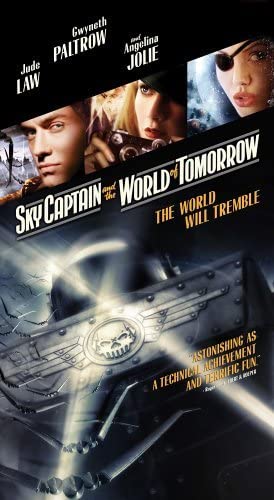
This is pretty much your average 1930s serial action movie, where the hero Joe Skycaptain and the plucky heroine, Polly Prissypants, join forces in order to stop the invading Germans^W Martians^W Killer Robots^W^W, well, the invading whatevers from generally making earth (by which we mean America, or maybe England) an unpleasant place, and globetrotting everywhere from New York City to Rivendell to do it.
What Sky Captain and the World of Tomorrow has going for it to set it apart is that it wasn’t made in the 1930s. Sure, it has a stylistic Metropolis look to it, and the watercolor look of a black and white movie that has been colorized. But it avoids the traps of hammy acting and a special effects extravaganza that would embarrass an avid Doctor Who fan.

Mind you, the special effects don’t make the movie. CGI has gotten just good enough that you can pretend it’s not there as long as the actors aren’t interacting with it. Since pretty much the whole movie outside of the actors is CGI this time, there’s a constant low-grade awareness of it. It’s very pretty, but it’s also very CGI.

No, what makes the movie work is a delightfully convoluted plot, well written (if a little salty for 1939) dialogue, and acceptable acting from the leads. Who, despite the credits, don’t include Angelina Jolie. Don’t get me wrong, that woman can still fill out an eyepatch like nobody’s business, but expect her turn as Major “Hot Lips” Houlihan to feel more like a cameo than worthy of the shared top credit she got. So, if you’re only seeing it for her, it’s not worth the price of admission.

If, on the other hand, you’re seeing it because you have a fondness for the unintentionally campy Buck Rogers and Flash Gordon of yesteryear, or if you want that last bit of popcorn before the Oscar-bait season swings into full gear, or just because you appreciate a gratuitous cow, then this is definitely the movie for you.

Pikmin 2

I wasn’t really impressed by Pikmin when it was first being advertised, but a guy at work loaned it to me, so I played it through. Turned out to be a lot of fun. Solidly in the real-time strategy genre, but disguised to look like a kid’s game. And better than most of them, because you have much more solid control over your troops than in Starcraft, say. But, it was also pretty quick, done within a week, so I gave it back and never got a copy myself. Fun is fine and all, but short is lame.

Except! Sometime in the past 3-4 years since then, my game practices have turned around, and I run out of patience pretty quickly now. (I have some fears about Grand Theft Auto: San Andreas in this same vein, as the reviews make it appear to be bigger than ever. And I didn’t quite finish Vice City.) So, when Pikmin 2 came out earlier this month, I leapt on it.

The gameplay is essentially identical. You run the little guys around killing big scary monsters (well, okay, ladybugs and frogs, mostly) and bypassing geographic obstacles in order to collect shiny objects that can be sold as artifacts on your home planet, thereby getting your shipping company out of hock. You’re limited to a set time per day, and must leave at night. On top of the strategy of building up the right forces for each task, the monsters will regenerate after a few days and the geography will too after a few more, so there’s the added strategy layer of how many days to stay in each area.

Changes to play include an unlimited number of days to play, randomly generated caves to explore, and two main characters to control the Pikmin, instead of just one. The first one doesn’t change play a lot; sure, you have time to be thoughtful and unhurried, but you pretty much had that during the first game. The caves aren’t as random as the literature would have you believe. Each one has the same treasures and creatures in the same order. The only difference is the layout of where these are placed on any given cave level.

Where the game shines is in the multiple player aspect. I’ve only played by myself, so all I can see is the glimmer of how useful two minds able to control two groups independently would be. The ability to control two groups on sequence is great, though. You can start a group on a task, then move back to another. It’s also a lot harder to accidentally leave any Pikmin behind. Also, I’m blathering, because this will be non-sensical to someone who hasn’t at least seen the first game. My point is, this is a boon to the strategic element game that cannot be overemphasized.

The rest of where the game shines is in the game world itself. It’s genuinely fun to watch and read everything that goes by. Fun enough that when I made a big flub on Day 10, I restarted and didn’t resent it. Fun enough that despite having played the end credits about an hour ago, I’m likely to pick up the controller and finish exploring every nook of the game that I can find, later today and over the next several.

Everything has a downside, of course. This one is in the save-game structure. You can choose to save at the end of every day, which is fine. You can’t have multiple save files, which is lame, but acceptable. (Technically, you can have up to three. This is designed for multiple players at the same time, but you can do copies and get up to three that way, if you really wanted to expend the effort.) The game auto-saves when you enter a cave and when you move on to each successive floor, which is terrible. You can auto-save or you can limit the number of save files, but doing both is ridiculous. This is why I had to go back and restart 10 game-days in, incidentally.

In any case, that’s not a game ruining flaw, and I would recommend either of these games to any Gamecube owner. It’s not quite good enough to buy a system for, though. Luckily, there are multiple Zelda and Metroid games released / planned over the next year to satisfy that issue.

Big Fish

mv5bodgyoteynjg0nv5bml5banbnxkftztcwmzy0ndcymq-_v1_I expected to digest this and figure something out in the morning. Only, it all came together in the last ten minutes, and I’m instead compelled to get it out now, before it loses the immediacy. Appreciate that, because I could be listening to the last 15 minutes of Loveline instead, which was my original plan.
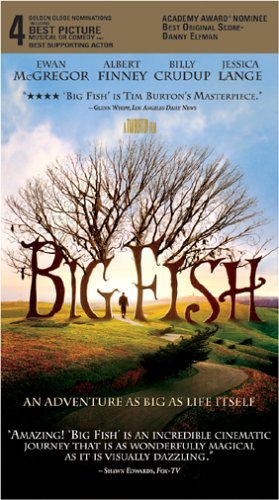
A synopsis will have you believe that Big Fish is about tall tales. In the last lines of the film, the scriptwriter (or it could be the author, but I haven’t read the book to know) will have you believe it’s about how stories provide immortality. Neither of these is correct. (Well, of course they are correct, but I get to say what goes here, and in this case, it’s all about me.)

Plotwise, the issue is that William Bloom is estranged from his father, Edward. After a few years of this, his father is diagnosed with terminal cancer, and William returns home to see him again and to try to know him better than he ever did as a kid or young adult. The rest of the movie combines his attempts with the stories his father has always told about his life, that William is trying to get through in search of the real truth. And that’s pretty much it. It’s better than that, of course, because the stories are both fun and beautifully filmed.

The movie is actually about that estrangement, though, and the attempts to heal it. Now, sure, I’m biased. I nearly lost my mother to cancer a year ago. I don’t know how near it was, but it felt very near at the time, and she’ll never be free of the monthly checkups to see if it has come back. And that’s what it took for me to work out in my head the differences I’ve had with my parents since I was a teenager.

The lesson Will learns is to get past all the stupid shit that has kept them apart and accept his father for who he is, who he always said he was, because all of the stories are true, even the lies. It’s a metaphor to all the estranged kids and parents out there. The stuff Will had to get past was all outrageously silly, but that’s the point. This is a caricature, but the truth is, it’s all stupid shit, and none of it’s worth giving up that part of your life. Once it’s gone, it’s gone.

So, here endeth the preaching. If you like the way Tim Burton films things, he did it again here. And it meshes very with stylistically with the tall tales, which makes sense; pretty much every movie he’s made has been along this theme. It was just never so explicit. If you like tall tales, then you should also see it, or better yet, read the book. Those kinds of things always work better told than filmed, even if Burton is good at it. If you’re avoiding your parents, then rent it and watch it now, if not sooner. Sure, most people have really good reasons why they’re staying away, and sometimes it’s valid and necessary, rather than the stupid shit I sweepingly generalized just now.

Watch it anyway, just in case.

Resident Evil: Apocalypse

mv5bmtc1ntuxmzk0nl5bml5banbnxkftztcwndq1mdizmw-_v1_sy1000_cr006721000_al_Mmmm. Zombies.

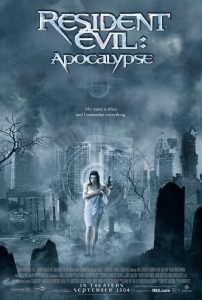
I’ve been waiting for this movie since the end of opening day for Resident Evil, when they left a big blatant hook for a sequel. And I waited. And I waited. Then there was a teaser preview that literally jerked my head toward the screen when I realized what they were advertising, but that was over a year ago. So naturally, when the time came, I ended up having to wait three days before I could finally go see it. Then again, this is a movie about dead people getting up and walking around, so maybe three days is appropriate.

I’m obviously a fanboy for both this kind of movie and for the Resident Evil console game series, so I’ll try to temper that. One thing I’m not a fanboy of is videogame-to-movie adaptations. I mean, I invariably go and see them, but then I almost as invariably bitch about how awful they were. (See Mortal Kombat or Super Mario Bros., say. Or more to the point, don’t. Really.) So I went into the original movie with lowered expectations, and was very pleasantly surprised by it being both an excellent zombie film in its own right as well as a pretty good adaptation; they avoided the trap of basing things too heavily on the game.

This time, as above, yeah, I had high expectations. And this time, they didn’t avoid the based on a game trap. Particularly, Jill Valentine and the Nemesis creature looked like they had been lifted straight out of the game. (The saving grace is that both looked perfect, not just like an attempt gone awry.) On the bright side, this is almost my only complaint with the movie. There was too much hand-to-hand combat for a scenario where being wounded by a zombie turns you into a zombie, and the combat they had was choppily edited.

Everything else about the movie was gravy, though. Good (if unoriginal) plot: Everybody is trapped in the city by the evil multinational pharmaceuticals corporation that fucked up and released an unstoppable viral zombie outbreak. The few survivors make alliances inside and outside the city in an attempt to find a way out. Meanwhile, an unstoppable mega-zombie (excuse me, biological weapons project) armed with a rocket launcher is stalking the people skilled enough to survive all the zombies and zombie Dobermans. Good acting, which is to say it was never quite overwrought with farcical camp drama, but also not overwrought with laughable attempts at real drama. And let’s not forget the randomly zombified topless dancers.

Basically, it comes down to the genre. If you like zombie movies, you should see this one. It’s a nice break from the remake mania that has plagued the last couple of years, even if it isn’t quite as scary as the first Resident Evil. If you don’t go for the particular zombie subgenre of horror, this is nowhere near enough horror movie to pull you in on its own. See Night of the Living Dead or Dawn of the Dead instead, as those are both brilliant character study pieces, with zombies merely as the backdrop. (Only original Romero will do.)

And if you don’t like horror movies at all, well, that’s just crazy talk. Honestly, I don’t even know what to do with information like that.

Added note for fetishists: No zombies were frozen in the filming of this picture.

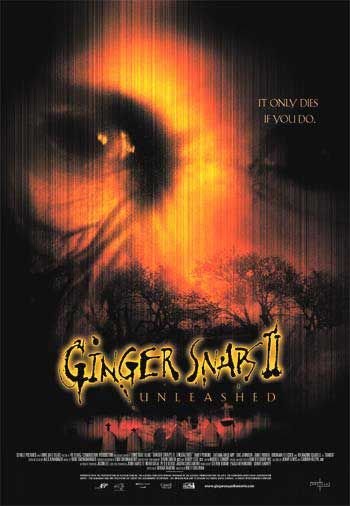
Ginger Snaps: Unleashed

MV5BMTgxNjI0MzQzOF5BMl5BanBnXkFtZTYwOTA3NDY3._V1__SX1859_SY893_Not long ago, I had the great pleasure of Netflixing a pretty decent werewolf movie in Ginger Snaps. Sure, okay, the metaphor of lycanthropy being analagous to puberty has gotten quite a bit of play in my lifetime, from Oz in Buffy to Michael J. Fox in Teen Wolf. And if you listen carefully, Lon Chaney’s voice breaks more than once in the original Wolfman. But Ginger Snaps had a lot going for it in the anti-charisma of its gothy stars, Ginger and her younger sister Bridget. Without going into the details, preppy cheerleaders were killed and snarkily buried (and their little dogs, too!), wolfsbane was freebased, and a couple of werewolves ended up dead.

Ginger Snaps 2 starts off about six months later, with Bridget hitting books and still freebasing wolfsbane (technically, a weaker related plant, monk’s hood) in a desperate attempt to delay or halt her seemingly inevitable transformation, while being haunted by a horny male werewolf and her demons from the previous flick. Things take a turn south when she’s found unconscious after the other werewolf attacks and is admitted against her will into a drug program for girls. She’s supposed to be only 16 or so, but I guess since her only ID was her library card, maybe they didn’t know she was a minor and that they maybe needed parental permission. (Also, it could be that her parents died in the original. I forget.) Despite these legal issues and the fact that her “drug” of choice is completely legal and available in craft stores, they hold her, and of course keep the needles and distilled wolfsbane away from her. The eventual outcome is predictable, but there are a few good twists after she is helped to escape from the facility by Ghost, a comics-obsessed little girl without any kind of drug problem who lives there for somewhat contrived reasons and has free run of the place.

Even though they were clearly going for the same older/younger sister relationship that worked to such effect with Ginger and Bridget in the original, it never quite gels between Bridget and Ghost. Likewise, the metaphor of lycanthropy to drug addiction fails more often than it succeeds. In recompense, the dialogue has the same occasional gleam of brilliance shown in the original, there’s more gore than last time around, plus a gaggle of teen druggies masturbating in a group exercise guided by one of the facility counselors.

If that isn’t enough to draw your interest (and who could blame you?), stick with the original. There’s also a prequel, just released direct to video. I’ll have it in a while, so I’d wait on that one, too.

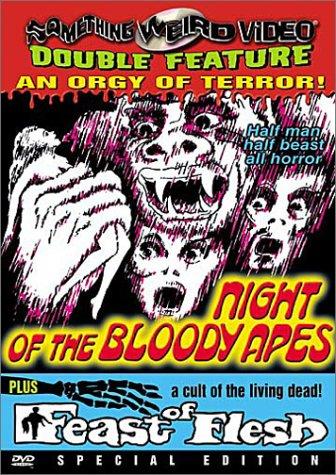
Placer Sangriento

mv5bmti5mjq1njiwnv5bml5banbnxkftztcwmtkzodeymq-_v1_A few months ago, the Alamo Drafthouse was showing Night of the Bloody Apes on the Weird Wednesday midnight show. I was all prepared to go and had talked Laylah into joining me, but she had to be on a plane the next morning and didn’t want to miss the sleep. Luckily, Netflix had it. Unluckily, she hasn’t had time to come over and watch since it arrived, what with the law school thing going on. But, in the meantime, I’ve watched the rest of the DVD, which included Feast of Flesh and a wealth of special features designed solely for me.

Lots of previews for movies far too bizarre to remember anything of. Four short subject films, including a burlesque of a stripper (eventually down to pasties and whatever passed for a thong in the 1950s) being carried around by an ape, a short of four topless chicks bathing with each other in a stream on film stock that would have embarrassed Zapruder, a female wrestling championship round announced by the most condescendingly misogynistic man I’ve heard in a really long time, and, um, a fourth one.

As for Feast of Flesh, it was your average Phantom of the Opera knockoff where the masked organ player stalks the 20-something party set on the beaches of Argentina, first hypnotizing young women in dated bikinis with his music (which, to be fair, had a haunting quality to it) and then overdosing them with heroin once they annoy him and leaving their bodies strewn on the beaches. And he might have gotten away with it, if it weren’t for those pesky cops!

The plot has nothing to recommend it; I was just barely able to keep my attention on it over the three days it took me to watch, and I’ve reconstructed some of the particulars from the imdb link above. It’s not impossible that I simply made up other details. If you can watch it and get a more accurate summary of what happened, then you’re a better man than I.

The reason to watch this, aside from the outstanding extras from a bygone movie era, is to laugh at what Argentinians and Americans considered shocking in 1963, including topless dancing girls, topless ocean swimmers (in all cases, the nudity can only be verified in slow-motion or frame-by-frame), bodies with large hypodermics sticking out of the chest, and lipstick lesbian volleyball players. According to imdb, that was enough to earn an X-rating in the United States. In any case, I’ve revealed every interesting point the movie has to offer, so unless you’re actually me (I’ve found that very few people are), give this one a pass.

A beginning, but with less wind than that

Once upon a time, which is to say back in May, I sent an email out to a few friends who wanted recommendations for something new to buy and read. I reproduce that email, largely unedited, here. For a few reasons: It hints at stuff I’ve liked to read over the past year or two, it gives me something to start with that isn’t very, very lame (you think I’m joking, but just wait until you see #2), and it gives me something to put in without much thought at this moment, since I’m also still neck-deep in getting the layout and functionality for the site that I want. At any rate, expect these not really to be actual reviews so much as tiny encapsulations of enjoyment.

Not that any of this matters to you people from a strange and mysterious future who will be reading it in the archives.
Continue reading