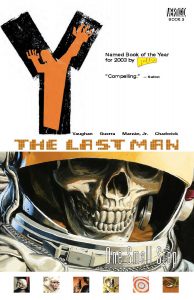
Y: The Last Man – One Small Step

The thing about nothing but graphic novels between now and next Saturday is that I’ll probably get through quite a few of them. Which means I’ll have a lot to do here. That’s not a bad thing, of course. Though sometimes I worry when I get all prolific like this that I’m just saying the same things over and over again. Probably not in this case, though, since the other stuff today was an action movie and a pretentiously dense allusion disguised as a book[1].

As for Yorick, his life goes on in the third volume of his epic tale of love and loss.[2] Being the most popular man on earth has drawbacks, though. Sure, you’re big with the ladies, but you get all that pesky negative attention too. So it is unsurprising that in One Small Step, rumor of surviving men in orbit around the earth brings a little bit of spring to his step. Nor is it surprising that his constant guardian, Agent 355, is less than pleased by the same sets of events. More men is a scientifically sound investment in the future, yes, but not at the expense of risking the one she has safely in hand to Russian spies or a platoon of Israeli soldiers. Yup, Yorick is pretty popular indeed.

Good story. Tied up a lot of loose ends. Maybe too many, because I have no idea where the story is going next. Sure, his sister is still somewhere out in the world waiting to gum up the works, and sure, they’re under the same basic set of plans from day one. Find out what happened and how Yorick and his monkey survived; find his girlfriend in Australia; save humanity from extinction. But the immediate plot is wide open now. Like I said, no more loose ends. At least for a little while. And the art has maintained quality. It’s simple, but very clear and fun to look at.

Plus, there was a nice two-issue story at the end, in very Sandmanesque style, about a troupe of traveling actors. Hardly any relevance to the main story arc, but it’s nice to get an idea of what the rest of the world is like, not just the world swirling around our hero. Because, after all, anywhere he goes? Things aren’t normal and everyday, pretty much by definition.

[1] That is not meant to denigrate, mind you.
[2] Okay, that was completely to amuse myself. And yet, it is technically a true description!
The Wizard

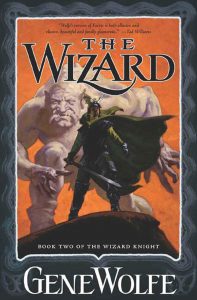
Gene Wolfe is an author whose work tends to exist right at the outer limit of what I can wrap my mind around. I swim through his novels, working to keep my head above water the whole time, and the nature of that effort leaves me with a limited perspective of the story’s surface from moment to moment. Not only that, but I’m aware of unplumbed depths of added meaning in a vague, unformed way; I guess I’m aware of it only to the extent that I can tell there’s a whole lot more happening that I’m not aware of. Possibly this all sounds unpleasant, and maybe it would be except for three things. The parts of the story I can grasp (a sizable amount of plot, bits and pieces of characterization, shadows of literary influences, and the faintest impressions of theme) have always been very entertaining; the prose is good enough to make mention of; and the parts of the story I can’t grasp exercise my reading brain. I’ll read the Book of the New Sun sometime again, and I’ll have benefited by that. Also, the Malazan series. (Which I’m sufficiently behind on now that I’ll probably need to start over. Oh, well.) Umberto Eco does this to me as well, but without quite as much enjoyability on the front end. I guess my point is that being challenged is cool.

However, it makes for difficult reviewing, because I don’t like to toss plot elements willy-nilly, and at the same time I have little else to reference right now. When I read The Knight last year, I indicated this same difficulty. Reading The Wizard was akin to leaving the public pool and taking a dip in the ocean. Which is ironic when you consider that water imagery was rife in the former volume. …and fire imagery as well. Whereas this one was much more about earth and air. So, hey, look at that! I figured something out right here in the middle of typing. Which would be cooler if I could attach some direct relevance to the revelation. But it definitely proves my point about the mind-exercise. Anyway, I’m going to see about minimizing the self-satisfaction and getting back to the review, now. I trust this will be taken kindly by all six of my readers.

Sir Able’s continuing adventures in Mythgarthr and its surrounding realities have expanded from faeries, knights, and dragons to include giants, angels, unicorns, Arthuriana, and the Norse pantheon. As difficult to integrate into my understanding of the world as these were, the (at first glance) simple plot was harder still. The first half of the book is the story not of Able, but of his companion squires and knights. The emerging lesson of the section seems to be that we are not what people call us; we are what we are, whether people call us such or not. But people will tend to call us what we are. For example, Able is a knight because he determined to be so and lived his life that way, not because anyone dubbed him or acknowledged him. Despite that from his first appearance in the book he refuses to use any powers , Able is called a wizard now by all who spend time with him because his inner reality shines through. These examples together with a spoiler from later in the book make me pretty confident that this sometimes struggle and sometimes congruence between what is and what is perceived is another important theme of the story. But again, just because I can see it doesn’t really mean that I’ve yet been able to plumb its depths and understand the buried point to it. Which, amusingly, is kind of a mirror of the theme right there.

I said it at the beginning, and I’ll say it again. Hard books are cool. Which is not an excuse for the incomprehensible mess of the previous paragraph, but it is an explanation of sorts. (Seriously. I’ve edited a lot, and well, to get it to what you see now. The original would have made you weep with frustration.) So, yeah, they’re cool, but they’re also hard. Thus, by executive decree, it’s going to be all graphic novels from now until Harry Potter.

Live Free or Die Hard

MV5BNDQxMDE1OTg4NV5BMl5BanBnXkFtZTcwMTMzOTQzMw@@._V1__SX1537_SY747_Hard to believe, but true: once upon a time, the modern action blockbuster didn’t exist. Armageddon? Deep Impact? The Rock? Time was, those movies didn’t get made. Sure, Star Wars and Indiana Jones were contributing factors, but they were more about the summer blockbuster. As far as the action version, you have to go back to Christmas of 1988. There’s this wise-cracking cop in an office building full of terrorists, and stuff that blows up, and Beethoven’s Ninth playing. And sure, that’s yawn-worthy now, but the writing and the acting for Die Hard still stand up, despite decades of mostly pale imitators. (Also, it’s the first time I was aware of surround sound in theaters.) And then it had a couple of sequels. Which were fine and all, with the explosions and the wisecracking, but they never really stood out to me in the same way.

Now, however… here’s the best way I can explain Live Free or Die Hard. The people who wrote it and filmed it were people who also think Die Hard was the definitive action movie, and they wanted to make a sequel worthy of the name. Sure, the action is over the top. It’s supposed to be, it’s an action blockbuster. But it’s not over the top in such a way that you find yourself wondering how we’re supposed to believe anyone could ever do that stuff. (Like, say, Rambo sequels.) There’s definitely one sequence that is over the top; I rolled my eyes pretty hard. But John McClane is never superhuman. He’s tough, and he’s luckier than his fair share, but mostly he’s just taking his only option and running with it instead of giving up, and that guy? That guy is pretty much what heroes are.

Also, the plot is more of a sequel to the original than either of the other sequels. I know that the third one was specifically about a guy who wanted revenge for Alan Rickman’s untimely demise. Even still, the fourth one is a much better sequel, plot-wise as well as thematically. Now that everyone in the country who isn’t me has seen the Transformers more times than you can shake a pointed stick at, I say go see Die Hard 4. Unless you didn’t like the original for some reason? That would be weird, but you won’t like this one either, in that unlikely case. Otherwise, you should be golden.

And I’ll go contritely see the Transformers. Because at this point, I’m kind of an embarrassment over here.

Disturbia

MV5BMTMyNTIxOTQ3M15BMl5BanBnXkFtZTcwMjU2NzAzMw@@._V1__SX1217_SY911_So, Rear Window, right? One of those classic Hitchcock horror movies that scared people who lived in the black-and-white world, because it was entirely too plausible for their tastes, unlike such fare as Them! or It Came from Outer Space. Which, okay, possibly these people have a point, I guess. But also because the writing and direction were so wonderfully tense, about which the people definitely had a point.

Back in the spring, along came imitator Disturbia. Troubled teen Shia LaBeouf (soon to be famous for his role in Transformers, natch) is under house arrest. See, his dad died, right?, so he’s been having a bad year, and then his Spanish teacher, well, provoked him. Probably unintentionally, but we’ll never really know since his motivations are not explored. That’s okay, though. It’s a pretty minor plot point, except for the part where it sets up the rest of the film. Because now Shia has an ankle bracelet that keeps him confined to his property. This is a bummer, because his XBox account got canceled by his mom, a hot girl just moved in next door, neighborhood kids are tormenting him and then running away, and also because the guy in a house behind him seems to fit the information being provided in the media as a serial killer from Austin who, if it’s the same guy, has already kidnapped at least one person locally. All in all, it’s not the best summer to be trapped at home.

On the bright side, at least the girl came over to visit. But really, that just results in her (along with Shia’s mom and his best friend) getting entangled in the paranoia surrounding the neighbor. And that’s what makes the movie work. Whether he did or didn’t serial-kill all those girls is barely the point. It’s all that voyeuristic paranoia and how it affects people and what they decide to do about it. Because, up until the point where you take a sledgehammer to the interior walls and a shovel to the basement and back yard, he’s still Schrödinger’s serial killer, and it’s probably not cool to send people to tail him while other people break into his car and steal his garage door code. (Or, for that matter, take a sledgehammer/shovel to his property.) So, that’s good moralistic tension to drive a movie with. And then on top of that, I think it has a win over Rear Window, in that the hero of that movie was wheelchair-bound. Shia, on the other hand, is only bound by the law. In a very real sense, his imprisonment is by choice; he can cross that invisible line at any moment and take things into his own hands. But only if he’s willing to face the consequences of that action. That’s just a lot better piece of character tension than ‘if only I could get down these stairs; but I can’t!’

Simply by virtue of being a worthy successor to Rear Window in the tension-ratcheting department, it would be worth a Netflix (or, like me, dollar movie visit); what with the aspect that managed to top Hitchcock, watching this one at some point is pretty much mandatory. So, y’know. Tick-tock.

Fantastic Four: Rise of the Silver Surfer

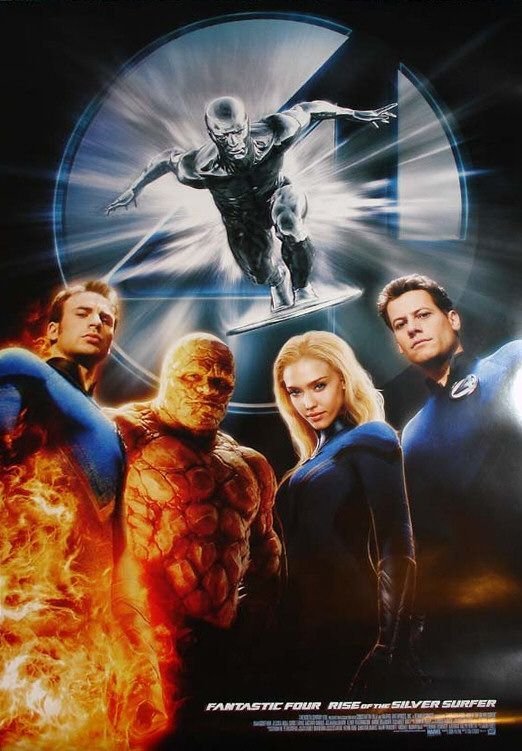
MV5BMTgxMDc2NzA4MV5BMl5BanBnXkFtZTcwOTI1NTY0MQ@@._V1__SX1859_SY847_So I went ahead and saw that Silver Surfer movie my own self, which probably anybody could have predicted. For people who have not read the Fantastic Four comic any time in the last forty plus years (e.g., me) or for people who don’t know any comic book fans who have done so and would be not so much thrilled as actively compelled to explain it to you from that perspective (this one, not so much me; but someone, surely!), a plot synopsis.

So, the Fantastic Four are this public superhero team who, you know, save New York. And probably other stuff as well. But mostly New York, because despite the presence of Spider-Man, Daredevil, and the close proximity of the X-Men, it still doesn’t have enough saving going on. (Plus inevitable others of whom I am unaware. Iron Man, right?) And they’re doing their bicker and save New York and maybe get married thing, living out their everyday lives, when this silver guy appears on a surfboard. From space. Which sounds pretty cool, and probably would be, except he’s kind of a dick. To cite a couple of examples, he’s altering peoples’ genetic make-up with his cosmic radiation and digging these giant bowling ball finger holes into the earth, because he’s the Herald of Galactus. Galactus is a giant humanoid in a purple helmet who likes to eat planets. Except, because pretty much everyone realizes that would look exceptionally stupid on a giant movie screen in 2007, he’s a floating cloud full of energy and lightning and stuff. Like V-Ger, but less our fault. So now instead of bickering and maybe getting married and saving New York, they (the Fantastic Four, our nominal stars of the story, right?) have to save the world from being eaten and/or used for a frame of intergalactic ten pins. Well, and bicker, and maybe get married. (Not all of them, as comic book world is not so enlightened as to allow semi-gay or possibly polygynous marriage. Just Mr. Fantastic and the Invisible Woman. Also, since Johnny Storm is her brother, there are incest problems as well. I’m just saying, maybe in this particular case, comic book world has a point.) Also, Dr. Doom (he’s the bad guy from the first movie) is trying to swing this whole devoured planet thing such that he gets more power. And, one supposes, a new planet in the bargain? Because lots of power but floating in the vacuum of space seems like kind of a win/lose.

It was pretty cool. Tightly paced, not hampered by trying to squeeze a complicated origin story and a climactic battle sequence into the same 90 minutes, pretty, funny, and just on the whole entangled with a factor of coolness. Sure, it was no Spider-Man 2, but what is? It definitely topped Spider-Man 3. Now, we pause for two or three years while the writers try to come up with a new way to get Jessica Alba comically naked, and then wrap a movie around it. (I know that sounds a little derogatory, but only if you think that I disapprove of Jessica Alba themed nudity.)

1408

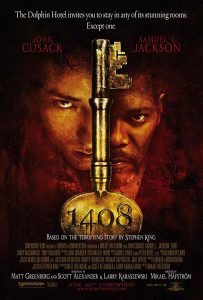
Stephen King novels that are adapted to film result in movies that are often, well, not very good. His short stories, however, turn into movies that tend to be pretty awesome. Most of the ones I would name just aren’t very horror-y, though, so maybe the problem is in the genre rather than the size of the adaptation? In the good news for people who have taken the bull by the horns of this particular dilemma department, 1408 came out a couple of weeks ago. John Cusack portrays a still popular but objectively washed-up author of scary-themed guidebooks (10 Terrifying Cemeteries, for example) who himself has long concluded that the paranormal just isn’t out there to be found. But he still has bills and deadlines to think about, and when he receives an anonymous tip that room 1408 of an upscale hotel in New York City would be worth his while, he naturally follows up.

In the novella, what follows is a Lovecraftian masterpiece of nightmarish hallucinations and gradually eroding sanity. The movie is a touch more straightforward than all that, but not in a way that bothered me. Mostly because the changes gave Cusack’s character a little bit more of an arc to grow into; the story was a lot more about the experience than the man having it. Although I found myself missing some really good interactions with the telephone that were kind of the essence of Lovecraft’s contention throughout his entire body of work that everything in the world is the enemy of mankind, biding its time and conspiring to remove us from the face of the Earth, the elements of the story that stayed in were more than good enough to keep me happy, and the acting was solid throughout. (They maybe could have removed or altered the scene in the mini-bar, but you can’t have everything.)

On the whole, it was that rarest of creatures, a horror movie released in the summer that’s actually scary. Plus, who doesn’t love Samuel L. Jackson? I say go see it. I will provide fair warning, though: there’s a scene that will make you, if you’re anything like me, want to walk out of the theater. You should ride it out, though, because things get better again. I promise. I think I need to watch more movies, though, because at the moment I’m quickly falling behind. Maybe someone has seen that Fantastic Four sequel by now, I guess? Any good?

Girls: Emergence

I’m reading pretty fast lately, I guess? Must be, if I’ve already gotten to Emergence this soon after reading the first Girls graphic novel. You may recall that the little town was trapped behind an impenetrable wall with a multitude of dangers around every corner. For example: a growing number of naked clone girls who have a very specific purpose in mind for every adult they meet. The other example I would name offhand still feels like too much of a spoiler to reveal. But it’s really something to see, I can tell you that. And as the dangers grow and more people die, those who remain are failing to really grasp the fundamental nature of their situation. Until they can learn to stop turning on each other, they’re pretty much doomed. On the bright side, they’ve got two books left to figure it out. Or better yet, to start dying off more rapidly so that the story narrows its focus back down onto the handful of characters that I’m actively interested in. It was suggested to me that I would find myself annoyed at some of the bad choices they make, and that’s been absolutely true.
Really, though, I’m okay with this stuff. The beauty of the horror genre is that, on average, whoever you find yourself annoyed with for acting stupid is going to pay for it with his or her life before very long. What I’m still not okay with is the art. All of the backgrounds and animals are quite good, and yet the people leave a lot to be desired. As before, I find a lot of my time is spent trying to figure out who is which; maybe I’d have investment in more than about five characters if I could tell them apart. But the rising death toll has helped out there as well, so yay?

This would make a really good sci-fi horror movie, as long as it doesn’t go terribly wrong plotwise. And with one notable exception, it wouldn’t even require that much of an effects budget. So that would be pretty cool. I’m ready to watch it now. (Well, not right now. But if I heard it was coming out, I’d finish the series right quick so as to be ready. So don’t delay production on my account; I’ll be fine.)

Dune Messiah

Wow. For such a tiny book, this thing is just jammed full of thought-provoking material. As you will doubtless remember, Dune left me a bit flummoxed. And at the end of Dune Messiah, I’m still not a lot closer to understanding the political and social forces that resulted in Paul Atreides becoming Emperor of the universe and his Fremen warriors unleashing Jihad upon that universe. For one thing, I don’t really understand either the religions being supplanted or the religion doing the supplanting to any real degree. But I’m starting to think that all of that is just background noise and only of minimal relevance.

There are several forces at play. The Fremen wish to continue their bloody holy crusade across the galaxy. The business interests, the Bene Gesserit, and the family of the fallen emperor want to restore their rightful places in the scheme of things, which is to say back on top. Paul wants to live out a life of peace and love and not be remembered as the man who unleashed the worst atrocities in history; and to his credit, he wants this not to be true more than he wants to modify the perception of the events. Then there are the lynchpin characters around whom all of these elements are turning: Chani, Paul’s Fremen wife who wants only his happiness regardless of what comes of the rest; Alia, Paul’s sister who wants that as well and the same for herself, even if she’s too blinded by the godhead that has been thrust upon her to fully realize it; and the being formerly known as Duncan Idaho, Paul’s teacher in his previous life and now shaped by fate to play as his Judas, who wants above all to know who or what he really is.

See, and that’s what’s cool about Messianic stories. At root, they’re the story of individuals. Once it becomes a story of a god, or even a story of one who is destined to be a god, the point is already too muddied. The huddled masses use gods for their own purposes. They always have, and the indication for this particular future is that they always will. Instead, then, Frank Herbert presents the story of two men hemmed in on all sides by fate and the choices that they make to escape that fate, or at least minimize the damage to everyone around them. There are two things I’m sure of after reading this. I’m going to have to read the Dune books again once I get through to the end, as it’s been a fair while since I’ve read sci-fi that was also fully literature. And I’m going to have to read the gospels again, because I’ve never viewed Jesus through the lens of somebody making the best of an impossible situation before.

Ocean’s Thirteen

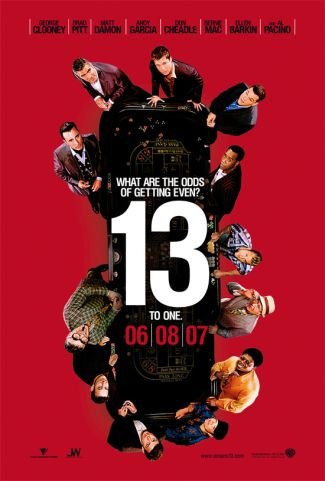
The plot of Ocean’s Thirteen is one that resonated strongly with me. Elliot Gould portrayed a man who was confined to his bed by a devastating illness. Initially hospitalized, he’s eventually released home, but even there he’s lost in a fugue state, catatonic to everything that is going on around him. It’s as if, in the midst of a whirlwind of life, he’s frozen and unable to interact in any meaningful way. It’s a bad way to be. Okay, admittedly I’ve merely been ill for a week while he lost millions of dollars and had a heart attack thanks to Al Pacino’s diabolical plotting; still, though, I feel like we shared a common bond throughout my watching the movie, Elliot Gould and I.

Danny Ocean et al, having learned of their friend’s dire straits, immediately embark on a masterful plan to shatter Pacino’s empire as well as his pride. Sure, a lot of money is there to be stolen, but the payout isn’t the point this time; it’s all about revenge. The only flaw this one can boast below the so-fine original is that the twists were somewhat more predictable; Ocean’s Twelve has been left in the dust. There’s not really much I can say here that’s not a spoiler, though. You know there’s a fiendishly complex plot to rob a casino, right? The rest is the nuts and bolts details, and that’s where the movie shines. You get to watch eleven twelve thirteen people who are far cooler than you personally will ever have a hope of being doing things that you would be arrested for merely thinking about. (Well, it’s more like five people who are cooler than you and a bunch of other people who fill niche positions. But the cool ones more than make up the slack.)

It is both awesome and hilarious is what I’m saying. Given that you enjoy the cinematic experience to any degree, why haven’t you seen this movie yet?

Hostel: Part II

I had a seriously hard time reviewing the first Hostel, too. That time, I think the problem that was it was entirely plausible from start to finish, so it was hard to criticize any part of it. And since I try not to go the spoiler route, there wasn’t much left to present but vignettes. Hostel II is less plausible, although still quite good. Where the first movie had an underground torture-murder society that operated out of a run down factory and advertised to the wealthy via fliers, this one has an elite internet bidding system and an impenetrable fortress with five different kinds of security that I can think of offhand. Which, while good for the wealthy murderous clients, is unfortunate for potential sequels. There’s a fine line to be tread between knowing good guys will survive and knowing they won’t; at the former extreme, the movie is too predictable, and at the latter, it’s too oppressive.

Anyhow, despite these sequel-destroying differences, the movie is basically a duplicate of the original. Which is exactly how a horror movie is supposed to work, so this is definitely a point in favor. Instead of a trio of guys in search of easy European sex, our hero-victims are a trio of girls in search of relaxing European mineral spas. And instead of a bunch of cardboard cut-out bad guys and a two-dimensional antagonist, we have a two-dimensional mastermind and a couple of fully realized antagonists. So, less nudity versus a deeper plot. And you know, until I put it like that, I was thinking that this marked an improvement in the overall experience. Man, that would have been embarrassing.

It was a good movie and a worthy sequel. Its main flaw is one that is unavoidable in almost every horror sequel (and most first movies, for that matter) ever made: not enough real tension. The majority of the tension that drove the original is necessarily removed from this one due to the lack of novelty. On the other hand, there was a scene in which Anne Rice bathed in the blood of a virgin. You have to admit, that’s pretty cool!