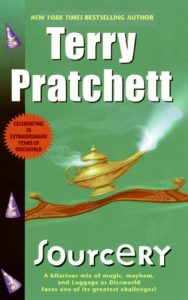
Sourcery

It’s been a while, here. Not for lack of reviewing, but my consumption has dropped dramatically, and I have no idea why. Don’t expect it to last. (For one thing, there’s another Horrorfest in November.) There’s no good excuse for the lack of movies, though, and the lack of books is part of the topic at hand, so onward!

After months of failure at finding it used, I gave in to the Amazon gold box and picked up the fifth Terry Pratchett book, Sourcery.[2] Upon cracking it, however, I took forever to read it. I’ve been pondering this for a while, and the best explanation I can come up with is that, well, it wasn’t all that good. I mean, it was frequently giggle-worthy, but I didn’t feel like I was reading a funny book. It wanted very much to be epic, but kept getting tripped up by trying to be funny, or derailed by the introduction of each new non-wizardly character, almost none of whom impressed me over the long term and none of whom seemed to actually accomplish, well, anything. They were funny sometimes, sure, but if they had never appeared again after Rincewind left them, the plot would have been hardly different at all.[1]

All that kvetched, I have gained a solid appreciation for Rincewind himself that was missing before. There was a theme all through here, about being true to yourself and about how badly things will go when you don’t. And it was a good theme, of which Rincewind was the ultimate realization. In addition to which, the more he was onpage, the more epic the plot seemed to be. Like I say: I never really got him before, as anything more than a silly little man who is terrible at magic. But that has all changed, and for much the better. I’m a bit sad that, now I finally appreciate him, he probably won’t be in the next several books.

Still and all, I liked Mort a lot better. But I’m glad that Discworld’s scope is expanding, as that promises to make up for a lot.

[1] Not entirely true, but close enough for the amount of pages they were given to get there.
[2] Interesting note: Before I grabbed the book for the first time, I had no idea what it would be about. Thusly, I had a failure of pronunciation. This is Sourcery as in “source of magic”, not as in “sourpuss sorcerer”. And now you know!

The Invasion

I believe that I am once again caught up on my horror movie quota. I mean, The Invasion is in actuality a sci-fi suspense thriller, but once you go longer than two words in a label, people lose interest, and so here we are in the land of miscategorized video shelves. (Except that since people no longer go to video stores, we’re in the land of miscategorized Netflix category links. Except they probably go ahead and categorize movies correctly, being who they are. But I digress.)

Space spores land on earth and jump into someone’s blood stream, re-writing his DNA in such a way that he loses many of the characteristics that we commonly consider human and is driven to reproduce the spores and introduce them into everyone else on the planet, the end result being that strong emotions will be eradicated, and along with them war and atrocities. But also passion, of course; what they’ve got is an infectious version of the Pax. It’s very much a remake of Invasion of the Body Snatchers, lacking only pods and Kevin McCarthy. (Though they did snag a female lookalike to restage his climactic scene from the original film.) Throwing a monkeywrench into the sporified plan is psychiatrist Nicole Kidman, who leads a small group in a quest to save her son, escape from the people who are no longer who they are, and maybe find a way to cure the rising tide of non-humanity. I could make jokes about how practically everyone in the cast is required to either act wooden and unemotional, or else act like they are acting wooden and unemotional for the purposes of fooling the former group. But the jokes pretty well make themselves, so I will not.

It was a perfectly serviceable thriller, making up in car crashes what it lacked in explosions. It was very nearly an excellent example of that perennial science fiction question, “What makes us human?”; it presented humans with all their flaws and their strengths, and it presented an alternative that was disturbingly non-human while at the same time debateably an improvement on the mold. But before I could start to actively consider the question, they cheated and removed it from the table. Coming so close to doing something that right has left me feeling disproportionately disappointed relative to the quality of the rest of the movie. A specific explanation resides below the spoiler cut, for the willing.

Continue reading

The Kindly Ones

1563892057.01._SX450_SY635_SCLZZZZZZZ_I spent about a week reading a book that should have taken me maybe two days, and all because I was trying to avoid its end. It’s just, I’ve read Sandman before, and I knew how The Kindly Ones was going to come out. But despite the fact that the reveal at the climax of World’s End had already sealed said outcome, and despite the fact that probably books don’t change themselves around to tell different stories while I’m not reading them, I’ve spent all week hoping that maybe I’d get to the end and it would be different after all. There’s no need to keep you in suspense: for this time, at least, it was not.

The Kindly Ones is structurally and all but literally a Greek tragedy, and between that reveal I mentioned in the previous volume and recognition of the structure, the outcome will be as inevitable to anyone reading it for the first time as it was to me on this, my first reread. It’s a skillfully constructed piece of fiction, liberally flavored with themes of loyalty and duty throughout. And, of course, revenge. All Greek tragedies are about revenge, though. About revenge and about causing, through one’s own actions, exactly that which one was trying to prevent. Loyalty and duty and revenge and directed irony. And unrequited love. And all manner of other things that also go right to the heart of what it means to be human. I guess what I’m saying is that it impresses me that either 1) we are so strongly affected by the literature of our millennia-gone forebears or 2) that the people who were creating some of the earliest literature of which we have record already understood the things that affect people the most. Or 3) that my flaw as a reading enthusiast is being all Western-centric without even realizing how narrow my view is. But let’s assume it’s not that one and move on.

I respect the book for what it accomplishes. I hate it for how it turns out. But the entire series is about the act of dreaming and the nature of dreams and the ways that they can make people better than they ever were (and sure, the ways they can reveal people as worse than we could ever imagine, too; we’re still talking about human people, after all). And so I love the book too, because it lets me believe that, like a recurring nightmare, the next time I experience it still might come out differently than it did this time. Really, how many books have that kind of power?

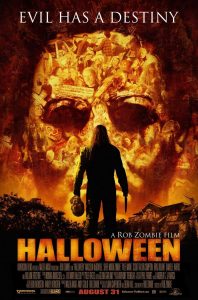
Halloween (2007)

[Note: I’m not concerned about spoiling the 1978 movie, because, come on. but I’ve found it impossible to discuss the remake without going in depth, so below the cut, expect heavy spoilers.]

How do you remake a practically perfect horror movie? You don’t change things around to suit yourself, and you make sure to have some kind of hook that explores something that’s never been explored before. If those sound contradictory, well, I maintain that they are not or at least don’t have to be. For a completely random example, Rob Zombie’s Halloween remake: it has to include a scary kid who killed his whole family; then was placed under the care of a psychologist for 15 or so years, who became obsessed with him; then broke out of the sanitarium to find his baby sister, who has no idea that their relationship exists. While hunting her, he has to be confronted by sex-crazed teens over and over again, so that he will kill them in re-enactment of the murder of his older sister. The scary kid, his doctor, and his sister have to come together in a deadly climactic confrontation. Maybe it’s formulaic, but it’s a pretty good formula, and one that John Carpenter all but invented.

Continue reading

Tempest

imgresI just finished the third Legacy of the Force book. (Yes, already. No, the next one won’t be Star Wars. Honest. Probably the one after that, though.)

Anyway, though, it was really good. The villain of the piece keeps getting darker, in interesting and often disturbing ways. He’s become very skilled at hiding his worst acts, which is nice. Because, a few times I’ve had trouble believing that all the people around him are able to let him proceed unchallenged, but everything he shows to the external world looks principled and only occasionally flawed, instead of the actively ruthless and all but evil decisions they truly are. So, one thing I’m enjoying about Tempest is that dance in which suspicions are raised and deflected, former friends are manipulated and attacked and then those actions are barely able to be justified. He doesn’t have much time left under cover, our aspiring Sith Lord, but I’m pleased by that too, because the thematically appropriate moment to turn the shadow play into an actual war is nearly upon us.

Even better than all that, though, the final third of the book played like the climax of a Star Wars movie. Daring escapes through deadly space battles, lightsaber duels that would easily transfer to the screen, and the John Williams themes thundering through my head on continuous loop. These things were missing from the previous novels, and as strongly characterized as they were, I knew I was hurting for something. I hope the step up can be maintained; if so, this is going to be better than the previous Yuuzhan Vong storyline, and with room to spare.

Spoiler character thoughts behind the cut.

Continue reading

The Walking Dead: The Heart’s Desire

My zombie serial has become a soap opera. (Although in the historically literal meaning of the term, that’s still not true. I can at least still count on the zombies to be rotting, putrid shambles of people who are completely unbathed over the past year of their new existences.)

But seriously. The Heart’s Desire is chock full of people cheating on each other and dudes having fistfights and mysterious drifter chicks who talk to themselves as though they were communicating with someone a long way off, except for the lack of apparent technology. (The only soap I ever watched is Passions, so it’s possible that last thing will strike some readers as unusual; but it completely fits my experience.) Sure, Rick Grimes and companions continue to struggle with what it means to live their lives morally in this dead new world, so it’s got good philosophy mixed in. But it’s completely missing plot, just like the second one was. I liked the character development, don’t get me wrong. But probably not as much as that time, which made the plotlessness stand out more. On the bright side, Volume 5 promises to return to form. I mean, based on the pattern so far; I haven’t cracked it open to check, or anything.

Preacher: War in the Sun

51Q1siZNCoLIf there’s a theme in particular, I guess I missed it. But War in the Sun has a heaping helping of plot and character arc, so I can forgive certain other lacks. The sixth volume of the Preacher series opens with a look into the backstory of dickhead antagonist Starr, leader of the shadow organization that wants to use Jesse Custer as a figurehead to distract people while it achieves global domination. That out of the way, events quickly spiral out of control when Starr, Jesse and his companions, and the Saint of Killers meet in Monument Valley for an explosive confrontation that, unless I miss my guess, will have echoes throughout the rest of the series.

At the very least, all of the major characters have reached the nadir of their respective emotional arcs. (Even Arseface, who is inexplicably still present in the story. And, well, not including the Saint of Killers: I expect his happened rather longer ago. Anyway, he’s more a force of nature than a character.) All that remains is to see how and if they can recover as the storyline starts moving into climax mode. I, for one, can hardly wait.

Bloodlines

51vYDOXEpILHave I been going crazy with the Star Wars books? Apparently! And I doubt I’m likely to slow down much anytime soon, despite an intention to space them out at least minimally. It helped for this one that I spent a solid day at the airport, of course. It would have been only a bit over half a day, except that I traded my seat on a plane for a free round trip voucher. That kind of behavior is, of course, completely awesome, because it means I get to fly somewhere else now, but for free. And since I seem to make quite a few of these trips, that is definitely a good thing.

Also a good thing, though, is having a Star Wars book to read while sitting around the airport. I mean, if it’s a good one. But it’s cool, because Bloodlines was. There was plenty and more involving the brink of civil war and the growing Sith menace I mentioned regarding the last book, about which more later; but the story the author really wanted to tell was a familial yarn about Boba Fett and his family. (Apparently, he had a family once aside from his father, which I was not previously aware of either, and yes, the extended universe authors brought him out of the Sarlacc alive years and years ago. (And if you don’t know what that means, then probably the book and the review alike are not for you. But it does have good themes, nevertheless, about which also more later.)) Said yarn is reasonably decent, but largely uncompelling outside the greater framework in which it was placed. Inside that framework, which has Fett’s family in microcosm, the galactic “family” in macrocosm, and the Solo-Skywalker family in, um, cosm all three parallely coming apart at the stress-ridden seams and for the same basic reasons, well, it’s damned compelling indeed. And just like in real life, for contradictory reasons at that. Putting on blinders to protect yourself from seeing who people really are, but also ascribing antagonistic motives to people too easily; taking the easiest path available without addressing the hard questions at the core of it all, but also being so paralyzed by trying to address hard questions that the easy solutions slip by; failing to account for the impact our past has on our future, but also focusing on the past too closely to keep track of the important things in the present. Which is all vague and high-handed frippery, really, but I like a book that makes me pause and think and also want to shake the characters to get them to see sense. And I especially like a book that lets me accept that sometimes sense isn’t there to be seen: that senselessness happens too, and all we can do is start getting ready to pick up the pieces after the storm has passed.

Yeah, and I didn’t really plan to write any of that. There was the “family in crisis” parallels, and after that I was done except for this one last thing. But apparently I liked the book better than I thought, if all that came spilling out. So that’s cool. But mostly, I wanted to talk about the Sith bit. As much as I liked the tragic fall of Anakin Skywalker, the one thing this series is excelling at is schooling George Lucas in what it means to write about Star Wars. Because these three authors (well, admittedly only two so far) are going above and beyond on providing a plausible Sith conversion. For Anakin, certainly the Jedi worked very hard at pushing him into the position he found himself, but without a huge gaping flaw in his character, the Sith Lord could never have won him over. But <spoiler averted>’s story is completely different from that. Every individual step taken has made sense rationally, and most of them are even steps I would have agreed with. There were a couple of obvious blind spots where selfishness trumped rationality, but even then, it only caused a bad but rational step, not a truly irrational one. Admittedly, I’ve been troubled by aspects of the character in question for about the previous ten books, but it’s really impressive to behold a basically likable character transform into a disturbing sociopath over the course of just two books, during which I agree with the majority of his individual actions. The upshot of all of which is, this is going to be a really ugly and disturbing story, before it’s all over. But also probably very good.

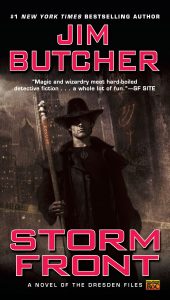
Storm Front

By right of expectation, this should be a graphic novel review. I’ve been pretty darn faithful about the alternating thing, and such. But then I went on vacation, in which there was a beach, and more importantly, an ocean. Also there were friends and children and laughing and a board game. And also, because I live inside myself so much and it’s worthwhile to reiterate the things that really affect me, on a bone-deep level, there was still an ocean. She had waves and a loud voice, and we had a friendly tussle in which she made sure to show me she could kill me at any moment without a thought, but that was only momentary and to demonstrate who was who; like I said, it was friendly. And just for me, flying in the face of all established knowledge on local weather patterns, she put a storm on the horizon.

If I wanted to get all cute and literary, I could use that as a segue into discussing the razor’s edge that Chicago wizard Harry Dresden lives on, between doing minor readings and finding lost objects for people and working freelance for the local police department on the stranger deaths, providing them with nudges of information here and there about things they don’t and couldn’t understand about the demonic underbelly of their world on one side of the razor, and on the other, that selfsame world of demons, black magic, monsters under far too many beds, and a council of wizards in charge of policing it all and keeping the bad guys at bay or even dead, which would probably make up for a lot of the badness if only they didn’t have reason to believe that Harry Dresden himself was one of those bad guys who they need to be poised to take care of after just a momentary magic-ethical lapse on his part. Magic is an ocean, I’d say, both wondrous and deadly by turns. Luckily, I have no interest in that kind of high-minded pandering to the gods of metaphor, and just wanted to mention what a great vacation I had, and how much I love the ocean and kind of need a permanent private beach that I could go to whenever I had the urge.

All that said, the image does have pretty good legs, especially when you consider that the incoming Storm Front is what marks Harry’s first real challenge. I mean, besides the ones in his mysterious and barely scratched past, of course. Also, ha, “pretty good legs” works really well when you consider that the book is all detective-noir, sheets of magical flame and summoned demons aside. (If I were a better, or at least more confident, writer, I’d have let that last image stand (ha!) on its own, without putting up the big neon sign pointing at it. But don’t look at me like that; you know you loved it.) So, anyway, there’s this guy, Harry Dresden, right? And he has a bleak past that won’t quite let go of him, and his job as a wizard slash consultant, and a friendly skull named Bob who helps him out sometimes, and relatively non-angsty problems with the ladies. And now he’s got himself caught up in a gang war, multiple homicides, magic drugs on the streets, police who are starting to have reason to suspect him as being complicit in some or all of these problems, and that bleak past isn’t really going anywhere, either. He’s more mature and less sex-obsessed, but it’s difficult at this early date not to find myself drawing comparisons to the Anita Blake series at its beginning. Rumor has it that they will ultimately find different directions to travel, which relieves me to no small end.

Also: I just realized I got caught up in my metaphor description of the vacation, and forgot to explain about the graphic novels. The thing is, I’m trying to take slightly better care of them than the only decent care I take of paperbacks, and bringing them all packed and luggaged and such to an ocean full of sand and water didn’t seem like a successful way to pursue that goal. Thusly, they were left at home. And now you know!

Betrayal

Betrayal(LOF)I guess I mentioned a new Star Wars series, right? I’ve read the first one, and even before I was pondering my review, I stumbled upon an enormous problem. See, between Return of the Jedi and this book, there are some 50 plus other novels, all directly contributing to the timeline in often meaningful ways. And the book assumes you know all of that stuff before you start reading it. (It assumed knowledge of events in the comic series from the 80s, for that matter.) Sure, I have a lot of this knowledge. But damn, it’s hard to write a useful review for people who probably don’t have it. Ultimately, I think, impossible. So expect the reviews of these books to be spoiler-cut early and often, even though my intention is to mostly only talk about spoilers for previous Extended Universe events.

As far as what I can talk about, wow, Betrayal is an intense book. After the resolution of the long war against the Empire and another war against an extra-galactic foe, stability should finally be the watchword. Instead, a civil war is looming as Corellia (famed for being the homeworld of Han Solo) and a coalition of other planets is agitating to not give up their personal defense fleets in favor of a unified army provided by the Galactic Alliance to which most inhabited worlds belong. And even as the schism threatens to tear families and friendships apart, one man is hearkening the overall situation as well as his personal one back to similar circumstances two generations previously, when Anakin Skywalker was balanced on the razor’s edge between the galaxy’s need for peace, order, and stability, and his own need to protect his loved ones. There’s a sense of ominous foreboding throughout the novel. History is doomed to repeat itself; the only unanswered question is, how bad can it get?

Upshot: I guess I could talk about it without more than vaguely referencing the events of the intervening 40 or so years. But expect future reviews in the series to have massive spoilers after all. Vagueness and handwavery can only carry me so far.