Ex Machina: The First Hundred Days

I guess I mentioned new graphic novels, right? The opening salvo is The First Hundred Days, which combines one part superhero comic with two parts recent events and two more parts politics. I’m still trying to decide how I feel about it. The writing was definitely solid, and given that it’s the same author as the Y series, I certainly expected it to be so. The content, on the other hand was… possibly outside my area of interest, I guess. There were only bits and pieces that related to Mitchell Hundred’s powers and stint as a hero, and while I did enjoy both of the major political storylines, the ins and outs of city hall doesn’t really seem like my long-term thing. I’m glad that there were hints of stories with a larger scope in the future and signs that we’ll learn more about his life before he became the mayor of New York City; if the rest of the series were to be very much like this one was, I’d run out of interest pretty fast, despite the quality of the writing. (As far as the art, it’s not really as good as most of what I’ve been reading lately, but without being in any way bad.)

Fury

51l3ROGsfaLI am now officially caught up with all thing Star Wars. By which I mean not the comic books, not most of the prequel era or Sith era novels, not the young adult section books, and not the video games. But at least all of the future of the galaxy stuff, right? Well, probably all of that, anyway. Definitely all of the current big time Legacy of the Force series. So fancy! Nothing new until late February, which is probably more time away than I’ve spent reading the first seven books in the series, so that’s probably going to be a relief for some people, I bet.

Fury chronicles another chapter in the descent of Darth Caedus from grey-shaded humanity toward Sithy goodness evilness, in the galactic civil war at large, and in perennial heroic families Skywalker and Solo’s attempts to work against those forces and try to bring about something good from it all, the kind of galaxy where people can solve things diplomatically instead of by starting wars, building or utilizing planet-destroying megaweapons, or disassembling other people via the aggressive use of lightsabers. There is some dramatic irony in the fact that Caedus’ only moments of humanity these days revolve around his interactions with and thoughts about his daughter, despite that without his monofocus on her well-being at the expense of the other sons and daughters out there in the galaxy, he wouldn’t have fallen to the Dark Side in the first place. But if you leave that out of consideration, there’s nothing particularly special about this book to distinguish it from any other good Star Wars story. The ground is well-trodden by now, is what I’m saying, and as the series ramps up towards its finale, there’s not really any room for the unexpected twists and thematic explorations that marked the early volumes.

I do have an active complaint, which is about the series as a whole rather than this particular book; but now is as good a time as any. Even though the series has been tightly plotted, the breaks between books are far too jarring. One author (this one) is invested in the space battles, and another feels the stirrings of the Force on a regular basis if you know what I mean, and the third has an enormous hard-on for Boba Fett. And there’s nothing particularly wrong with any of these things, except that the books are written alternatingly by each author, with only enough attention paid to the other authors’ foci to maintain that it’s a single series and probably these earlier references will come back before everything is over. I’m fine with Fett still being alive and in the series, but if he pops up tangentially to the story, disappears for two books other than a few throwaway lines, pops back up on an even greater tangent to the story and then disappears for two more books minus a few more throwaway lines, then by the time he pops up for the third time, I’m going to feel a little jerked around by the pacing, even if he’s suddenly integral. And of course that’s only the one author; the other two are doing the same thing but with the characters they’re in love with instead. So, that’s the fly in an otherwise extremely entertaining serial ointment.

Hitman (2007)

hitman_ver3_xlgOnce upon a time there was a video game named Hitman 2 that I played in a desultory fashion before setting it aside and moving on to other things. It had a pretty good stealthy assassin vibe rather than the guns-blazing Rambo style, and as big a fan as I’ve been of the Thief series, I expected to like it a lot. However, I kind of failed to really get into how the game ticked; despite my best efforts, I ended up doing the guns blazing thing consistently instead of sneaking in and out, leaving behind just an inexplicable dead body. So, y’know, that’s probably on me, and the story would end there in a completely dissatisfactory way, except that someone decided to make a movie based on this game and the others in its series.

Between the fact that it was a movie based on a video game and the fact that I’d had so little luck getting into one of the games it was based on, my expectations for Hitman were kept manageably low. It’s possible this was an extremely good thing, but I mostly found it to be unnecessary. Several characters and the look of things were drawn straight out of the games, but plotwise this could have been any boilerplate “extremely skilled assassin is abandoned or turned on by his former bosses, and must race against time and an army of theoretically equally skilled opponents to discover the truth or make amends or take down the organization that betrayed him” story. Nothing is left out, not the graceful action scenes turning violent, bloody murder into a dance, not the frequently naked $ETHNICITY prostitute who had no way out until he came along, and certainly not the overly convoluted, red-herring-littered revelation of the conspiracy that has brought everything to this point of crisis. Don’t think of it as a video game movie, think of it as an action movie that has a spin-off video game. It’s not entirely inaccurate, and gives a much fairer snapshot of both media.

Beowulf (2007)

MV5BMTUzMjM0MTc3MF5BMl5BanBnXkFtZTcwNzU0ODMyMw@@._V1__SX1537_SY747_Things which I did not like about Beowulf: the way that either the 3D glasses directly or my regular glasses compressed beneath them were pushing against my sinuses so hard that occasional tears would stream down my face, and also the way that this gave me a nearly blinding headache by the end of the movie. I also wasn’t a giant fan of the times when coins or rocks or other small objects would fly out of the screen at me; the closer they got, the more out of focus and obviously fake they looked.

Things which I did like about Beowulf: practically everything else. I expected it to be gorgeous and awesome, and it pretty well was, what with the strides in depth of field they’ve made over the past few years. The screen really does look like it’s there in front of you spread out with the same depth as though you were in the front row at Beowulf: The Play, with the added bonus that the larger objects sometimes stick out over the audience instead of staying on the stage. The people looked… well, pretty fake at first, but mostly not too fake towards the end, as though my brain just took an hour or so to accept them. (Oddly, Grendel never looked the least bit fake.) The acting was often over the top, but look at the source material! And it had a good bit of subtlety and skill in it when needed.

So, a long time ago, like in the 4 digits range of years ago, someone wrote down a poem. In it, a warrior called Beowulf came to Denmark to kill a monster that was bothering everyone there. Later, he killed its mother, because of how she was unhappy about her son having been killed. Much later still as a king, he killed a dragon, but died doing so. That’s basically the entire story, as far as it goes. The only things particularly notable about it are that the stories are padded out to extreme length, partly with battle details but mostly with braggadocio on the behalf of the protagonist, and that it is the first piece of literature written in English. (Where first equals oldest in existence, at least that we’ve found yet. But since English doesn’t greatly predate the poem, it’s a fairly easy claim to make.) All of which adds up to a story with eye candy that has clearly been leveraged to great effect, but not much else going for it, right? Right.

Except, wrong! 10th century pre-British people understood spectacle[1], make no mistake. But they did not particularly understand story structure, probably because mostly what people wanted out of their story-telling was to be amused or excited, and you don’t really need themes or foreshadowing or alliteration (well, it was a performed piece; probably alliteration was fine, but they for sure frowned on fucking foreshadowing) to accomplish these goals. With our rather more sophisticated modern tastes[1], we of course hope for a little bit more to tie everything together. And with Neil Gaiman in the script credits, I can’t really act surprised that we got it. My point is, there was a lot more movie there than I expected from the trailers. Comedy[2], pathos, consequence and regret, all in addition to completely acceptable spectacle. I can dig it.

I did say I liked practically everything else. In the interests of full disclosure, one more thing bugged me. Late in the film, there’s a damsel-in-distress scene. I’m not automatically opposed to these on principle, but it simultaneously served no plot function and required no masculine intervention to solve, and yet I immediately knew that they were going to need the big strong man to come save them and had to roll my eyes. To those who will complain that modern feminism postdates the story of Beowulf, and thus making a point of the girls saving themselves would have been a little bit grating and out of place: I agree completely! The scene served no purpose at all and should have been removed entirely, is all I’m saying.

[1] By which I mean, check out the rack on Grendel’s mom!
[2] Clever scripting, sure, but also pretty decent physical comedy. Beowulf runs around naked, but the goods are always artfully concealed by random candlesticks or severed arms or things. Which is only a little funny by itself and has been done before, except that the 3D thing makes it seem as though if you crane your neck just right, stupid Wiglaf will no longer be blocking your view. (Trust me, the girl in the seat next to me was trying.)

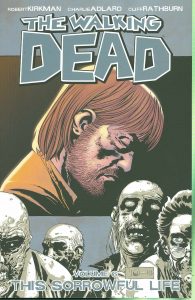
The Walking Dead: This Sorrowful Life

I’m starting to get caught up to or finished with graphic novel serieses, which in a way fills me with trepidation. Now I’ll have to start finding new ones with no idea whether they’ll be good. (There are three in the pipes right now, and a fourth I have solidly in mind but not yet in hand.) The good news is that by the time I get caught up on The Walking Dead, the latest one in January will almost certainly have been released, so I can push out that moment of doom just a slight bit further. The even better news is that my distaste for the previous book‘s apparent retreading of well-covered thematic ground has been assuaged for now.

This Sorrowful Life opens on the resolution of the biggest cliffhanger the series has enjoyed. Captured and injured, Rick Grimes has to find a way out of the clutches of his captors in time to prevent a veritable army falling upon his companions in their place of safety. Blah blah blah, spoiler-laden plot synopsis, but I should point out that it maintains speed and tension throughout the book like no previous volume has managed to do. And the moral stakes are growing ever higher. The questions are no longer “How can we survive and thrive in the new world?” or “Will we ever find safety?” or even “How drastically must our laws change to accomplish the previously considered goals?” At this point, I’m beginning to wonder if their safety will ever be possible without first evolving into a society that no longer recognizably maintains America’s morality at all, into a society that is only barely more enlightened than the one that they may very soon be at war with. And this is exactly the kind of thing that I enjoy the most about zombie stories, which is really to say any post-apocalyptica: philosophical questions that cannot readily be examined in the modern world as it is.

Thank you for expanding my brain, zombies!

Inferno

519vbU0Qg1LThe upshot of all these Star Wars books lately is that after the next one, I’ll be caught up to the release schedule. Also, there are only two more after that one, so however you look at it, it ends soon by volume if not by calendar date. On to the 6th book, Inferno, where I am continuing to be amused by the Amazon reviews of the series. For five books, people have been complaining that the plot is moving along too slowly, and nothing is happening, and it’s lame. Now that we’ve come to the first book past the crisis point of the series, where events are spiraling rapidly out of anyone’s control, people are complaining that the writing used to be intelligent and character-driven and possibly philosophical, whereas now it’s flat and derivative. Luckily, I occupy a middle ground devoid of shrillness.

The truth is, the first few books were chock full of philosophy and character development, none of it outstanding in the literary sense but most of it quite good, and well above previous Star Wars fare. And those elements were important to providing a convincing fall from Jedi to Sith as well as to providing a plausible excuse for family and friends not to have acted sooner. Each incremental change wasn’t so bad, and it even seemed that an act as despicable as trying to destroy one’s parents’ ship could be forgivable in context, although obviously a sign of a mind darkened by circumstance. Now that Darth Caedus[1] has moved on to such actions as setting the Wookiee homeworld[2] to burn, well, you might say that’s a cartoonishly evil decision. But for my part, it doesn’t seem all that far out of line from the last such decision he made, and there has to be a point at which you take an action that is tactically as well as strategically sound but which people use as the catalyst to finally re-qualify you in their minds as the bad guy, no matter what they wish were the case. If you never do anything like that and are eventually able to bring peace and order to the galaxy regardless, then, well, probably nobody would oppose the Sith in the first place, right? The obvious parallel is to the destruction of Alderaan, and I’ll argue for hours that this was nowhere near as capricious and cartoonish as that.

Anyway, that’s what the book is mostly about. Now that Caedus has reached his turning point in the prior book, the remaining characters get the chance to catch up to the way the galaxy is these days and start closing ranks and drawing battle lines. Which means more space battles, more lightsaber duels, more pitched fights with blasters against menacingly-uniformed troopers, all the excitement that those early book reviewers were asking for. Both aspects have worked throughout the series, for me, but I’m not going to complain that the scales are tipping toward the exciting end of things. I do wish that one of the three authors of the series had a little bit more investment in R2-D2, but as complaints go, that’s pretty minor.

[1] Yes, he’s a full blown Sith Lord now. And yes, I’m finally able to allude directly to who I mean with still no fear of spoilers, just as though the original name would be one that more than a fraction of my readers had ever heard before.
[2] As Star Trek fans would call it. Kashyyyk for the sake of accuracy[3], but again, what fraction of my readers has heard that name? I feel confident that many of them have heard of Wookiees, at least.
[3] Did I know this prior to reading the book, down to the correct spelling? I did.[4]
[4] Still, ladies, I have a lot of good qualities!

The Wake

And now I’ve finished my Sandman re-read, this time with all of the volumes in hand[1]. Well, all but the first two, which are still packed up with the rest of my books for the past two and a half years now. Argh, I really need to build those bookshelves. Anyway. The Wake is flawed in a couple of ways, I’ll acknowledge right up front. The art is initially somewhere between soft and blurry, which could be a problem with the art, or with the printer, or a purposeful representation of the reader’s eye-based emotional state at the time. Second, it frankly lasts a little bit too long. After a three-issue denouement plus an epilogue, there are still two more issues. And they’re both very good, and neither could have come any earlier in the series. But they’re still a little bit too much for the confines of the final Sandman story. It’s not like I have a good answer for what should have been done instead, so I feel a little bad even complaining about it.[2] But still, this kind of thing is my job for now, right? Right.

Those complaints are for the most part minor, though. Primarily, it was poignant, occasionally funny in that way that makes you feel a little bit sadder after you’re done laughing, and inclusive, a thank you note to the readers from the author. “I’m glad we stuck it out together, and we’re all a part of this.” Which sounds goofy when I read it over, but I still believe it. And it was very cleverly constructed, using ‘wake’ in every sense of the term I’m aware of. First, consequence, as in dealing with the outcome of what has happened, the wake of events. Second, and most obviously from the title, a celebration of the passed life. And lastly, inevitably, wakefulness, as in the long dream has ended and it’s time to return to reality. That one, I simultaneously appreciate and reject. More on that in a second, though, because I need to especially praise the epilogue first. Sunday Mourning gives us a last look at a couple of the most important secondary characters[3] a little further down the road of time, to let us know in a manner simultaneously ironic and apropos that, sure, life goes on. And back on the topic of clever, the epilogue was that, too: it managed to nicely capture everything, everything that I love about these books and everything that they mean to me in just a few short pages in which the main character is only ever referred to by pronoun.

Anyway, though, the part I mentioned appreciating-slash-rejecting, right? I quote:

…and then, fighting to stay asleep, wishing it would go on forever, sure that once the dream was over, it would never come back, …you woke up.

(And make no mistake, the art surrounding those lines is equally perfect.) Anyway… it’s good, because it admits that you have to wake up, and move on, and live. But it’s also patently false, because dreams do come back. They’re not ever the same as they were the time before, sure. They might be identical in composition, but the fact is, the dreamer has changed by the time the dream returns, so no, they’re not the same.[4] But they come back, and you get to be terrified in a different way, or sad in a different way, or filled with hilarity in a different way, or just quietly happy in a different way. And only the most vindictive author (or for that matter, personification of the concept of dreaming) would take away the option to re-experience those most powerful dreams again, as a new person, and see what they mean this time.

It will have to be a while, but I’ll come back here again.

[1] That a beautifully restored and collected series of Absolute Sandmans (Sandmen? I think not, though) has been released in the middle of my multi-year purchasing schedule is kind of unfortunate, but it’s at least something to look forward to.
[2] While on the topic of things I feel bad for saying, the very last issue, The Tempest, took me right out of the story. It was extremely good and had its place both emotionally and thematically. But at the same time, and for the first time in the series, Gaiman felt a little too self-absorbed, or maybe too self-congratulatory, or maybe the former is a necessary aspect of the latter? And I had a hard time enjoying the story part, because it pulled me so hard out of what has otherwise been a reread in which I appreciated the series just as much as the first time over a vacation week in 1996, and often more than that first time. So it at least deserves a footnote’s mention.
[3] It says something about the strength of the series, I think, that I can name many of them immediately without being able to say who was more important, only knowing that it would be impossible to talk intelligently about the themes of the series (not the plot, for which there are dozens more than these that would be necessary) without talking about Hob Gadling, or Nuala, or Matthew, or Death, or Delirium, or Rose Walker… and I’ll just stop now, rather than waste more space on a footnote nobody would bother to finish reading anyway.
[4] If I might steal another theme from The Sandman, it is literally impossible for the dreamer not to have changed. To not change is to die.

Incubus Dreams

I’m a little bit pissed off right now. After reading 500 pages of porn broken up by less than 100 pages of plot, I’ve been relishing the degree to which I’ll at least be able to savage Incubus Dreams, since I insisted on putting myself through it. I want to be perfectly clear that I’m not exaggerating. The first four-fifths of the book had a smidgen of plot, but mostly it had a parade of discrete situations, unhampered by any particular connection to the plot of the book or even the over-arching plot of the series except in the broadest of terms. Anita Blake faces up to a personal problem with one or more of her relationships. Or, Anita Blake has a metaphysical crisis to resolve, related to her powers and the cost that accompanies them (or more rarely to vampire politics). Or, Anita Blake gains new, untested powers and isn’t quite sure how to handle the stress or use them properly. And each of these problems has a single solution, which is for Ms. (excuse me, Federal Marshal) Blake to have sex with anyone who happens to be at hand as the problem is experienced, preferably with more than one man at a time and preferably including some of the pain play or dominant-submissive dichotomies that she had never even heard of just four books ago.

Add to that the misspelling of “triumvirate” on such a consistent basis that it had to have been purposeful and the author’s continuous tic of having Anita think something and then say it aloud seconds later, with identical construction to the thought’s phrasing, and you can see where I was going to have myself a real head of steam built up. (Not to mention a tic new to this book where people are no longer aroused by something, or even more pedestrianly turned on by it. The only way to make reference to this phenomenon is that the act or thought being referred to “just flat does it for” whatever particular person is, er, flat done for.) I guess what I’m saying is that I had some real rage in me directed at this book, enough so that talking about it right now is dredging it all up again. Books this long do not normally take me three weeks to read, but there’s only so much of this crap at a time that a man can take.

But, despite all that I’ve said so far, that’s not what has me pissed off just now. Even though none of the dangling plot threads from the previous book were more than glancingly addressed here, and even though this book’s plot had somewhat more dangle than resolution its own self, the last 150 pages or so just flat did it for me. This is the Anita that keeps me reading these stupid books: clever and quippy, sensitive to her own emotions but able to get the job done, heading out into the night to kill the bad guys (a band of serial killers who are also vampires, this time) with extreme prejudice. There wasn’t quite as much mystery-solving as I’d like, but Anita the action hero is in her own way as entertaining as Anita the detective. And both of them are so, so much more entertaining than Anita the accidental ho.

So, am I pissed that I ended up having to say some nice things about the book? Why, yes. But that’s not the biggest problem. What pisses me off more than anything is that I had nearly broken free of the series.

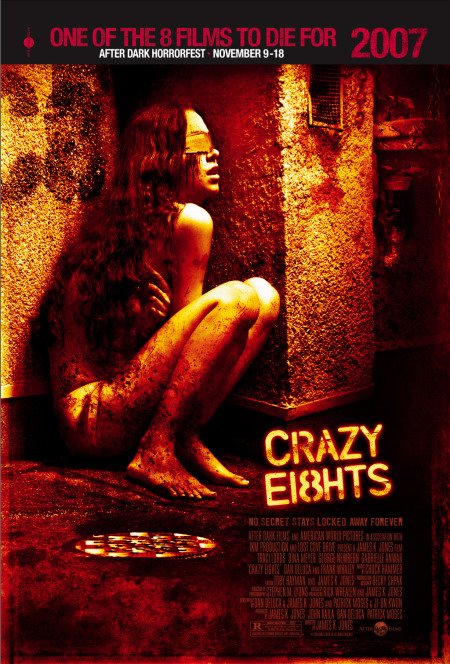
Crazy Eights

MV5BMjAwMzczMzE4Nl5BMl5BanBnXkFtZTYwNjcwMDM4._V1__SX1859_SY847_Horrorfest 2007’s final film may have been the most solid of them all. Crazy Eights deftly mixes the setting and atmosphere of the approximately brilliant Session 9 with the loose plot outline of The Big Chill, except if they were being haunted. After attending the funeral of a friend, six people follow a treasure map at his request to an old barn in the woods, where they find a time capsule full of their old toys from when they were kids. And, in the bottom of the trunk, they find the curled up body of a dead child. Almost from the start, the movie plays tricks on their (and by proxy our) perceptions. Freudian slips and flashbacks scattered throughout the film reveal that they know a lot more than they’re willing to admit, even to themselves. And after circumstance traps them in a nearby abandoned hospital, the dead girl has them right where she wants them.

Here’s the thing, though. It was a long weekend, and it was pretty late at night. Sometimes I drift off during movies, and I notice and fix the problem. In this particular case, I seemed to drift in and out of consciousness with perfect timing to follow all of the plot but miss all of the revealing moments that explained what happened so many years ago that they are now being punished for. And since I never had any plot gaps, I never noticed that I’d done more than close my eyes for a couple seconds. Sincerely: I stated aloud that the movie had to have another 15 minutes left in which the explanations come forth, about 45 seconds before the credits rolled. Then my friend amusedly explained to me what had happened. So, based on the atmosphere alone I say this is a good movie, and it looked like it had some pretty deep themes as well. But, I’m pretty much going to have to watch it again before I can give it fair due. Oops?

Nightmare Man (2006)

MV5BMTA4NzAzNjI3MDZeQTJeQWpwZ15BbWU2MDA3NTY5Nw@@._V1__SX1217_SY911_As with the previous two nights, Sunday started out with the weakest entry of the evening. Of course, there were only two movies on Sunday, which might make the claim seem somewhat spurious. But I promise, if you were to name any three horror movies at random, this would be worse than 98% of them. Nightmare Man chronicles the trials of a woman (portrayed by a very bad actress) who has ordered a fertility mask from Africa or somewhere because her husband (portrayed by a reasonably bad actor) is having performance problems, and she wants babies. Unfortunately, upon its arrival she starts to have dreams in which a man in the mask is trying to kill her, goes generally crazy, gets prescribed pills that she infuses with a talismanic power to keep the evil Nightmare Man inside her from getting out, and semi-voluntarily commits herself to a psychiatric hospital.

Except, on the way to the clinic the car runs out of gas, and she’s left alone while her husband forges ahead to a gas station. Whereupon I start to have Penny Dreadful flashbacks, insofar as there’s a girl in a car being stalked by some kind of bad guy. Except: is he real? Then, suddenly, the movie changes gears entirely, to a pair of couples in a cabin in the forest, playing erotic[1] Truth or Dare. The next fifteen minutes are a treat as we cut back and forth between the bad actress being chased by the crazy mask dude and the couples ramping up toward a pretty flimsy porno premise. And then, against my express wishes, the two plots collide when the couples hear the screaming woman outside and go find her. Of course, there’s no sign of her Nightmare Man, and the psychological games continue. Is he real? Is he her husband? Is she as crazy as she appears? (I mean, make no mistake, she’s crazy. It’s just a question of whether there’s really anyone out there, on top of her being crazy.) One thing I can say without it being a spoiler: sure enough, people start dying.

As bad as the acting was all around, there was one bright spot in Tiffany Shepis as the bisexual cabin owner with an NRA membership. In a sea of both character and actor mediocrity, she stood out as a shining beacon. The film itself tried to have the tongue-in-cheek badness of Saturday’s Lake Dead, but between the abysmal acting and an incomprehensible[2] final act, it was doomed to failure. Still, if you can forgive those things, which you should not, it was notable for providing me with the most opportunities to argue with the characters about how stupid they were being and how easy it would be to do smart things and maybe not die instead. On the bright side, karma was out in full force?

[1] I have no idea why this was specified, as there’s not any other kind of Truth or Dare that anyone has ever played.
[2] I mean, I know what happened. It’s just incomprehensible to me that the writers made that choice.