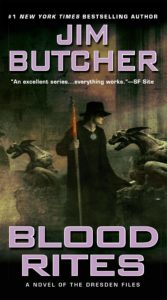
Blood Rites

At some point between the last Dresden Files book and this one, I got accidentally spoiled for a piece of character development between Harry Dresden and Thomas Raith, a vampire of the White Court he’s been palling around with lately. (That is, of course, a drastic simplification and barely accurate at that, but so be it.) As such, it’s going to make it tricky for me to dig into the rich thematic ground here that I would and often have plumbed with great abandon for similar situations in other works. And while I could probably still kill this paragraph and start over in a theme-based review without letting you get spoiled by the character elements, these things are mostly more about me than the actual stuff I consumed, as you will have no doubt noticed by now.

After reading five previous novels, what I find that has been the most glaringly absent from the series, the single thing I could point at and say, “Where’s that?”, is porn. Thankfully, Blood Rites has solved this problem to my satisfaction. It’s like, you can only read so many books in a series and remain interested before someone puts some porn in there, am I right? And at long last, there Harry is, surrounded by women in lingerie, watching the cameramen and the boom operators as the director tries to get the shot just right. Because, porn![1] So, um, anyway, Harry is hired to clean up a little bit of entropy that has gotten all over the porn studio.[2] And as the formula dictates, he finds all too rapidly that he’s in something way over his head. Because, there’s the porn and the thing with Thomas, sure, but there’s also more fallout from the war between the wizards and the less pleasant vampires of the Red and Black courts, and at last a little bit of overt sexual tension between Harry and his long time CPD contact, Karrin Murphy.[3]

Plus, bonus awesome evil-detecting puppy!

[1] Oh, hey. You didn’t think I meant, y’know, a gradual devolution of the ongoing plotlines until all that’s left is a series of orgies “held together” by a pregnancy scare? Jesus, that would be a terrible book.
[2] Ew.
[3] I grew up on Moonlighting. Sue me.
Lucifer: Inferno

Here’s an irony for you. Despite being the book I finished most recently (and wrapping up today’s spate of reviews, in fact), it’s the one I remember least. Not, I’m pretty sure, as a reflection on Inferno‘s quality, either. I know I was liking it as I read. Anyway, though, I can say a few things about it. The first of which is that it feels like the second half of its predecessor, The Divine Comedy. And, okay, eponymously speaking, that seems apparent. But I still find it noteworthy because of the regularity with which graphic novel editors make a point of having standalone collections, as far as an ongoing series can accomplish that. And given the thematic divisions that tend to accompany plot breaks in Gaiman’s work and its spinoff here, it’s more noteworthy still. Which I guess is a lot of time spent to say, “Huh, it’s two halves of the same basic storyline, and that doesn’t happen often,” but like I said, it is unusual for the format.

Thirdly[1], I have a fair amount of respect for the character evolution that Carey has been giving Lucifer. He’s always been an interesting and occasionally, briefly, likeable anti-hero. It would be hard to publish very many months’ worth of comics without that much to recommend the main character. But at some point that has crept up on me unawares, there was a tipping point to a process I hadn’t really perceived before the fact: he’s been gradually infusing Lucifer with a certain nobility of spirit[2] to match his uncompromising (albeit typically self-serving) sense of honor, to the point where now, any time things seem to be going pear-shaped, I’m not merely interested to see the story of how he twists things to his advantage and wins after all. No, at this point in the tale, I unexpectedly find myself genuinely disappointed at the idea that he might not win through. Sympathy for the devil, indeed.

Also? Mazikeen[3] has surprised me once again, and I think before very long at all she will be my favorite character in the series, and maybe even retroactively a very strong finisher in Sandman itself.

[1] I know what you are thinking. I respectfully disagree.
[2] See also the impressive To Reign in Hell, by the always impressive Steven Brust.
[3] Who I see I have never previously mentioned is Lucifer’s one-time right-hand woman, and more recently (as the newly-appointed leader of her people) one of his many grasping adversaries. Though of course it’s more nuanced than that.

Star Trek

MV5BMjE5NDQ5OTE4Ml5BMl5BanBnXkFtZTcwOTE3NDIzMw@@._V1__SX1859_SY893_Obviously, you are aware of this movie, and you’ve probably already formed your own opinion. And anyway, I’d be leery of spoilers for anyone who hasn’t seen it. In theory, this constrains my review by quite a lot, but I figure it leaves me free to talk about what I really wanted to anyway. But, first things first. Did I like it? Enough to see it three times on opening weekend. Did it have flaws? I can think of a couple offhand, one extremely nitpicky and one that, absent, would have failed to feel like a Star Trek movie anyway. Plus, I think I’m willing to claim that at one point, there was actually an insufficient amount of technobabble. Was it accessible to non-fans? I feel as though it really was, and the reviews I’ve heard from non-fans (and in one case, an actively anti-fan) have borne this impression out. So you should really go see it, if this has not already occurred.

Because what J.J. Abrams made here was a philosophical, character-driven action movie, and really, how many of those do you think exist? Of the ones that exist, how many do you think aren’t insufferably smug about it? This right here is a narrow field to occupy! Action: ’cause, you know, space battles and laser gun fights. Character-driven: the driving forces of the story are all based in interactions. Kirk and McCoy’s friendship. Kirk and Spock’s rivalry. Spock’s relationship with his human mother. Nero’s irrational impulse for personal rather than systemic revenge. (He’s the bad guy.) Philosophical: take a group of people that shook the foundations of the Federation (and, projecting outward less than you’d think, the galaxy) and drastically change their history. Okay, many of the changes were not drastic, but one was, and there are clear, subtle ripples from there even before the main plot of the movie takes over. And then explore the question of random chance versus unalterable destiny.

I liked that by the end of the movie, the history of the Federation is vastly divergent from the one that fans of five TV series and ten movies know. And I like that it’s not going to be “fixed.” It was a bold move that I think is going to pay off in spades for the future of the franchise. But as much as I approve of that, I absolutely adored watching as, moment by moment, destiny pushed beloved characters into roles that they had fallen into by seeming happenstance in the original timeline. This new Trek may have surprisingly non-causal time travel that never really existed in “my father’s” Star Trek, but it also has some modicum of fate. And that’s kind of cool.

Ultimate Marvel Team-Up, Volume 3

This third volume marks the last of the Ultimate Marvel Team-Ups, and I cannot say I’m sorry to see them go. For every reasonably good story, such as Spidey’s encounters with the woefully underused Ultimate Black Widow or the Chinese storybook account of his meeting with an ultimate (as opposed to Ultimate) fighting guy (Shang-Li, or something, who I guess was relevant in mainstream Marvel continuity at some point, that point probably falling in the 1970s?), there’s a kind of terrible story about him running into Blade (Blade, for fuck’s sake!) and Elektra and the old-people version of the Fantastic Four[1] and a particularly bitchy Daredevil, all for no apparent reason. Yet even here, there are moments of good writing, such as when he has a conversation with Johnny Storm about power and responsibility as related to stable living, or when he gives a class speech about his research into a hero. The last bit, in fact, rose above every attempt by writer and artist alike to be cloying and overwrought, and I have to give mad props to the soul of the story for managing that in the face of such strong opposition from its creators.

Which I guess is my point in a nutshell. It really has been a very rarely bad series, but I’m so used to unadulterated brilliance from the majority of the Marvel Ultimate universe that something merely okay but with moments that shine still feels like too much work. So, I’m glad it’s over because I’d continue to go looking for those moments, and now I won’t have to anymore, secure in the knowledge that I’ll have them dropped in my lap by ongoing future titles instead, where the rhythm has already been perfected. (These three books were among the earliest written in the Ultimate continuity, in case you were not previously aware.)

Oh, and I’m also glad it’s over because the art kept changing, sometimes in the middle of the same story, and as annoying as that sounds, I also almost never liked any of that art. Would stable and bad have been better or worse than fluctuating and bad? This is a question I hope never to consider again.

[1] Who have since been replaced-or-retconned in Ultimate continuity, as you will no doubt be aware from my review earlier this morning, and from the nine previous ones.

12 Rounds

I ducked into the dollar movie last Wednesday to watch 12 Rounds, which is kind of a puzzling film. At first glance, it’s a cross between Speed and Die Hard 3, in which our New Orleans cop hero is forced by a vengeful international terrorist to cater to his every whim, one round at a time, or risk the death of his pixie-looking but tough wife. And within the set time limits, for added tension. The characters’ puzzle-solving skills are dumbed down just a little too much for my personal taste, possibly as an artifact of the WWE audience that was its primary target, but by and large it’s a serviceable action movie as put together by a, y’know, vengeful international terrorist.

And then there’s this weird turning point in the final act where the cops and FBI guys suddenly get a lot more intelligent than they’d been at any previous moment, and using clues that do not actually exist anywhere in the prior scripting, they determine that this movie has a twist ending wherein revenge was never really the point. And suddenly there are unreferenced helicopter pilots in the cast, and it’s all very much like a particularly imaginative audience member at one of the test screenings had said, “You know what would be a cooler ending than what we just watched?” and the writer and director had nodded and just created this new, purportedly cooler ending out of whole cloth without worrying about the fact that they needed to alter the rest of the movie for that to make any kind of sense.

This is maybe not as bad as it sounds. I mean it was bad, no question, but it was also interesting in a head-spinning kind of way to see the rules of plotting be so flagrantly ignored. Very few movies are (let’s say) brave enough to make this kind of artistic decision. Kudos?

Ultimate Fantastic Four: Ghosts

It’s been almost a week and an unfortunately high number of other books since I read Ghosts, but I can certainly say that I liked it. The Cosmic Cube storyline that started all the way back in God War finally comes to a head, and in such a way as to make me like that book a little better than I did at the time[1]. Basically, big bad guy Thanatos shows up to swipe the Cosmic Cube he tricked Reed Richards into making for him, which has consumed Reed’s attention for so long that all of his relationships are falling by the wayside. And as if a godlike dude with complete control over death being given a device chock-full of cosmic powers[2] isn’t enough to worry about, two threats from the communist past are also hanging around to make life tricky for our overwhelmed heroes. So, if you’ve been missing the Crimson Dynamo from your admittedly non-existent Ultimate Iron Man series[4] or the Red Ghost (who you may recall controls hyper-intelligent animals and is also sort of a ghost) from this series, Carey has got you covered! Meanwhile, brief spoilers below the break. Continue reading

The Time of the Dark

It turns out, and probably unsurprisingly, that the landscape is littered with old fantasy series that never struck my fancy or I otherwise never got around to, and that’s nevermind the many current(ish) ones I’m interested in. So what brings an otherwise random element of that book-studded landscape[1] to my attention? I think more unsurprisingly than the last not very surprising thing I said, I started reading the Darwath trilogy on the advice of a pretty girl.

The Time of the Dark is very much the picture of a book that was written for me.[3] It has a couple of people who more or less stepped through a random portal in the universe to end up in a fantasy realm, much as I’ve wanted to do since I was in high school, and that realm is threatened by eldritch[2], floating Lovecraftian abominations that avoid the light of day, not unlike the premise of Pitch Black. And there’s even a proto- Chain of Dogs situation that informs the final third and climax of the book. Ultimately, the only bad thing I can really say about the book is that the me it was written for is probably ten or fifteen years less experienced, minimum, in the elements of fantasy and horror that it describes. But it’s quite easy to recognize all the holy wow moments I would have had if I’d read it at around the same time I was reading, say, Eddings.

In addition to the cool plot and setting tricks, there seems to be some veins of philosophy beneath the surface that I expect to show up a lot more strongly in the second and third books. And also, there are some mysteries yet to solve, even aside from the central one of whether humanity can be saved from the Dark Ones. (Oh, right, speaking of things that are designed to lure me in, civilization is on the brink of utter collapse. So, yeah.) Good stuff, and I am pleased to be reading more soon.

[1] I’m really loving this imagery, by the way. I mean, not my portrayal of it, just the idea that you’re walking around, and there are these piles and drifts of book every which way, scattered about like a nine-pins. Except for the problem of rain, that would be a pretty sweet world.
[2] You pretty much always have to say “eldritch” in these situations, you know?
[3] Aside from the ridiculous cover art, that is, which I feel obliged to mention since it’s the only literal picture in sight. In its defense, that is (inexplicably on first blush) a literal portrayal of a scene from early in the story.

X-Men Origins: Wolverine

Summer arrived at last. Technically, it arrived in the form of a horrendous downpour that was among the worst I’ve experienced from the driver’s seat. But the important thing is, I and my companions got to the theater in time, so none of that matters. What does matter is having seen the Wolverine movie, and having it work pretty well. Explosions: check. Pathos: check. A few new mutants, both familiar (to me, that is) and un-: check. Matches current movie series continuity: check. Matches current Marvel continuity: well, okay, that part not so much, although it could be that it matches some Ultimate continuity I have not yet exposed. However, I do not care that it didn’t, because all the other parts were done pretty well.

In the end, it was a nice little summer comic book movie, better than some that have been released over the past decade; and I have no driving need for more. Though if they want to give me a simultaneously hysterical and horrific riff on the Superman origin story while they’re at it, I am willing to laugh and cringe appropriately, and with a song in my heart. Well, y’know, sort of. Maybe less so during the cringe?

Ghosts of Girlfriends Past

This is a really easy review, because of how the story is well-covered ground. You know, A Christmas Carol? Or the Disney version, or the Muppets version, or the Bill Murray version? I’m saying, you know this story, and Ghosts of Girlfriends Past does itself the service of not leaping out with a sudden surprise twist that leaves you wondering if you’re watching the right movie after all. The question, then, is what’s the point of watching a romantic comedy remake of an old story you’ve already seen (or read) several times? The point is this: it’s very, very funny. Funny via quite a few different genres of humor. It’s also a little bit sweet, like you’d expect from the “romantic comedy” tag, but it’s not cloying by any means. Mostly, though, funny. If you like laughing for an hour or two, check it out!

Friday the 13th (2009)

Without meaning to, I let a good two months slip by before I finally saw the Friday the 13th remake. And when I did see it this weekend at the dollar theater, it was by myself and a little bit creepy. I mean, not the movie, which was every bit the traditional slasher flick. No, it was the theater crowd. Five minutes before the movie started, there were four men scattered in various parts of the non-stadium theater with decaying seats. It was starting to feel like I imagine a porn theater did, back when those were still around. But yay, some people finally came in together, even a woman in one case. And thus the day was saved and I was able to focus on the plot.

Basically, this is a reimagined Friday the 13th Part 2, after a straight port of the original movie was covered in black and white flashbacks prior to the title screen.[1] The reimaginings are a bit of a mixed bag. On the one hand, it’s pretty smart to have the new victims not be a batch of camp counselors come to reopen Crystal Lake a few years after a series of brutal murders. Because, that would never happen, right? Much less four times in a row as in the original series. On the other hand, it’s strange to have an explicit hero character in Jared Padalecki[2], roaming town and environs in search of his missing sister. One of the brilliances of the Friday the 13th series was that the characters were almost always on an equal footing going in, such that there was no way to guess who might live.[3]

The important part, though, is that they waste no time getting to the action, which follows the formula almost to a tee. A large number of TV-recognizable[4] young people in the woods who take drugs and engage in premarital sex are punished by a deformed, avenging spirit with a machete. Do heads roll? Are pokers shoved through faces? Are feet liberally stabbed? Are minorities slightly more likely doomed than everyone else? Yep, it’s a slasher movie. 14 bodies. 6 breasts. Drive-in Academy Award nomination to Julianna Guill for flirting so hard with the Asian kid that she literally burned his lip and then having the grace to be hung from a pair of antlers in penance, and also for her “spectacular” talents.

[1] Not that it matters one way or the other, but I’m almost surprised they didn’t take the color out of the original’s footage and use that, instead of filming their own version. They added some new footage right at the end, sure, but it still could have been done.
[2] That guy from Supernatural. Yeah, that one.
[3] Caveat: the We Have Seen Your Breasts, You Must Therefore Die rule was of course always in effect.
[4] Sam Winchester[2], Dick Casablancas, Kira the Bajoran (not technically young, her), and a handful of others from shows I don’t watch.