G.I. Joe: The Rise of Cobra

In my halcyon youth, which is to say late elementary school and possibly early junior high, one of my primary goals each day was to get out of school and home to my even then twenty-year-old, cableless, rabbit-eared television and click over to one of the handful of UHF channels[1] and watch back-to-back episodes of Transformers and G.I. Joe. So when the Transformers movie hit, there was a significant nostalgia quotient even though I really didn’t trust it could turn out that well. Because, giant transforming robots just seem more plausible in a cartoon, despite that modern special effects turned out to be up to the job after all.

Surprisingly, it didn’t cross my mind then that a G.I. Joe movie might happen, even though it seems a lot more plausible that one could be successfully made. Still, once I caught wind of the film’s existence, I was pretty excited. And then, over months of previews focused on metallic combat suits that might be better placed in a game of Halo, that excitement gradually drained away to nothing. Which, really, is the way that expectations management ought to work on big budget summer adaptations of childhood memories.

The Rise of Cobra is at least as much about the existence of a secret military organization under UN authority tasked with solving unique problems on the geopolitical stage as it is about the emergence of yet another new terrorist threat. G.I. Joe, says its commanding officer General Hawk, picks from the very best of each member nation’s armed services, by invitation only. They have a secret base. They are, in short, every UN-armed-takeover conspiracy theorist’s wet dream. Luckily, instead of making a movie about that, it’s about fan favorites Duke, Scarlett, and Snake Eyes’ fight to stop an (implausibly) Scottish arms dealer from carrying out a plan to bilk the UN of a lot of research money they paid into his nanomite[2] program by stealing the weapons back upon delivery, demonstrating their power, and then selling the remaining warheads to the highest bidder. All while carrying out a second, more sinister plan that will ensure adequate sequel bait if the box office performs as expected.

But you know what? It worked. I’ll watch it again, and I already look forward to that all-but-certain sequel, and if there were a few pieces of dumb to ignore over the course of the movie, well, that never stopped me from enjoying the cartoon either. I am well-pleased.

[1] Maybe channel 39? I guess it doesn’t matter anyway; all the UHF channels either got bought up by the emerging new networks or else went Spanish when cable ate up too much local marketshare. (Also, I’m not sure who I’m kidding when I say I had to click over; why would I ever have changed it away in the first place?)
[2] Nanomites, as you shouldn’t really care to know, are tiny robots that, in this case, are programmed to eat pretty much everything until told by their software to stop. The ability to strip a city bare in just minutes, although insignificant next to the power of the Force, is a pretty potent threat; albeit perhaps a wee bit too easy to lose control of.
Grand Theft Auto IV

I’ve played but not reviewed previous Grand Theft Auto games. Most of the modern ones pre-date my reviews, of course, but then San Andreas was never finished by me. There was this thing with impossible-to-fly biplanes that I finally gave up on, since there were only going to be more planes in the future, and the training aspect had overtaken the fun. That said, I have reliably enjoyed all of them, and each more than the last. Grand Theft Auto IV is likely the best in the series; it has kept each of the improvements developed across the previous three games while quickly ejecting the overly bloated chaff that came with San Andreas. The result is a streamlined and mostly trouble-free game experience. Mission-based play and a large world guarantee that there are times when a mission replay will be exasperating, but at least for me, this problem was rare. The sandbox design is even improved, with ever more reasons to wander the streets for the hell of it. Plus, y’know, it is about as pretty as the generation gets.

All of which to say: I am impressed with the game design and playability, and that’s good. Which leaves storyline. On one hand, it’s the same as previous Grand Theft Auto games. You wander the city as it gets gradually opened up to you, making deals with bad people and doing worse things in order to get money. You’re pretty much a bad guy, or at best amoral in pursuit of your own goals. But on the other hand… Nico Bellic is an interesting, conflicted character who is drawn in by events beyond his control at least as often as he makes bad choices. And there are a handful of secondary characters (if not more!) with depth that nearly matches Nico’s. It is possible to disapprove of this game’s morality and not need to know more than that to make your decision. But I’m pretty sure it’s impossible to play the game for any duration[1] and not get emotionally invested in more than one of the characters. The game is every bit as story-deep as Mass Effect, and well worth almost any gamer’s time.

[1] For my part, I played it over the course of 18 months. I almost never come back to games once I’ve played stuff in between or let more than a few weeks pass.

Funny People

As I mentioned quite recently, I’ve never seen a full-on Judd Apatow movie. Well, had never, at least. But, last night I caught Funny People. I can say without reservation that the movie had a significant number of funny people in it. Despite that, I’m pretty sure the goal of the title was irony. Because, as funny as it was, both in the stand-up segments and the main story segments, the bulk of the movie showed people wronging themselves and each other in ways both blunt and subtle, and only sporadically taking away hard lessons on how to be better. I think it had to be a comedy, not because Apatow and Seth Rogen and Adam Sandler are known for comedy, but because if you remove the regular doses of humor, Funny People would be slit-your-wrists cinema.

Rogen stars as his increasingly common, and increasingly likeable, schlubby everyman, this time an aspiring comedian trying and mostly failing to work his way into the Hollywood scene. His life changes dramatically when his set follows that of a famous comedian, played by Sandler, who has just learned he is probably going to die of [let’s say] Robert Jordan’s Disease and then flubs his first public stand-up routine in years, due to his dark mood. Rogen takes advantage of the situation to get some fairly cheap laughs at Sandler’s expense, whereupon the comedian decides to hire Rogen as a writer and assistant, and most importantly, as the sole bearer of the knowledge of Sandler’s illness and probable death. Occasional digressions into Rogen’s personal life are interesting from a character development perspective but mostly serve to remove focus from the chemistry between the old and young comedians, their growing friendship, and the lessons that each is taking from the other. And then, as the previews made perfectly clear, Sandler’s disease goes into unexpected remission, and he decides to embrace the second chance he has been given in pretty much the worst ways imaginable, while Rogen is left the impossible task of damage control.

It really is a very funny movie. I said that and I meant it. And a lot of the time, it’s funny like things that are funny, and that’s pretty sweet. But sometimes, it’s funny like watching a crash between a car full of clowns and a limo full of midgets, which crash has happened in full view of the Special Ed bus. You can’t look away and you know you’re going to hell, and there’s a voice inside you desperately trying to convince you that those kids are going to have nightmares for months, that midgets are totally people, and that clowns… well, okay, the clowns are probably better off. But you still choke out laughter, because you can’t not. That kind of funny, is, y’know, probably less good in large doses.

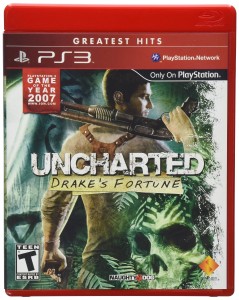
Uncharted: Drake’s Fortune

91B0KvHV0UL._SL1500_Check me out, I finished my second PS3 game! This was more of an ongoing thing, since it is not at my house and I don’t own it. But still! Definite fun times. In Drake’s Fortune, we follow the adventures of Nathan Drake, descendant of the explorer Sir Francis Drake, as he follows his predecessor’s footsteps in search of El Dorado, the famed lost city of gold. Standing in his way are rival hunters, a shady partner, a documentary filmmaker, Nazis, more barely navigable rock walls than you can shake a pointed stick at, and a semi-ancient curse. But in the plus column, hey, treasure! Right?

The game is an extremely pretty 3D platformer / cover-based third-person shooter in the vein of Gears of War if the latter were less focused on warfare and had a jump button. And lots of rock walls to climb. Pretty much, it’s a Tomb Raider game where they reduced the budget on breast motion physics and invested that money into storyline and dialogue. It was, I think, a good trade.

Land of the Lost

Unemployment plus dollar movie plus having failed to catch a lot of my secondary summer movies equals a pretty good deal, right? The moreso, of course, because only paying $1.25 to see Land of the Lost feels a lot better, even in a substandard theater, than paying full price would have done. They did a pretty good job of hitting up on a couple of nostalgia-meters, and a halfway decent job at a plot, and an occasionally decent job at being funny. And then, of course, there was the rest of the job they did at being funny, which ranged from iffy to my being able to see what they were going for to solidly unfunny to scientifically offensive.[1]

The story, lifted straight from decades of Saturday morning kid television, revolves around the fate of [Dr.] Marshall, Will, and Holly, who, while on a routine expedition, accidentally go over a waterfall and through a rift in the space-time continuum, landing in a lost world populated by monkey people, lizard people, dinosaurs, and all kinds inexplicable modern detritus that has fallen through, one supposes, other rifts that were less waterfall-accessible. The chick was pretty hot if unfortunately lacking in story relevance otherwise, the Judd-Apatow-friendly actor was about as funny as you’d expect him to be[2], and Will Farrell… it’s like, when he’s playing a pompous blowhard, I appreciate his talent. But as soon as the physical comedy shows up, I just want him to stop, as quickly as possible. This movie, alas, had a healthy mix. For the record, despite me coming down mostly negatively, I did not at all feel like my childhood had been raped.

[1] I should note that that eight-year-olds in the audience did find the last part pretty damn funny, to my chagrin.
[2] This is true whether you are an anti-fan of Apatow or not, I expect. I still haven’t seen any of his movies yet, only the ancillary stuff that floats around in his wake, but I’m pretty okay with him, to date.

Lost and Delirious

MV5BMjYzMDk0NDEzNl5BMl5BanBnXkFtZTgwNzQzNTcxMTE@._V1__SX1217_SY887_My latest Netflix movie is Lost and Delirious. And I’ve watched it, which was a positive experience. Yet I have been staring at this mostly blank screen for the majority of the day. I think it’s that my opinions are too many and too contradictory. In short, the chick from The O.C. is sent to an all-female boarding school, where she becomes roommate with a pair of seniors, one hard-nosed and feminist, the other vivaciously popular. At first, it looks like one of those coming-out-of-the-shell stories in which Mischa Barton would have been the main character embarking on her journey toward personhood. Then, at the end of the first act, it veers sharply into one of those obsession thrillers in which our purported main character mostly serves as the audience’s window on the action when it is revealed that her roommates are engaged in a sexual relationship.

And I think it could have made a fine obsession thriller too, except that it couldn’t make up its mind to commit to that. For every scene in which a new boyfriend is about to die in a sword fight and simply isn’t taking it seriously enough yet, there are three in which someone screams and runs out of a room / across the school lawn. And it’s not like that’s unrealistic high school obsessive behavior; it’s that the swords and the pet falcon are, and after it was hinted that I might get that movie, it became the one I wanted. Still, what was left behind was good stuff. Surprisingly good acting from a variety of very young actresses, modernly relevant sociosexual politics, not terribly many overwrought or thematically pushy scenes. And, y’know, sword fights.

Spike: Lost & Found

I have a tendency to regularly troll a number of area Half-Price Books, looking for ever more cheap, used copies of the huge stack of Ultimate Marvel comics that I read. I end up seeing a number of other titles as a result, and grab the odd one now and again. Today’s such find, Lost & Found, was an extremely short Buffy-themed comic set more or less as an episode in Angel’s final season. In a sequel to the Gem of Amarra sequence, Spike and Angel go looking for yet another vampire that seems to be able to survive the sunlight. It’s not a bad little story, short though it be. It tries and (I think) fails to provide much in the way of character development for Spike or Angel, but if it had been the main arc of an actual episode in the show, I would have liked watching it. To be perfectly clear, it very much needed a secondary arc to have felt fully formed, though.

Ultimate X-Men: Magnetic North

Historically, I’ve been down on the Ultimate X-Men titles as compared to the other ongoing series. I know there was a point, several books ago, when I changed that opinion. Magnetic North marks another such shift, as this is simply one of the best Marvel Ultimate titles I’ve read, period. Almost every minor and major event in the past several books is pulled together into one web of intrigue, surrounding the escape of Magneto. It is both too complex and too good a story to get into in more detail than that, and in all honesty, I think the title and the cover[1] revealed as much as I already have anyway. It has a cinematic plot, with almost as many story and character twists as there are pages to turn. I just cannot stop being excited over these books!, and more the further into them I get.

[1] at least, the cover of my copy, which does not match the one Amazon shows.

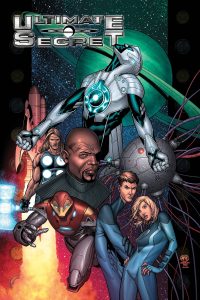
Ultimate Secret

Ultimate Secret continues the Ultimate Galactus trilogy in much the same fashion as the opening volume. That is, it tells a reasonably good story whose main flaw is feeling entirely too short. I mean, most of the Ultimate books have felt like discrete storylines in the lives of our heroes. The Galactus books, on the other hand, have felt very much like part of an (extremely incomplete) ongoing story. It is not particularly a flaw, except that it makes it hard to feel much excitement for the review; it’s as though I’m reviewing thirds of a book, instead of three books.

Another way it matches the first volume is that it uses the Galactus story to talk about other characters entirely that had not yet been drafted into the Ultimate universe.[1] In this case, the fight is against the alien Kree who are sabotaging mankind’s space program, in the hopes that when Gah Lak Tus arrives, the planet will have no survivors. The story was decent, it just wasn’t what I was looking for. Again. I’m really relieved this is only a trilogy, as I’m not sure I could take much more pushing back the payoff.

Except for the lack of character continuity, what this has most reminded me of is the old G.I. Joe event weeks when they’d present a five-part series in which Cobra and G.I. Joe were crossing the world in search of parts for a doomsday machine, and inevitably Cobra would manage to get all the parts, fire up the machine, and then lose anyway. The continuity meant that each episode had a series payoff feel, unlike these books, but there’s still definitely a race across the world in search of clues feel. (Does anyone but me remember those episodes fondly? I mean, clearly there’s a movie studio that hopes so.)

[1] Captain Marvel? Really?

Harry Potter and the Half-Blood Prince

I’m genuinely unsure what to make of the 6th Harry Potter movie. It took its time and worked hard to include what was necessary, unlike some of the previous films. Lots of backstory was ditched, but it kept the important bits. And they did a great job with the character interactions. Every cylinder fired really well[1], honestly, except for the parts that dealt with the central storyline and mystery. The Half-Blood Prince’s identity scarcely registered as a mystery in the first place, despite so many revealed reasons as to why it might be troubling. Voldemort’s secret was mostly an afterthought, though I suppose it being the main focus of two more movies will make up for that. And the climatic scene felt, well, rushed.

But what I can’t decide is how it would have looked to a newcomer. Were the scenes unsatisfying because the script and the direction weren’t quite up to it? Or because I was able to choose the pacing in the book, and the movie simply didn’t live up to my preferences? You’ll have to ask someone who came at these from a different direction, I guess, because I’ve got nothing to go by here, except what I’ve already said. On the bright side, it was pretty good in itself, just not as satisfying as I had hoped. Alan Rickman, as usual, is the tops. Oh, and speaking of bright sides, I think I recommend an afternoon or evening viewing. It’s a very dark film, visually, and emerging into the bright of summer would be… disorienting, at best.

[1] Okay, Daniel Radcliffe is simply not keeping up with the emerging talent of his co-stars. Pity.