Ultimate X-Men: Absolute Power

A tried and true way to annoy fans of a series is with a drug metaphor. There you’ll be watching [spoiler elided] perform magic, getting better season after season, even earning a girlfriend out of it, and then suddenly in the sixth season, it turns out that [spoiler elided] has an addiction to magic that must be stopped any any cost, lest lives be destroyed. Or in the Ultimate X-Men, say, there’s Colossus, this big steel guy, but it turns out he’s been doing drugs all along to be strong enough to support his impenetrable skin. And now all of his friends are addicted too, and the ones who aren’t had better step in and save the day! Oh, and also, it’s time to introduce another half-dozen Marvel characters that you won’t be able to care about unless you already know who they are, because heaven knows we certainly don’t have enough time to actually introduce them and find out if they make any sense or should be cared about, before they’re gone again.[1]

It’s too bad, too, because without the rush job, well… I mean, the drug thing still would have annoyed me. Ongoing series of every flavor really need to stop with that shit, because it is never done well. Ever. But, without the rush job and the drug-story allergy, the last couple of pages of climax, dramatic revelation, and cliffhanger would probably have been pretty cool. Instead of feeling excited about what comes next, though, I’m mostly glad that Absolute Power is the last Ultimate X-Men book I have to read.

[1] That right there is the biggest problem with the Ultimate line of comics, in a nutshell. If you’re going to pretend to be shedding forty years of continuity so that new readers can join the fun, then stop letting your stable of writers add in old characters unless they promise to tell me who they are and why I care. Or, better yet, make me care within the confines of the plot. I know that’s not that hard to do.
Naamah’s Kiss

Jacqueline Carey returns to the world of Terre d’Ange in Naamah’s Kiss, set a century after the events of her previous books. The magically modified historical Europe has progressed into the 16th Century, with tales of a new world away west across the sea, but not-France seems content to rest upon her laurels as a center of love and decadence. Into this more superficial version of a country already obsessed with beauty and fame is thrust Moirin, a half-Alban[1] girl with a capital-d Destiny, descended from the same magical small folk that gave Prince Imriel such trouble during the previous trilogy. Of course, as the other half of her descent is a d’Angeline priest of Naamah, the goddess of Love, it can be no surprise that her parentage and uncivilized mien make her an instant success. Unfortunately, she spends the first two thirds of the book on that, laying groundwork for events in future unwritten books before actually engaging in the plot of this one.

On the bright side, once that plot gets a move on, it’s really quite pleasant, racing to the far corner of the world to rescue a not-Chinese princess from a demon. If you can leave aside the iffy pacing, the book has a lot of things to like. A circle of demon-summoners, ancient Ch’in wisdom, cliff-diving, an implausible amount of lipstick lesbianism, chases, escapes, true love… y’know. Stuff a sick kid would want his grandfather to read to him. But, okay, even if it’s clearly not that funny, it did feel like something out of a storybook. If that sounds ridiculous, take it as me having accepted the characters that thoroughly, by the end. Pacing issues or not, I care about these characters and want to know what happens to them next.

[1] not-England, don’t you know

The Wolfman

The longer I wait to write this review, the sadder it gets. And what’s funny is, I wasn’t avoiding it at first, I was just busy. But then later, I got to a point where I didn’t want to write anything at all, and I don’t know if that was valid and on me or if it was due to review dread. And then later still, I realized that it kept getting sadder the longer I waited, which of course did not do anything to encourage me to get a move on. But then I finished a book last night, and if there’s one thing I cannot abide, it’s a log jam. Resultantly, you get this horribly explanatory paragraph because at least it gives my fingers something to do while my brain is still warming up.[1]

As you have no doubt worked out for yourself by now, I saw The Wolfman last Wednesday. In 19th Century England, an Americanized actor returns to his ancestral home when he receives word from his brother’s fiancée that the brother has gone missing. By the time he arrives, his brother’s badly mauled body has been found, but of course before all of the affairs are concluded and he could leave, events conspire to leave him bitten by a werewolf, and then we’re off to the races. Here’s what I can say about the movie: it got a lot of things right. The brooding moors, the equally brooding London town, the yet again equally brooding characters, both bit and primary, I guess what I’m saying is that there was atmosphere thick enough to choke upon. And the wolfman himself? It was simultaneously a perfect callback to Lon Chaney Jr’s original look and a special effects updatestravaganza. What I’m saying is, this was a very moody, very pretty film, and it was cast to match.

If only they had saved some money and / or creative energy for use upon the script. Or even, if they couldn’t afford dialogue, then at least for the plot. ‘Cause, man.

Man.

[1] If I were smarter, I would edit out these process pieces after I’d had time to write something actually good instead.

Shutter Island

Shutter Island is one of those movies that Hollywood (in the collective, generic sense) manages to abuse badly and thereby annoy me.  The previews have been going for at least six months, with the obligatory gap in the middle when they realize that they don’t know when they’ll release it after all, and hadn’t they better wait and find out? But then, after the gap, right back to the same previews as before. Plus, separately, the previews themselves were horrid and revealed to me everything about the movie.[1] Still, good cast led by a good director and in a beautifully dreary setting means that for the bargain price of a free day-ahead sneak preview, I was more than willing to go see just how it turned out, regardless.

And do you know, there was a period in the middle-to-late section of the movie where they actually had me doubting my preview-based conclusions? Ultimately, I found myself correct all over again, just like I’d known from the start, but despite everything, I did not walk out of the theater pissed, nor even mildly annoyed save at myself for getting briefly suckered. Because, the journey really was the worthier part, this time around. Turns out that, just as with rewatching an old favorite, knowing the outcome doesn’t mean you can’t still enjoy the ride. Oh, and speaking of engrossing and well-acted psychological thrillers, I’m nearly positive that I recognized at least two interior sets from the incredible Session 9.

[1] Look, if you know what I mean by this, they’ve probably already done the same to you too. If not, just don’t go looking for it, I guess?

Frozen (2010)

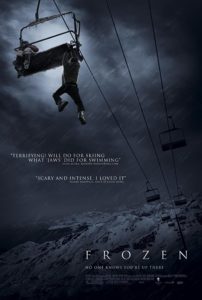
There’s this movie, Frozen, that you’ve never heard of. I had never heard of it before it showed up on my list of ‘movies to see on a Wednesday afternoon’ last week. And even though I found the idea of college kids trapped on a ski-lift during a winter storm to be extremely compelling, pretty much nobody else did, at least by appearances; I’m pretty sure it won’t even be showing in area theaters anymore by tomorrow. What’s cool, though, is that for movies that nobody much has heard about, I get to be the representative of the film in a way that my review of, say, Avatar holds no comparison to. And it’s not like this is uncommon for me; I watch a fair number of movies that are outside the mainstream. But only every once in a while do I see a movie that people maybe haven’t heard of, but should still actually watch.

Except, I’ve already told you most of what you need to know about Frozen, and where does that really leave me? I mean, the plot is kind of predictable. Of course they’ll get trapped on the ski lift in some unlikely way. That’s the premise! And of course they’ll have moments of rescue that are dashed away. That’s the genre. But eventually the reality of the situation sets in[1], and then you have a compelling glimpse at physical danger, emotional collapse, and the ways that people react in the face of death. And even before that reality hits, the film is at times brilliantly shot. I shouldn’t spoil the scene I’m thinking of, as it’s quite affecting. But, like the rest of the movie, it really drives home the tagline, which I will repeat here instead of relegating it to mouseover text as usual: “No one knows you’re up there.” In a way, that simple fact is more terrifying than all the snowstorms, fifty foot drops, and razor-sharp cables in the world.

[1] Interestingly, at least to me, I think this happens for the audience before it happens for the characters. Or maybe it is just my personal experience with a superficially similar situation that made me sensitive to it.

The Walking Dead: Fear the Hunters

I hope the Walking Dead series is nearing its conclusion. I hope this because I’m getting a little bit tired of trying to figure out who is who, as the characters get more haggard and similar and there’s no color palette to tell them apart with. I hope this because, as of Fear the Hunters, the majority of characters have finally made it into survival mode, and I no longer have that much concern about whether or not they’ll be okay, but only about in what manner they will succeed. Most of all, I hope it because I fear that Kirkman is running out of new stories to tell. The push-and-pull between survival at any cost and the dignity of retaining human goodness? Rick’s[1] band of traveling survivors versus unseen and unknown human horrors to match and surpass anything that zombies could possibly dish out? I have, as they say, both been there and done that. And the thing I really hope is that I don’t get to a point where the stories bore me. It hasn’t happened yet, but without some kind of fundamental shift (or else that conclusion), I can smell it on the wind.

[1] Although, here’s a twist. I don’t think the book addresses last names anymore, and I know I don’t recall the main character’s. Between the lines and in the silences, it is nice to know that the story still has progression, even if it’s starting to feel played out on the surface.

Ultimate Iron Man II

One of two things happened between my readings of Ultimate Iron Man and Ultimate Iron Man II. Either the writing got a lot better, or I relaxed about the continuity weirdness and accepted that this whole prequel thing could be true after all without breaking anything that has happened later in Tony Stark’s timeline. Regardless, the upshot is that I got to enjoy this book lots more, and yay for that! Despite being labeled and numbered as a new series, it picks up right where the last one left off; Tony is using his new experimental armor to fight against bad guys and his father is in jail, framed for the murder of a rival arms manufacturer. The story adds in a few new twists that work well as prequel fodder, including government agents who want Tony’s new “robot” and continued visits to the pre-Richards Baxter Building. But mostly it’s a straightforward murder mystery set at the highest levels of corporate espionage and global terrorism. The man inside the Iron Man suit may be far more powerful than I’m comfortable with, but his story is always funny and never boring, so I can cut a little slack on my complaints this time.

Card has still come nowhere near a connection point between this ongoing origin story and the Tony Stark that joined the Ultimates way back in the second issue of that comic, and I suppose now that the Ultimate series has ended and been rebranded, perhaps he never will. Despite my previous complaints, I have to be a little disappointed by that, as the characters were really starting to pop. At least I’ve got something like 40+ years of main sequence Marvel continuity to read, so I don’t have to feel too sad about it.

Ultimate Power

I have thought about mentioning for a few books now as it kept getting coming up (but then ultimately never did so) that things have changed within S.H.I.E.L.D., the organization that is mostly concerned with terrorism, superheroes and supervillains, and the management thereof. Good old Nick Fury, one-eyed ass-kicker extraordinaire, based on Samuel L. Jackson for the appropriate level of badassery right out the gate, has gone missing and is no longer in charge of the Ultimates or much of anything else. And people keep talking about how weird it is that he’s missing and wondering if he’ll ever come back. I had been expecting something along the lines of Ultimate Power to come along and explain this to me, and not only was I right, but it turns out I should have actually opened it earlier in my readthrough; who knew it came out in a hardback version first? (Must definitely re-order these books correctly, once I finally have the missing X-Men volumes back.)

Reed Richards of the Fantastic Four is working on a promise to change his friend the Thing back to human form, because being a giant rock creature is just not very pleasant for some people, even when they’re stronger than just about everyone and practically indestructible. As part of that project, he sends a handful of probes into several parallel dimensions[1] in search of scientists willing to assist him, against Nick Fury’s explicit orders. Naturally, moments later[2], angry superheros from one of these other dimensions[3] appear to arrest Reed, because his probe nearly destroyed their planet. Being a stand-up guy, he agrees to be arrested and tried; being a master tactician with Marine sensibilities, Fury immediately mounts a rescue operation including pretty much every good character in the Marvel universe. And then, you know, things explode or generally go down in strange ways.

The story was pretty okay if you can get past only being able to follow the two-thirds of it that involved Ultimate characters. But it had massive continuity problems. Because, all the people wondering where Nick Fury has gotten to, in other books? They were in this book to see. Also, there’s a completely inexplicable appearance by a character who, last I knew of, should not have been available for this particular event. But writers sometimes do things because they’ll look cool without worrying about whether it makes much sense. And this did look cool.

[1] Not unlike the N-Zone that he was running teleportation tests through when he accidentally created his group’s superpowers in the first place.
[2] Probably, it took longer? Comics as a medium can fail to properly express the passage of time.
[3] I took a little while to catch up here, as none of these characters was familiar. Apparently, they are meant to be a crossover from a different current Marvel series about the Supreme universe, in which all the heroes are ripped off from DC. It is not clear to me why this would be compelling, but there you go.

The Walls of Air

At an unreasonably slow rate, I have gotten to the second book of the Darwath trilogy, The Walls of Air. And as a chapter in that series, it was pretty good! Characters and relationships developed, plot advanced, the world and its history gained a little more clarity. All the things you would want out of an ongoing story. It’s just that, as a book alone, it had issues. (This right here is where my penchant for staying away from reading groups of books all in a row meets with occasional failure.)

Our romantically entangled heroes split into two groups, with wizards Ingold and Rudy off to seek the assistance[1] of the wizard school at Quo, whose residents may have the knowledge and/or power to fight the Dark, while city guard and former grad student[2] Gil and widowed Queen Minalde stay behind with the last vestiges of the kingdom of Darwath at the ancient Keep of Renweth, renowned for being able to keep the Dark Ones out. Rudy’s arc is both the slowest and the most necessary, as by the end of the book, it actually seems like he might have grown into a useful element in the story, instead of being only an observer to Ingold’s awesomeness. Gil’s arc deals with the acquisition of knowledge, which she does with the same single-minded determination she throws into her guard duties. Minalde’s arc is about growing into leadership and Ingold’s arc is about learning to rely on people who are not himself. Like every middle book of every trilogy, things seem far worse by the end than they did at the beginning, but glimmers of new hope are still out there.

The problem I had, I think, was the pacing. I feel like there were maybe 100 pages of text devoted to plot, and not that much more devoted to character development. Rudy grew a lot, as I said, and Minalde grew a little, but Ingold’s changes were incremental at best (a problem with someone who starts off so strong) and Gil didn’t particularly change at all. Then again, she hardly needed to. My point, I guess, is that when the plot status is hardly different at the end of the book than where it started, and only one character has undergone major changes? It feels like things could probably have been tightened up. Still, I should say that this was something I thought about but rarely during the course of the book; it’s only that I have so little to say while reflecting on it now, and I think that this pacing issue is the reason.

[1] Should I back up a step and mention that society is collapsing because underground-dwelling, shape-changing, light-averse beings known as Dark Ones have burst forth from beneath major cities to mostly slaughter humankind? Consider it mentioned!
[2] Should I also mention that Rudy and Gil[3] are from California, brought by Ingold when he was saving the royal heir during the first modern attack by the Dark, last book? I guess I already have, in a way.
[3] Jill? Gill? I wish I had any idea how that’s meant to be pronounced!

Beautiful Katamari

I really don’t know how to review Beautiful Katamari in a way that would be any different from my original review of Katamari Damacy. It has equivalent zaniness, equivalent gameplay, an equivalent plot, a different but equivalent J-Pop soundtrack, significantly fewer Lego people observing the zaniness, and a higher number of goals than to merely make the biggest Katamari possible. But for the most part, they made exactly the same game as they have done over and over again since the original was released, in the tradition of the best slasher horror movies. And that’s all I have to say about that.