Astro City: Family Album

An inevitable downside of reading books back to back[1] is that I’m forced to make comparisons that I might not make if there was a several-month gap in between, per the usual. In this particular case, I am forced to admit that Family Album does not have the strength of the first volume. …and, apparently that it is itself the third volume, not the second as I had believed? Note to self: stop borrowing graphic novels, as you are apt to read them out of order! (In everyone’s defense, there are no numbers on the covers or for that matter inside, so I can see how it happened.)

Well. That was disheartening. Anyway, the stories were a mixed bag. Even though they have been universally fun and well-drawn[2] throughout, I cannot help but notice overly intentional comparisons to familiar comic book heroes. And it’s not like these comparisons are badly created or even particularly derivative. The respectful homage is clear, it’s just that it pulls me a little bit out of the story when I catch myself saying, okay, yeah, that’s definitely the Fantastic Four, nice twist in the family dynamic here, I see what they did with the enemies there, and so on. And as that is certainly my biggest complaint for the book, you can see by its size that in general things went quite well. The big theme of the book, children in unusual family situations, covered three stories that simultaneously gave me a lot more background on some already familiar heroes. And of course there’s always something new around each corner.

It’s just… it didn’t have the bright shiny sense of wonder of the first volume, that feeling that, whoa, they’re really pulling this off. Instead, I’m already into the “What can you do for me next?” phase. Which is clearly my fault, but like I say, I would’ve been better off if I had just read it later than now.[3]

[1] This is a thing I am noticing, rather than a reason why I never do so; still my policy is clearly correct, as is now shown.
[2] Both ways
[3] And in the right order.
Astro City: Life in the Big City

Never let it be said that I do not leap to grant the wishes of my loyal readers! Or at least, that serendipity does, ’cause my semi-boss semi-randomly loaned me the first two volumes of the Astro City series within a day of when lots of people here recommended I read it soon. And I put loaner books on the top of my reading queue, as you do, which means I have already read one such, and the other is not all so far behind. Astro City has a thousand stories: Life in the Big City is a very episodic series of vignettes about six of them. And they’re really all quite good, but I think the whole exceeds the sum, because they are merely “quite good”, aside from the first one which is basically a meditative work of genius on the negative sides of being a hero.

But taken as a whole, the book has to accomplish a lot of things in a very small amount of space. It introduces an entire world with decades of history, and, okay, since there are decades of comic history and everyone always starts these parallel worlds back in the late ’30s when the superhero comic was born, I suppose it’s fair to say that people have a frame of reference there. But in addition to the world itself, it introduces decades of heroes and villains, tragedies and triumphs, all of which I have learned only enough about to know for a fact that I want to learn more; and yet I will almost certainly never accomplish more than scratching the surface. This is the kind of depth you can’t always count on getting out of multiple volumes of doorstop fantasy series, and it’s just scattered around like leaves in the fall, underfoot and part of the landscape, barely remarked upon from one vignette to the next. And I guess this is why I’m so impressed, because it has the feel of a new author writing stories in a world that has actually existed with decades of continuity all along, this being just the current batch of events; except for how that continuity does not in fact exist. And then the stories themselves take you from the petty to the profound, the average to the alien, and obviously not to every stop along the way, because that would be stretching the metaphor and the praise both a little thin. But at the same time, I can’t help believing that if the series went on long enough, “every stop along the way” would be entirely possible.

Wicked: The Life and Times of the Wicked Witch of the West

A couple-few years ago, I saw the musical performance of Wicked in Dallas. It was a little heavy-handed with its pro-PETA message, but entertaining for all of that, plus at the time we were under a tornado warning (no shit) and the power actually went out briefly mid-show. The chick who was playing Elphaba? Good lungs, as she was able to joke at the audience until the power came back up, and everyone could hear her. So you see.

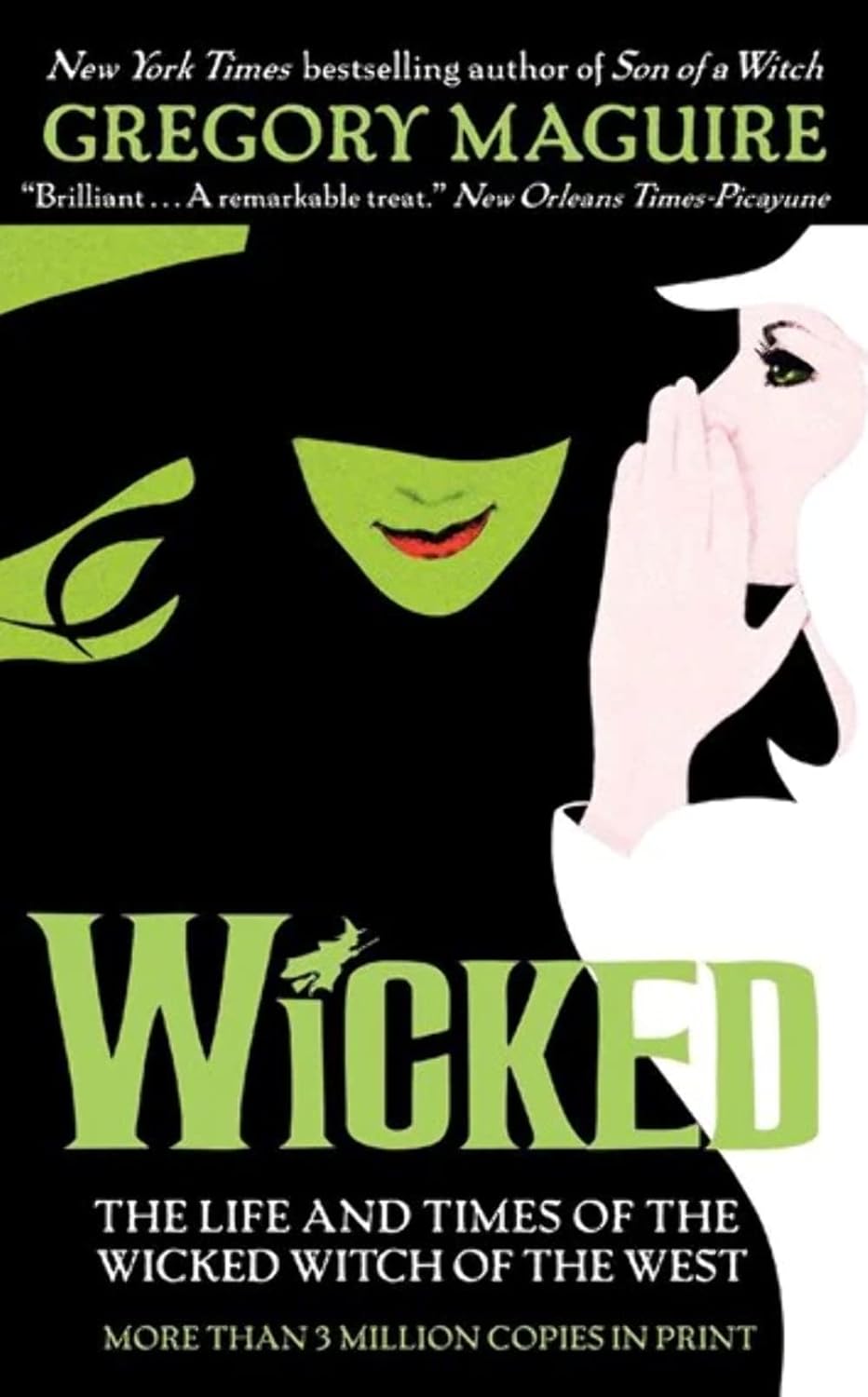
Sometime not long afterwards, I picked up a copy of the book that inspired all that, also named Wicked. Then, as is often the case, some years later I have read it, and my reaction is extremely mixed. On the one hand, I’m a little surprised to have liked it, even though I couldn’t say why. I mean, I liked its derivative work well enough, right? But still, I went into it expecting not so much, but with enough interest to understand why all the fuss. Instead, I got a pretty neatly put together series of five stories that probably could have been about five different people, even though they are not. The styles differ wildly (my favorite was the second part, at school, which reminded me constantly of Jane Austen) and the portrayals of our main character differ as well, due mostly to extensive passage of time between each section. I wouldn’t want to see it in a lot of books, but I kind of approve of Maguire’s choice to disregard continuity, perhaps in an attempt to give his audience more insight into the central point he is making about passing judgment without very many facts?

Which, right, I suppose I shouldn’t ought to assume everyone knows about the book. It is, basically, the other side of the story of the Wizard of Oz, in which our wicked Witch, Elphaba, went to college with Glinda, joined political resistance against a tyrannical usurper who styled himself the Wizard of Oz, and was eventually brought low by one Dorothy who frankly had no idea what was going on around her and was everyone’s pawn at every turn. And like I say, it’s a pretty entertaining story, with a lot of interesting character voices and structural choices. So why am I ambivalent? Because, at some point in the story, after her political agitations but before the arrival of her destined nemesis, Elphaba starts to reflect upon her legacy and quickly to fixate upon it, which gives Maguire an excuse to start dealing with everything through the prism of Literature, and Theme, and Essay Questions. And if there’s one thing I cannot stand, it is the 20th Century tendency toward intentional art. People should ought to create what they want to see, not what they believe other people will consider important. And that’s the worst part: this book is something I wanted to see. It just lost its way, somewhere along that yellow brick road.

A Nightmare on Elm Street (2010)

You already know this story. And if you don’t, it’s not that hard to explain. A group of teens is being stalked in their nightmares by a man in a festively-striped sweater, a man who is horribly burned and has knives on his fingers. Whatever he does to them in their dreams happens to them in real life. They have to figure out that it’s happening to them in the first place, and they have to figure out why, and they have to figure out how to stop it, or they will all die. Also, they can’t go to sleep, which makes clarity of thought a little tricky. Like I said, you know this story.[1]

A Nightmare on Elm Street has been remade, is the upshot of all this reminiscing. Which leaves only one particularly relevant question: was it remade well? And the answer is, it’s good. It took me a while to get over Robert Englund’s absence from the movie, but I’m pretty sure that was inevitable. What matters is, I got over it. And what’s left behind is… well, it was not a revelatory masterpiece like Rob Zombie’s Halloween, but neither was it a disaster like his Halloween II, and neither still was it lukewarm retread like Michael Bay’s Friday the 13th. It was, you know, good. It’s been so long since I’ve seen the original that I cannot remember if it was made straight and all the campy theatrics came later in the series, or if they were always like that. But I can say for sure that this version was neither campy, nor theatrical. Seeing it without knowing the backstory, it would have been more than a little creepy, and even knowing what I knew, the tension between exhaustion, fear, and a horribly revealed past was downright compelling.

If you’ve never seen a Nightmare movie, this would be a fine start. And if you enjoyed the series, I’m pretty sure you’ll be as happy with the remake as I was.

[1] The first few books of the Wheel of Time, amirite? *fingerguns*

Ultimatum: Requiem

If you are anything like me, you are wondering: why did you read so many Marvel Ultimate comics in a row just now? Way more than usual, and also you were kind of pissed, right? Well, the thing is, despite my distaste for the handling, I really had no choice but to see how things worked out for Spider-Man after reading that issue, so finishing up was my only valid option. And here we are.

Ultimatum: Requiem does about what a student of Latin would expect. That is, it sings a song for the dead. At least, that is kind of what it does. Although there are obituaries galore, at least one very moving and many of the rest little more than thinly veiled character histories, the bigger theme tying the three authors and stories together is aftermath. What will New York City be like with its self-appointed guardian Spider-Man presumed dead in the wreckage? Can the Fantastic Four survive the losses they have taken, to their families, to their mutual trust, to their innocence? Will the mutant community survive the knowledge that one of their own became, in one day, the most successful mass murderer in history? What could have been (and okay, in the case of the X-Men, was; you can’t win ’em all) not much more than an excuse to tie off loose ends before the brand changes to Ultimate Comics and new stories begin was instead a chance to acknowledge the wounds experienced by a whole world and put them in a human context. Superhero comics are always about wish fulfillment to some degree or other, but sometimes, they are more. Despite a deeply flawed execution of a tenuous premise, I figure a couple of authors were able to eke that out of even this situation.

(And I’m not just saying that because Joe Pokaski proved me wrong by in fact explaining to some degree what had happened to the Human Torch after all. I mean, it still wasn’t all that interesting, but at least he gets one of the two aftermath wins to make up for it.)

Ultimatum

jpegSo, Ultimatum, right? I’ve been talking about this for maybe longer in real time than Marvel did when they were gearing up for it in the first place. Due to some extremely poorly hidden spoilers that even show up in the titles of graphic novel collections, Magneto is finally sufficiently pissed off at humanity to do something about us once and for all, the major upshot of which is that Manhattan is devastated by an enormous tidal wave, in exactly the style you have seen so many times before. And then, shit goes down.

And the thing is, that sounds pretty okay to me as a premise. The whole world is affected, sure, but New York gets the lion’s share of focus, just as Marvel has always done. But then they screwed up my experience by dividing the story between the Ultimatum issues and the issues of the various series they had in progress at the time. Still, I think I could have been okay with that too, except that the actual event issues, even after I disregard the poor ordering, were… tawdry. Largely, they were a series of strung-together faux-shocking events, one after another, designed for maximum impact predicated upon minimum thought. And even that I could forgive, except that solid chunks of the events have no explanation at all. What really happened to the Human Torch? Did I miss something regarding Quicksilver’s fate, or was it presented as a fait accompli with no prior reference? Does Namor actually have any relevance to anything in the entire Ultimate universe? And since I’ve actually read the entire sequence now, it’s not like I can pretend to myself that these questions were answered or even acknowledged as valid.[1]

Essentially, there were a handful of characters that had a story arc in the Ultimatum event, and everyone else was only present to be trimmed down or because we knew they’d be supposed to be present during a global terrorist event. For the record, Wolverine, Magneto, Spider-Man, and J. Jonah Jameson actually had interesting stories to be told. Oh, and, to my very great surprise, Henry Pym. Iron Man and the Thing did okay. And that’s really all. For the climactic event of a ten year series, that is not nearly enough.

[1] I lie, as I have not completed Requiem yet. But I know I’m right. And even if I’m wrong, making stuff up and explaining it a few months later? Unsatisfying!

Ultimate Spider-Man: Ultimatum

Okay, just to get it out of the way: the Ultimatum storyline is poorly collected across three or four books. (I am hoping across only three, and that the epilogue book will at least have continuity[1] again.) I have read each of the three books in question, so I can say this with authority now, not merely the speculation that marked my last review. As a result, even Spider-Man’s take on the Ultimatum event is kind of disjointed. But here’s what I liked about it. While the other authors were stumbling past each other trying to figure out who could tell which part of whose story and in what order, Bendis got past the actual event as quickly as possible so that he could tell a smaller, more personal story about the immediate aftermath, and not incidentally about the nature of heroism.

The final issue of Spider-Man’s Ultimate run, #133, had the fewest words I think I’ve ever seen in a single comic issue. It may also have been the most affecting I’ve seen. And just to repeat myself, this in the midst of what has otherwise been a useless mishmash of tangled and rarely more than half-complete storylines. But, y’know, I should save a little vitriol for the next review, since this one deserves basically none whatever.

[1] The literary kind, not the years-or-decades-of-plot kind.

Collision Course

As you may already be well aware, William Shatner wrote several entertaining-despite-their-self-indulgence novels about the future of James Kirk, who thanks to various authorial tricks is functionally immortal. You couldn’t take them as high drama, but except for the last one you could mostly like them. Anyway, another two and a half years have passed, which made me due for reading his Kirk prequel novel, Collision Course. The series it was evidently meant to be spawning is not in evidence anywhere, so I suppose that means the book didn’t do too well. I theorize that this is a result of the previous book’s badness rather than any particular flaw of the current one, because honestly it was exactly what you would expect it to be. Which is not to say it was without flaws: far from it. But there are enough of them out to have a pretty good idea of whether you like Shatner’s vision enough to make up for his excess, so nobody could really buy it not knowing exactly what they’d be getting, is my point.

As for said prequel, here’s what it does. It takes teenaged Jimmy Kirk and slightly less teenaged Spock and chronicles their first meeting and the start of their friendship. See, there’s a plot involving stolen dilithium, stolen Vulcan cultural artifacts, and an army of killer children, and they end up in the middle of it due to possible complicity from Spock’s father and Jimmy’s Academy girlfriend, non-respectively. Also, there is a link to Kodos the Executioner, so that’s nice for longtime fans. And as usual, he gets a lot of things right through his many years of time spent in Kirk’s head. The only thing he particularly gets wrong, in fact, is that it’s a little too perfect. All of the important protagonist and antagonist players are involved in the plot from start to finish. There’s no tightening web of intrigue, no choice to get involved. As a result, everything is too pat. Which didn’t make the storytelling less good, but it did constantly take me out of the story. Pity, as it was a quick, engaging read except for that.

Iron Man 2

Iron Man 2: I liked it. That has kind of an epitaphy feeling, which is not precisely what I’m going for, as I decidedly do not presume that it marks the gravestone of a franchise. I think I may be mildly disappointed with it relative to my expectations, though, mostly based on how Spider-Man 2 turned out. ‘Cause there was a pretty great sequel. Still, though, on the whole it was a thoroughly entertaining sequel to an even better first movie, with nothing to particularly dislike about the new execution. Spectacle plus franchise equals success, right?

Also in the win column, Robert Downey Jr. maintains his essentially perfect portrayal of a billionaire superhero who is always secretly dying, having trouble forming real attachments to women, and drinking a lot. (It occurs to me that this may not be an acting job, ‘dying superhero’ aside.) This time he is facing trouble from the U.S. government, a rival military industrialist, and a brand new supervillain that shares characteristics with a couple of people from the comic book, most notably Whiplash. And while a bad guy who can split metal with his special whip may not seem all that interesting in a comic book[1], it works a lot better when he is using Stark’s own ARC reactor technology to create really cool-looking energy whips; also, when he is played by Mickey Rourke. The plot was probably a little bit muddled, but the pace was fast enough for me not to care, when combined with my knowledge that comic plots are often at least a little bit muddled in the first place. But then again, any time you sit me down in front of a movie screen where Downey either gets to be constantly awesome or gets to relearn how to be awesome after some kind of setback, that will be enough to satisfy me regardless of anything else that happens.

Also, if the spoiler-laden transition of Stark Industries’ CEO position never happened in the comics run? It should have. (I mean, the details are spoilers, the fact really isn’t. So please don’t misunderstand this as me having given away the farm, over here.)

[1] For my money, that seeming is fully accurate, though he’s only appeared in one story I’ve read so far and may get better later.

Kick-Ass

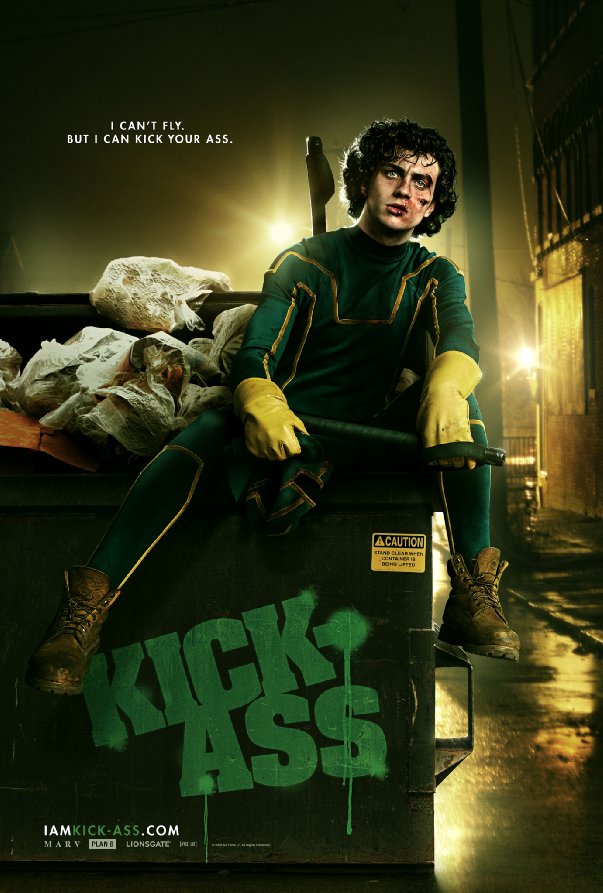
MV5BMTc0Mjg4ODc1Ml5BMl5BanBnXkFtZTcwNTUwNjEwMw@@._V1__SX1859_SY893_Here is an interesting true story for you. In addition to seeing Kick-Ass yesterday evening, I also happened to read Marvels (by Kurt Busiek and Alex Ross) the same day. I should probably review it separately, but since I read them as someone’s loaned comics instead of in a book, I have nothing to reliably link to, which is one of my lines for “shouldn’t get reviewed after all”. But also, it makes a very convenient companion piece, and so here we are. So, quick nutshell: Marvels is a four-issue comic that shows stories from the golden and silver age through the eyes of a news photographer, a regular guy who is the stand-in for the audience. Pretty much, a reaction shot to stories that the reader is theoretically already familiar with. A way to show not what being a superhero is like, but what living in a world with superheroes is like.[1]

But, anyway, Kick-Ass. It is almost exactly the same thing, except that the world doesn’t really have superheroes (or does it?), and the stand-in character wants to be one. Named Kick-Ass, as you may have already surmised? And I understand that this doesn’t really sound the same at all, but I don’t want to go much further into the plot, because it works extremely well fresh, or at least I thought so. The similarity is that Kick-Ass is in far over his head, in a world that he doesn’t yet know the rules of and has no real power over, and yet he still struggles to impose his values upon it. To the good of the world? To the good of himself? Neither? I say, just as in Marvels, that this isn’t the point; the struggle is.

The only problem with this review is that I’m making the movie sound far more high-minded than it is. I think it is high-minded, don’t get me wrong, but only in the deep undercurrents that I could for that matter be imagining. On the surface, it’s an insane, ultra-violent[2] romp through several origin stories and culminating in an over-the-top spectacle of a battle royale with the supervillain, the way most comic books movies want to be. And it is threaded through with the essential humanity of every one of its characters, the way more comic books and their movies should aspire to, but frequently do not.

[1] It’s also pretty good / recommendable, if that matters.
[2] I am utterly mystified how it got a PG-13 rating.