Category Archives: Words

Eric

If all the Discworld books had been like Eric, well, okay, probably most people that I know would still have read them. They are, after all, competently written comedic fantasy. But they wouldn’t talk about them nearly as much as they do, at the least. I mean, as a representation of the kinds of things that tend to happen in Discworld, it is a top notch book. The problem is that, even as short a distance into the series as I am, I’ve come to expect a fair amount more incisive literary and social depth, and never mind the amount I expect from all the buzz that surrounds later books in the series. By contrast to that experience/buzz, this book was a merely[1] funny series of vignettes strung together as a parody of Faust with a horny thirteen-year old in the eponymous role and resident failure (as a wizard, too, but I more meant it with a capital F) Rincewind as the wish-granting demon. If that doesn’t make a lot of sense, well, that’s what the plot is for, yeah?

The sad thing is, I’m totally not joking about it being funny or a really good sample of the kind of thing that happens every day on the Disc. If there’s a moral to my story, it’s this: expectations are a fickle bitch. And as for great expectations, well, they were written by Dickens, which I think tells you everything you need to know.

[1] he says, as though that’s not a reasonably tough accomplishment on its own
Powers: Roleplay

The upside of the second Powers book is that I’m continuing to enjoy the slow reveal of Bendis’ created superhero world, which is chock full of history, dark secrets from the past, and ongoing plots that are heating up in the background toward what I trust will be a violent boil. The downside of Roleplay is that its plot, in which a number of college students in illegal superhero costumes run afoul of the law and a powerful supervillain, was slightly easier to wrap up than any given episode of Law and Order, and mildly disinteresting besides.

Which is not to say the book was bad: all the bits that aren’t essential to this particular current plot were, as I said, fascinating. It just concerns me that if the story arc and history mines are ever played out, what is left will be a disappointment, and it concerns me more that an overly slow reveal of those elements might make equally iffy immediate plots become intolerable before I reach that other point.

All that said, I’m glad I read the first of these books before I read Astro City. Because Bendis’ created superhero world is good, but it wouldn’t stand up very well if I’d had to compare it from the start, and then I’d be depriving myself of what I still assume will be a good story.

Ultimate Spider-Man: The World According to Peter Parker

The only particular problem with The World According to Peter Parker[1] is the name. I mean, it’s not a terrible name, and if it felt as much like the first entry in a series as the name implies, I might well have no complaints. But it’s obvious that there’s some amount of continuity that the reader is behind, regardless of the new imprint[2] the series is being published under. Maybe it’s not obvious that there are twenty-two volumes of continuity, but some amount is definitely detectable.

Everything not the title, though? Good stuff. Six months have passed since the Ultimatum event, which indicates some decent passage since Tony Stark’s one-man war against his stolen technology, and things are kind of getting back to normal. Well, unless you’re Peter Parker, whose life has changed in all manner of unpredictable ways. But that’s what I’m digging the most about this brave new world, is that with so few titles as yet launched in the Ultimate Comics line, Bendis is at least for the moment at the helm of the whole Ultimate universe. So we get to see the fates of some other familiar heroes[3], the violent rise of a new nemesis[4], and generally see the lay of the land, all while leaving room for a very gradual reveal of the changes (and underlying causes thereof) in Peter’s non-hero life. And, okay, I’m willing to admit that for the most part, this actually does work as Volume 1 after all, not just of the new series but of the whole new shebang, even if it was the second story to be told in this recovering universe. Which really is why I’m glad Bendis is the one mostly in charge right now, until more titles have launched.

All that said, the art is surprisingly manga-like. It’s not bad, other than in the case of one character that it might be spoilerish to even mention, but it’s a little jarring in this context. Still, yay for not being bad!

[1] And it may be a Garp [or some other] reference that I’m just not getting?
[2] Is that the right terminology?
[3] And, predictably, more of the awesomeness that is May Parker.
[4] True story: the end of the first issue? Total “Holy shit!” moment.

Blockade Billy

There’s a thing that happens when Stephen King books come out, and it is this: I buy them and read them. Of course, sometimes they slip by me unnoticed for a little while; and for that matter, sometimes they should. Blockade Billy and its companion piece are not bad stories, by any means. I enjoyed them both! And despite the tiny size of the book, I only paid paperback pricing or so, and even for a book that only took about a day to read the lot of, it’s not like I feel ripped off by undersizedness or anything. The only real problem I have is that the two stories (one about the meteoric rise and precipitous fall of an eponymous baseball catcher, the other about an indecent proposal) are both too short to really count as a book, and now I feel like I should be reading the rest of a short story collection that I do not, in fact, have to hand.

Leave ’em wanting more is one thing, but I’m pretty sure leaving ’em entirely unsatisfied is a bad motto. And it’s a pity, because the first story especially was quite good. I should caveat that it was very baseball-heavy, though, as some people who are insane don’t like baseball.

Jack of Fables: The (Nearly) Great Escape

A few volumes ago, I made reference to my knowledge (garnered through the publishing industry) that Jack Horner, the same Jack who climbs beanstalks and kills giants, would be getting his own spin-off comic series soon. That was true, of course, and I’ve finally reached the point in publication order where his book interrupts the straight-through Fables series. (Which, by the way, is wow, long series. And I think it has no end in sight? So that’s a thing.) The Jack of Fables series picks up exactly where his story in the main continuity left off: with Jack once again on the wrong side of Fable law and in pursuit of a new way to re-create his wealth, fame, and generally easy lifestyle that he so richly deserves. Just ask him!

As the title of this first volume implies, he is almost immediately derailed in these intentions by his capture into a home for the dissolution of fables. Being the type who is not generally fond of being forgotten, he immediately sets about getting out. From there, adventure, chaos, and some amount of comedy ensue. The exact amount depends mostly upon just how much you are either willing to accept Jack’s conceit that he really is the most important person anyone he meets will ever meet, or upon how much you’re willing to accept the authors’ backhanded irony within Jack’s conceit. I’m split about halfway down the middle, laughing with him and at him in equal measure. If you find him intolerably boorish (which is fair!) and annoying conceited (which is even moreso), then you’ll probably hate not just the book but the whole series. In which case, I hope the eventual crossover is not much different than when Jack was just one of the characters in the series and will require no other knowledge to follow along with. That would be unfair.

Ultimate Iron Man: Armor Wars

My recent history with Iron Man has been an odd one. The original run of comics has become truly terrible over the course of the early ’70s, the second movie was only serviceable, and the two previous solo comics in the Ultimate series were not to my taste. Despite that, I have consistently loved the character of Tony Stark in every format with which I am presented, and certainly he always works great in other, more collaborative works. Why can’t I find a consistently good solo run of Iron Man stories?[1]

Meanwhile, the Ultimate Comics brand has launched[2] in the same continuity as Marvel’s Ultimate series, only different I guess for publishing purposes? In any event, it’s right after the Ultimatum event, complete with destroyed New York City and a real dearth of living superheroes and -villains. This dearth does not include Tony Stark, who has escaped with his life and [in the collapsing economy, still] hundreds of millions of dollars. It does include the realization that his technology has slipped its bonds and there are suddenly people in advanced military suits all over the western world. And it’s Tony’s job (because it’s his responsibility? because of his pride? I guess the real question is whether those concerns are even extricable in his psyche) to get into Armor Wars with them to put at least this small corner of the brave new world aright.

The thing is… I mean, it was pretty good, right? But in all honesty, I think I liked it more because it was better than what I’ve been used to seeing than because it was an objective upgrade to the solo Iron Man oeuvre. At the very least, though, I’m glad this was Tony Stark in the full bloom of his ego instead of another chapter in his iffy origin story.

[1] I should note that I have faith in the badness of the current ’70s run being finite, and frankly also that I expect Iron Man 3 to be pretty great. Y’know, someday.
[2] Well, probably last year in real life, but the graphic novels have only launched over the past few months, which means I am approximately live on these books from here forward.

Boneshaker

Oftentimes, I do not read Hugo-nominated novels. Basically, any times. This is not by design, and I’m sure you could prove to me that I’ve read several by pointing things out on a list, but I’m at least never aware of it. I wonder if next year I will start? It would at least be an interesting change of pace. This matters to you because my good friend Skwid lent me Boneshaker, on the premise that it was a steampunk/zombie crossover novel and I would therefore like it. Which is plausibly a fair assumption to make.

So, anyway, I did.

Longer review: yes, it’s Seattle steampunk set in the late 19th Century, yes, it has differently-named zombies, yes, it has wholly gratuitous zeppelin chase scenes. Yes, it has a lightning fast pace that would be well suited to future filming. But at its heart, it’s a family drama about parents and children, husbands and wives, learning how to let go and when to hold on. It sounds insulting to say that if you removed the steampunk zombies and gratuitous zeppelins, I could find this story on the Lifetime Movie Network a dozen times a week, but it isn’t. It isn’t insulting at all, because Cherie Priest made me fail to hate the idea of reading [or watching] that story, and it turns out that (as you’d expect) it’s a pretty good story indeed when told interestingly rather than hand-wringingly. I have of course no idea whether it’s better than the other Hugo-nominated books, nor am I likely to. But yeah, maybe next year?

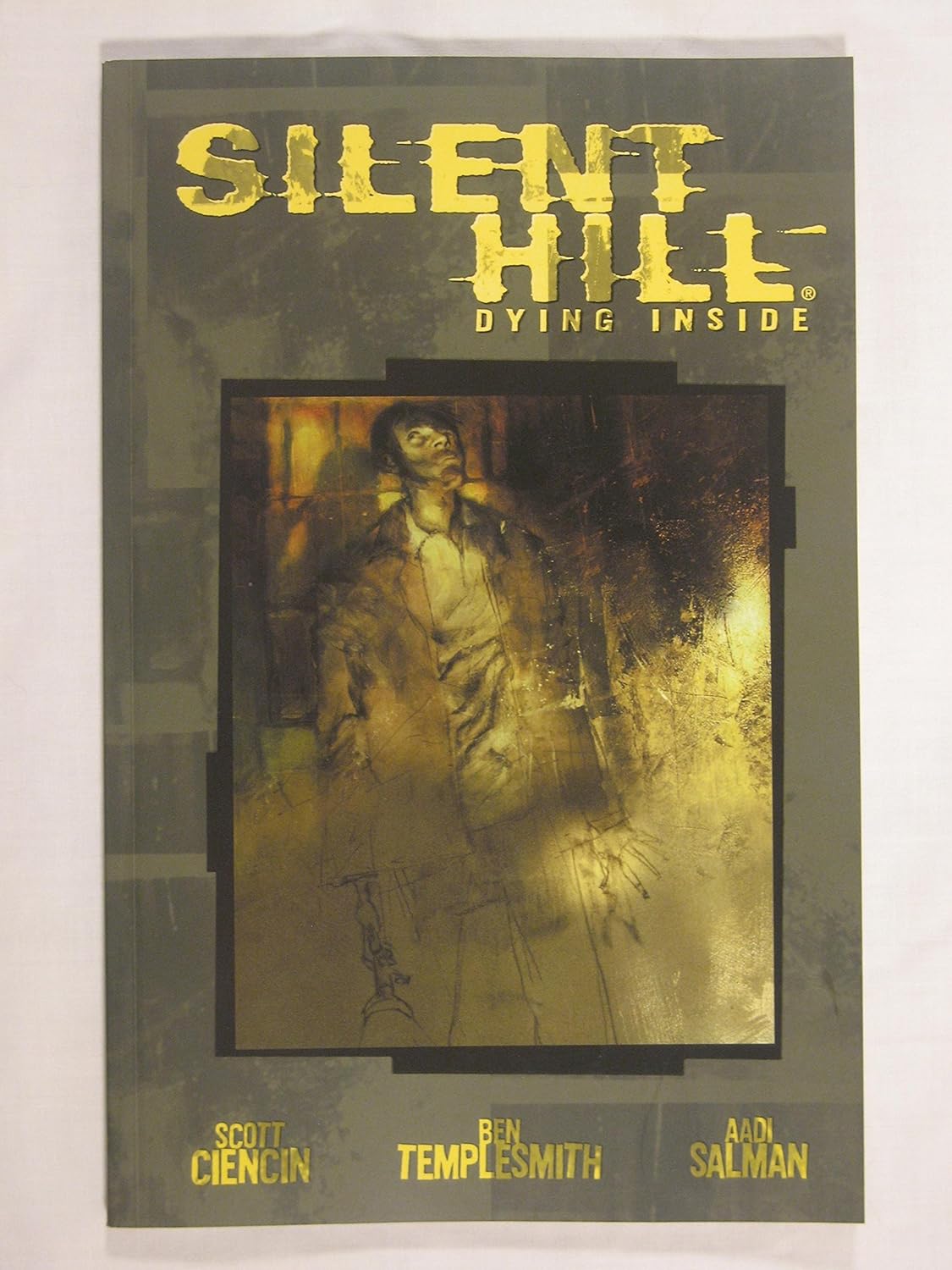
Silent Hill: Dying Inside

They say you can never go home again. Then again, they also say that home is the one place where, if you go there, they have to let you in. What is interesting to me about Silent Hill is that it is somehow the opposite of both of these things at once. Silent Hill is a place where, if you go there, it slithers inside of you and you can never really leave again. Which is why I find the games compelling enough that even though I only ever beat the first one, and with the worst possible ending, I still want to go back and play through the whole series. Which would I suppose be easier if I owned any of them.

This makes it all the more disappointing just how non-good the (apparently first in a series) graphic novelization is. Dying Inside follows a film student, a lauded psychologist, and a punk chick as they interact with the disturbingly empty (although, often it is even more disturbingly not-empty) town of Silent Hill, where a person’s bad thoughts have a way of doing more than haunting them, and really of haunting more than just them. It’s like a horrifying state of mind given flesh, and sidewalks, and hospitals and elementary schools. The story is sufficiently creepy, and has the seed of a really great concept, about a girl’s guilt over losing her little sister at the mall in pretty much the most horrible way imaginable. But the execution is almost total failure, with direction changes that come out of nowhere and plot elements that barely make any sense, even when taken as a whole after the fact. Or it’s possible that it would have been fine if I had not been so distracted by the art, which bleeds all over the page, one panel indistinguishable from the next. And that style could have been very effective as a means of demonstrating the breakdown in reality between Silent Hill and the outside world, except that it was used indiscriminately from the first page to the last. So it could be that it was the art I couldn’t follow and the plot was just fine, instead? I don’t know or really care, because I have forgotten to even write this review for the past two or three days. Not dreaded it or wondered what to say, but consistently forgotten I had even read the book.

That probably makes my point better than any of the rest. Still, it was in some way effective, because damn if I don’t wanna play me some Silent Hill! (Did I ever mention it was originally a video game? Oops.)

Lucifer: Crux

I have spotted my point of failure as a reader of the Lucifer series. All the way back in (judging by the covers[1]) the first volume of the series, there’s this performer named Jill Presto who is forcibly impregnated by a sentient deck of cards called the Basanos. And it’s an obviously important element of the plot of both the first and several of the later stories. And although in each case it’s obvious why she’s there and what’s going on, it is an inescapable fact that I cannot keep a sense of her and her doings as she relates to the arc of the story. I probably just haven’t tried, when you get right down to it? At least I know what I’ll be especially watching for when I do a someday reread. But it’s just sad to me that no matter how easily I can follow or at least unravel the rest of the plot and respectably examine the themes, there’s still this whole character that I have a blind spot for.

That said, the rest of Crux, the part that I was caught up with and able to follow along, I mean? Solid transition book in which I do, in fact, get to see more of Lilith, just as I had requested. I’m not sure yet if this was a mistake on my part. After the previous volume’s escalation toward Armageddon, every moment of Crux was set at that eponymous balance point before the plunge, getting the characters into position for the great conflict of our age. It was, y’know, successful at that, and even in plot-based transition Carey has a good eye for storytelling. Still, that next climactic book? I am hoping for big, unexpected things!

[1] Which you should never, ever do.

Ultimate Wolverine vs. Hulk

At long last, the weird forgotten story that languished for a few years in developmental hell even as the rest of the Ultimate universe was being tied up in a neat (by which I mean Gordian), tidy (by which I mean murderously violent) bow (by which I mean bow). After Ultimate Wolverine vs. Hulk, which I would for my sanity place after Ultimates 2 ended and before any of the Ultimatum prequel-storylines, I will be explicitly in the “after we killed the Ultimate Universe and launched a new line of comics” territory, which is physically marked by my buying them in hardback graphic novel instead of paperback. Plus also, I’m almost completely caught up and will soon run out of new ones immediately available, which is a strange feeling all itself.

As for the story, well, the title kind of covers it. There are definite twists along the way, plus also pointers to Logan’s fate in the post-Ultimatum landscape, neither of which I have any interest in spoiling. I can say that series author Damon Lindelof, famous as an integral part of Lost’s creative team, is clearly the same guy you would expect to have written both things. He plays with the narrative structure pretty much from start to finish, calling it an effect of Wolverine’s constantly tampered-with memory even though we all know it’s an excuse to tell the story out of order for dramatic effect. I have no problem with that, and I guess I can see why he felt obligated, in a world he never made didn’t create, to come up with an excuse for why it was happening, but mostly what I think instead is, come on dude, we know you did this only because you think it’s awesome, so why pretend there’s a valid in-story reason?

Anyway, though, Hulk and Wolverine? They totally versus each other, way more than that time when Iron Man was supposed to but it turned out pretty much entirely otherwise. Truth-in-advertising for the win!