Category Archives: Words

Neutron Solstice

I am still a little bit astounded by just how well the Deathlands series is paying off for me. Okay, sure, I’ve only read three of them so far and the series is still being published some 25 years later, but the truth of the matter is that the setting, formula, and characters are enough to keep me satisfied for a very, very long time. It turns out that post-apocalyptic gun porn with a hearty dash of science fiction and hints of a large backstory around the edges, being revealed piece by laborious piece, is pretty much my idea of comfort reading. And the irony of it is that my review of Neutron Solstice is essentially identical to my review of Red Holocaust, at least in every important way. The only differences are in the window dressing; instead of the bitter cold of Alaska, our heroes have teleported to the steamy swamps of Lousiana, and instead of Soviet invaders as the enemy, they must face the iron fist of a giant baron who is improbably not named Samedi.

But if you are looking for giant mutant alligators, voodoo zombies, maddening hints of the past from resident anachronism Doc Theophilus, or a decent chunk of backstory on one-eyed hunk Ryan Cawdor, you’ve come to the right place. Of course, you have no reason to be looking for most of those things, but that’s what I’m here for. If you’re like me and societal decay is your literary bread and butter, prepare to be astonished by just how much you’ll care about these characters, and especially by how affecting each scenario can become. Whoever this James Axler is[1], he’s actually a pretty damn good writer. Who knew?

[1] Pete knows, and I cannot help but dread the day when a new author shows up under the farm name, because what if the books drop back down to the quality of generic men’s adventure stories?

The Way of Kings

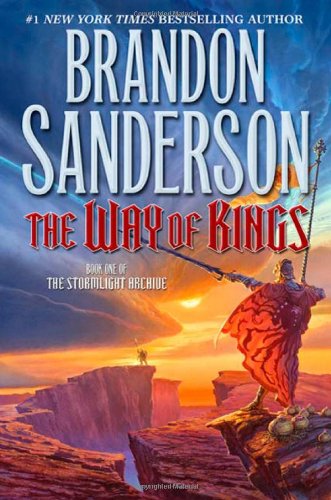
51WC999OnyLTruth be told, I finished The Way of Kings days ago, during the weekend. (Don’t worry, I’ve been reading only loose comics since, so it’s not like I’m getting backed up or anything.) I guess the reason there’s been no review is because it’s a very large book. Physically, too, but I mean it’s a very large story. I mean, it’s referenced on the cover as Book One of The Stormlight Archive, and it’s being written by the guy who stepped in because Robert Jordan was crushed under the weight of the Wheel of Time.[1] So you can see why this is tricky; I don’t think I’ve ever reviewed the first book of a doorstop fantasy series without having read other books in its series prior to any review. Still, since I keep thinking about the physicality of the book, it’s a good place to start, particularly during a month in which a lot of the chatter I see in my corner of the internet is about the migration to Kindles or other electronic book-reading devices.

Whether because Tor is also thinking about the e-book revolution a lot lately or simply because they’ve been sufficiently satisfied with Sanderson’s output over the past few years to want to splurge or maybe it’s something Sanderson wanted out of this book in the first place, but The Way of Kings is probably the prettiest modern book I’ve ever seen. The cover art is nice but not all that noteworthy; the inside is where it’s at. The inner covers have multiple different maps of the same continent, in startlingly fine color detail. The paper is heavier than I’m used to, not quite to the way I imagine vellum, but definitely of superior stock. There are any number of drawings and diagrams scattered throughout the story, each also of excellent quality. It’s the kind of book you’d expect to buy a special edition version of, years later, to get this many goodies. I know that has no real relevance to whether it has a good story, but it strongly informed my initial impressions, and even filtered through my distaste for non-physical books, it would be a pity to be looking at this on a screen. (Or even a paperback, almost certainly.)

So, was it a good book? I will say unreservedly yes, because a) I otherwise had nothing to complain about and b) my favorite part of any good-sized tale, the characterizations, was masterfully drawn. There are about four main characters and a handful of important secondaries, and another handful of very minor characters adding world flavor and possibly highlighting Important Facts that are not yet clear to me but will seem painfully obvious upon some future mythical reread. And except for those last few, I really do care a great deal about what’s going to happen to all of them. Of course, things will happen to them, as Sanderson doesn’t innovate the fantasy tropes: the world is falling under a long shadow for the first time in millennia, a shadow humanity has all but forgotten, and our heroes must figure out their own shit if they have a hope of doing anything about the worse shit coming. But Sanderson innovates like nobody’s business on sense of wonder, and he got it all over me. Still, that wouldn’t be enough to leave me excited[2] without how well he writes his characters and without the attention to foreshadowing and as yet unsolved mysteries and the promise of more that lie ahead.

I guess, after all is said and done, my excitement comes from the fact that this is the best kind of doorstop fantasy: the kind that leaves me wanting more and at the same time willing to pause and digest and discuss and (yes, someday) re-read. And while there are several series I’m in the middle of that leave me with some portion of those desires, this really is the first one since I finished Jordan’s The Shadow Rising and was officially caught up on Wheel of Time publications that has left me with all of them at once. That’s a heavy expectation to leave on a book, but I can’t really lie about it, right?

[1] I have a saidin-poisoning joke floating around in my head, but it would almost certainly be in bad taste. Well, worse taste.
[2] As opposed to merely entertained.
Ex Machina: Ring out the Old

So it turns out I was wrong about which was the penultimate volume of the Ex Machina series. But, since the series is now over in monthly publication form, I can definitively state that Ring out the Old is next-to-last. Superficially, it has the same structure as all the books: Mayor Hundred addresses a political issue (environmentalism!) while at the same time a piece of the puzzle of his past and the mysterious powers he’s been granted is revealed. The big difference is that Vaughan finally noticed his story was nearly over and picked up the pace on the latter portion. I can’t help but wonder whether the pacing would look right if I read the series all as a piece, but at the same time, the series has been released piecemeal (in two different formats) over the past few years, so there’s only so much credit I could give to that possibility even if it were factual. It’s not that it was a bad story, but since I’ve spent all this time wondering what was going on only to see it all finally revealed in a chunk at the end, mainly I’ll be glad it’s over. I guess I had a journey fail, here.

Oh, but the initial story in the book before all that I just mentioned, about Hundred’s biographers? That was just shameless self-indulgence.

Marvel Zombies 2

The thing about the Marvel Zombies series, or at least about these first two books’ worth that I’ve read, is that they’re not all that good objectively. Despite the fact that they have interacted with one of the two mainstream Marvel continuities and are therefore entirely valid storylines, the main purpose behind them is still to be a little bit of a laugh. There are serious moments in Marvel Zombies 2, don’t get me wrong. Early on, when Peter Parker and Luke Cage are talking about why Pete still makes jokes, after 40 years in which they have devoured an entire galaxy’s worth of sentient life, he replies that if he doesn’t, all he’ll be able to think about are the decades of horrible atrocities he has just committed. Sure, they don’t really pick that up and run with it, but it’s heavy stuff for nominal superheroes to deal with.

But my point is that, after all is said and done, it’s still a lightly comedic look at a Marvel world where things went terribly wrong and now everyone is dead and our heroes still need to eat, and whatever will they do? You can be sure it will be violent, gory, and a little bit hilarious. And that there will be four more sequels, for some reason? If I find them used, I’ll check them out, but I just don’t have the necessary hunger for the subject matter that would require me to make them appear on my doorstep in a few days.

Drood: A Novel

The very best and very worst thing about Drood is how heavily invested it was in Charles Dickens. Because, and here’s the thing, I really dislike that guy! He probably wrote great stories full of interestingly-drawn characters, but the names are so twee and the plots so meandering (ah, payment by the word) that I’ve never been able to get past that to whatever it is underneath that people rave about. But this book, you see, in which Dickens and fellow author William Wilkie Collins concern themselves with a mysterious foreign priest and  murderer, has narrator Collins espousing the same Dickensward distaste I have, and for some of the same reasons. So it’s nice to start off a book with someone that’s on my side.

I mislike the idea of delving very far into the plot, as Simmons is good at doling that out at his own pace; it’s only the endings that seem to fall apart. And in this case, I can truly say I don’t have that complaint. The complaints I do have are largely character-based and hard to elaborate upon other than through those spoilers I’m avoiding. Suffice it to say that for a variety of possible and overlapping reasons, our narratorial window into the world is severely compromised, making it impossible to have any confidence in unraveling the central mystery of the novel, and even worse, making one doubt that Simmons actually has any complaints about Dickens himself.

Still and all, the twists and turns are entertaining and the narrator’s personality made up quite a bit to me for his compromised perspective, so if you can live without being sure what happened[1][2], it’s a pretty fun book. Also, if you care, this is explicitly the same world as his previous The Terror, right down to the fact that Dickens and Collins wrote a play on the very topic of that missing expedition. In real history, yo!

[1] And I know that some people cannot…
[2] If you’re sure that we are told what happened and I’m just holding on to alternatives unreasonably, I am prepared to have a discussion about why that would mark pretty shoddy writing and also to bring up a pair of scenes that cast vague, formless doubt on the whole enterprise.

The Walking Dead: Life Among Them

Unexpected event: reading two books in a row by Robert Kirkman. And both with zombies, at that, despite the fact that he apparently writes lots of non-zombie scripts as well? (I have some small evidence of this, at least.) So the main difference is that I started off kind of angry about this book; the first few moments contained a bait-and-switch that made me pretty confident the series will in fact never end and not-at-all confident about my willingness to be dragged along for the next 72 issues. But then, over the course of the rest of the book, Kirkman reminded me why I’m still on this ride in the first place, which is that he really is good at the psychology of the zombie apocalypse, not to mention good at tension.

Life Among Them raises a new question that has not been asked before in the series: is it possible to go back to the old life? And although watching various familiar characters trying to adapt to the hope and possible fact of new safety, among people who claim to have held it for some time, is interesting enough on its own merits, I was most taken with my own reactions so similar to the characters. Constantly looking for something out of place, latching onto to anything strange, and unwilling to let my own guard down. If that’s how I feel about it, it must be only the very tip of how tense they feel. And by the end of the book, other new questions are being raised, questions that leave me squirming uncomfortably and yet still completely sold on at least one more volume, just to see where he goes next. Considering I started off angry, that’s a pretty neat trick.

Marvel Zombies

I’ve been sitting on this book for over two years, apparently. As has often been the case in my various Marvel readings, it’s worked out really well for me, the delay. Sure, there are things I haven’t read yet and things that haven’t happened yet and so on, but the very fact of making it all the way through Stan Lee’s era as chief editor of Marvel (which ended just this month, basically, where this month is September of 1972) means that I have seen at least most of what any given Marvel homage is going to make reference to. And boy howdy does Marvel Zombies assume you are familiar with most of the characters and at least a couple of the plot lines their universe has spawned over the past 50 years.

The very concept seems ludicrous at first blush. Take all the Marvel super-powered characters, infect them with a zombie virus, let them destroy humanity in a matter of hours, and then leave them doomed to eternal hunger while figuring out what to do next? But it works, partly because this particular earth has missed a key event in the Marvel mythology, but mostly because, zombie or not, they’re all the same characters when they’ve had enough food to clear their heads for a moment. Hank Pym is still a colossal jackass; Tony Stark is still entirely full of himself; Peter Parker is still wracked with guilt and uncertainty. It’s not a classic zombie story where the zombie thing is just a backdrop against which some social theme is highlighted, but it is pretty damned funny. And I think I’m glad; if they’d played up the existential angst of heroes sworn to defend humanity having been its extinction, and with hardly a pause for thought until after the fact? That just would’ve been depressing.

Proven Guilty

The only problem I have with the Dresden Files series, at least for right now, is the pretense that there is a broader world beyond the bounds of Chicago in which things are happening over which our wizarding hero Harry (no, not that one; the cool one, Harry Dresden) has no influence and can only react to when odds and ends of it affect his city and the lives of his nearest and dearest. I mean, that’s factually true, which I suppose makes some kind of case for it not being a pretense at all and me just filling a paragraph with lies for the sake of volume. But the thing is, we all know that sooner or later these world-shaking events will drop onto Harry’s doorstep and he’ll be forced to deal with them[1], and while that will make for an exciting plotline, it’s still somewhat disappointing that the depth of world will be proven a bit of a pretense after all and it really was all about Harry Dresden, start to finish.

On the bright side, Proven Guilty is yet another entry in a long and seemingly unstoppable series of books designed solely to justify making it all about Harry by presenting a cool, funny hero who is always clawing his way out of the hole with equal parts style, honor, and romantic frustration.[2] In this case, much to my delight, he’s doing all of that at a horror convention that is being stalked by exactly the kinds of horror icons the fans are there to see, more or less. Stir in a new practitioner of the dark arts on the loose and Harry’s new duties to take care of that kind of problem, plus all the usual suspects (good and bad), and you have, well, a book of the Dresden Files, which alone is enough to pretty much guarantee a good time.

[1] In fact, this has already happened at least once.
[2] The many, many series of urban fantasy with female protagonists seem to have as a common thread how irresistible said protagonists are and how much sex they either could or do have, depending on whether they’re co-filed into the paranormal romance section of the bookstore. The Dresden Files, in addition to being just about the only one with a male protagonist in the first place, also seems to be about the only one without any supernatural powers of sexiness for the protagonist. This leads me to no particular conclusion, but what with my psychology hobbyism, I can’t help forming questions.

Hack/Slash: New Blood, Old Wounds

The downside of the many brief glimpses of plot lines that are not yet quite relevant to Cassandra Hack’s current circumstances is that, not reading the entire storyline in one huge gulp[1], it’s easy to get lost and not quite remember people when they do finally take center stage. The upsides more than make up for that, though; not only is there a sense of a world that matters out there, a world that is moving and changing and preparing to hand nubile slasher-killer Cassie her next big emotional or physical face-plant, but a quick glance at my previous review is usually more than enough to remind me of what was going on. I mean, these are really good T&A horror-films-presented-as-comics, but they’re still T&A horror stories, and only so much depth of plot or theme can be accommodated between panels of girls naked in bathtubs or disrobing prior to exactly the kind of sexual shenanigans that rile up slashers so much in the first place.

In this particular case, the depth of plot that is permissible revolves mostly around revelations about the cult that has made the world the way it is, which is to say: full of dead and yet unkillable slashers that mindlessly stamp out “sin”, by which we tend to mean underage drinking, drug use, or pre-marital sex. Mix that with a handful of those hints about what else is going on that I previously mentioned, a few scenes of light angst for  Cassie and her comrade-in-arms Vlad, and probably an only four-to-one ratio of regular panels to titillating ones, and there’s not really room for anything else in the latest such volume, New Blood, Old Wounds. I know I’m making these sound like a guilty pleasure kind of read, but even if I were guilty about reading them, the truth is, they’re a little bit higher rent than the connotation behind that phrase. Not a lot higher, but a little bit.

[1] I mean, I wouldn’t anyway, but the incomplete nature of the series would make it impossible even were I so inclined.

Ultimate Avengers: The Next Generation

With my completion of The Next Generation, there are no longer any Ultimate Comics for me to read, and I have to wait for new ones to be published. That’s just weird, is all I’m saying. As for the story itself, well, that was pretty good, albeit with a healthy dose of the darkness that the Ultimates have been known for in the past. That said, my ongoing read of old Marvel comics[1] has served me well in caring much about this story, because if I was not aware of the long-standing rivalry between Captain America and the Red Skull, it would have been a lot harder to swallow the idea of this giant terrorist threat that’s been around for decades, only we never mentioned him before now because of how he retired prior to the current wave of genetic superheroism.

Anyway, though that’s the main focus of the story, the stuff going on in the background as set-up for future stories is entirely intriguing, and that’s what I want out of another first volume of a re-reboot: lots of groundwork for awesome futureness. And I guess I’m done, because the plot part of the story is more than good enough for me to not want to carelessly reveal anything that actually happens, and yet the themes are not really all that deep the way they have been in previous Millar Ultimates stories. The weird (and sad) part is that there’s some pretty fertile thematic ground available, if they had chosen to exploit it.

Oh, and I will complain about one thing, which is the random insertion of a ton of new characters that seem unnecessary when there are old characters already sitting there, in some cases filling identical roles. I trust there will be some kind of payoff in future volumes, when these new folk become awesome? Except for the random new Stark brother, as that is just a downright stupid retcon that violates every other published story with Ultimate Tony Stark present, and as far as I know violates all the main continuity stories. (At least, the ones through the spring of ’72.)

[1] I am up to April of 1972!