Category Archives: Words

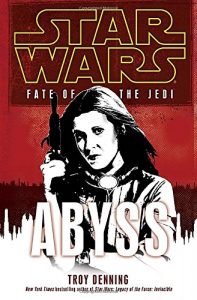
Abyss

As with previous ongoing Star Wars series, Abyss marks a point in the storyline where it gets a lot harder to say anything much useful while also avoiding large spoilers for previous books. But I’m interested enough in seeing where they’re going with it to lay out at least a bare-bones sketch, all the same. First, things I’ve probably already told you anyway: the Fate of the Jedi series takes place some forty years after Luke and Leia and Han saved the galaxy from the Emperor. They have since saved it from the rest of the Empire that wasn’t really done yet despite their boss’s demise, from extra-galactic invaders, and most recently from a newly risen Sith Lord with uncomfortable family ties. Now, the Jedi are trying to save it from themselves, since many of them are suffering psychotic delusions, while navigating a political minefield that has already resulted in Luke Skywalker stepping down as Grand Master of the Jedi Order to go on a pilgrimage and figure out why good people do bad things, more or less.

Okay? So, the series at large has been Luke and his son hopping from one group of non-Jedi Force-sensitives to the next to gather this information, while everyone else plays at political shenanigans back home. The political shenanigans have been interesting, but in this book (as, I suspect, ultimately will be the case in the series as a whole) they’ve been largely irrelevant stage-dressing, since they don’t really touch on the Force, which is what we’re honestly here about, right? That part is where I’m getting to be interested, for two reasons. The first is one I’m likely to be let down by in the long run, but they seem to be making a close examination of Lucas'[1] underlying cosmology for the entirety of his creation, and I hope to see interesting conclusions drawn. The second, though, is a thing I haven’t mentioned previously (I don’t think), that there seems to be an old-fashioned Jedi-Sith confrontation on the way. Not the master-and-apprentice always-two Sith Lords of the last good long while, no, I mean the actual Force-sensitive species of them that wanted to take over the galaxy way back before there was an Old Republic. Which admittedly doesn’t sound that different on the surface, but old things coming back has always seemed pretty cool to me, and I do not expect to be disappointed as far as seeing where that goes. So, y’know, possible cool stuff in the outing, and interesting philosophical turns and the omnipresent swashbuckling and aforementioned political shenanigans in the meantime are more than tasty enough mind-candy to keep me coming back for more.

[1] I mean, obviously he has never given it even a tiny fraction of this much thought, but I guess at some degree of abstraction he still has veto power.
Fables: Sons of Empire

I think the main oddity of having started the Jack of Fables series is that it breaks up the flow of the “big event / build-up to next big event” in the main Fables sequence. Thankfully, it didn’t make me like Sons of Empire any less, but it does explain my unwarranted confusion over the slow pacing. Having gotten past that, the story was superlative for one of the down-cycle stories. In and around the Empire’s plans of vengeance against Fabletown, family vacations, and thumbnail character sketches of the bit players, the book is mostly about paternal relationships, and mostly about bad ones at that. Still, the woes of fathers and sons would only be so interesting of a theme, however well presented, if it were not for the fact that I’m sure these particular relationships — between Gepetto and Pinocchio, and between the North Wind and Bigby Wolf — will be of vital importance to the rest of the story.

Well, or to the next phase of the story, depending on whether or not Fables is an open-ended or an arced tale. I honestly have no idea which is the case, so.

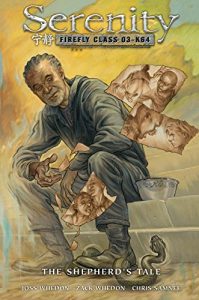
Serenity: The Shepherd’s Tale

51OPFX5nmALA third[1] graphic novel in the Serenity universe has just recently been released, and I love me my Firefly more than enough to snap it up and into the rotation right quickly. If you are familiar with the universe, the title alone will be all the spoiling you could hope for, and if you are not, this would be a hard (but not insurmountable) place to start. Still, just in case, The Shepherd’s Tale chronicles the history of Shepherd Derrial Book, focusing especially on his life before taking up a berth as a passenger (and eventually as crew) of the Firefly-class transport ship Serenity, a history that up until now has been as shrouded in mystery as anything that happened in that story. There were, to me, a couple of pieces that don’t quite add up, but not enough to object to what was a very well-presented, long term character arc in the fewest number of pages possible. Then again, the nitpicking (and the small sense of letdown from which it stems) could be more about another in an almost certainly finite number of doors closing on one of my favorite stories.

[1] As has been my perhaps unfortunate wont, I read the first two as they were released in comic form. So, uh, oops, no review for you.

Full Dark, No Stars

New Stephen King books really are quite reliable. Once per November, and once per spring, which may or may not reliably be March-or-April, as somehow I’m less used to those and they always catch me by surprise. But not the November ones, and thusly I have consumed Full Dark, No Stars, which is a set of novellas. Unusually[1], the stories have a unifying theme. Well, three out of the four do, and the odd man out differs in shortness as well as lack of cohesiveness with its brethren and sistren. And that story was only okay, though I will say in its defense that any time King trots out an iteration of his dark-souled Monty Hall stand-in, I’ll at least enjoy those scenes.

Anyway, though, the other three stories, concerning a pre-Dust-Bowl farmer, a mystery series author, and a coin collector’s wife, each of them is dark indeed, if perhaps not always as dark as the title would indicate, and they have a lot of common threads. Not, thankfully, the prop of possibly demonic rats that I spent a little time expecting. But misogyny, the penance of confession, and bloody vengeance? Those in spades. I also want to claim justice, but that one is murkier. (Revenge is the crossover point to our odd story as well, if you were hoping there’d be something there.) As is ever the case with King, there’s not a lot to spoil, because he but rarely writes stories with twists, and quite frequently he reveals the destination in the first few paragraphs. But he’s still my hands-down favorite for documenting the winding paths that normal people, who he manages to flesh out into reality with often only a few deft strokes of the brush, will take into or back out of the valley of the shadow of death; or, most often, into and back out.

[1] It is always of course possible that there are buried themes in each such collection, and these are just closer to the surface and easier to find, or that I’ve gotten better at it in the intervening years. The former is the more likely of the two, unless I was right about it not being usual in the first place.

Lucifer: Morningstar

As has been the case for a while, I blame myself for my disappointment in the Lucifer series. The irony of that statement being, I still consider it completely fantastic. But at the same time, it has become more and more apparent to me that I’d have gotten more out of it from a straight readthrough than the piecemeal affair that has served me so well with most every other series I’m reading, graphic novel or otherwise. So, my disappointment is rooted in the fact that I’m positive I’m missing some subtleties, and noticing callbacks to other subtleties in earlier volumes that I had felt comfortable with then, but now wonder if I was missing things all along or have perhaps forgotten small, important details. (Not unlike Sandman, Lucifer is full of details that are both small and important.)

Be that as it may, the series’ penultimate volume, Morningstar, does about what you’d expect out of a long literary work: it provides the climax. And when your players are the Devil, the archangel Michael, the massed hordes of hell, and let’s not forget God himself, you are looking at the mother of all climaxes. It is fair to say that this book includes literal Armageddon, as the universe winds down and the biggest questions on everyone’s minds (readers and characters alike) are 1) will we all survive this, or it it really over? and 2) what about dear old Lucifer? Will he save us, die in the attempt, ignore us entirely, or snicker up his sleeve as we are burned in the metaphorical flames of the coming apocalypse?

As it has been for a while, the most interesting question to me is how all of these literary takes on the struggle between God and the Devil, fate and free will, order and chaos, they are always based in Judaism without Christianity. I’m not sure exactly what about the revelation interests me, but it is heavily on my mind whenever I’m waist-deep in this kind of story. My current theory, which probably changes once per new such book I read, is that the author fears (rightly or wrongly) that books with Jesus in them wouldn’t sell as well, because while we as a mass of Western Civilization consumers have no problem with Lucifer being ascendant over God at some point in the story[1], there’s something about Jesus that would feel more inviolable than when it is God, non-sensical though that is when the slightest shred of light is played upon it. Like, it’s some kind of collective gut reaction. …or it could just be that Jesus is simply less literary of a figure than the others, who after all have thousands of years more weight and additional stories behind them than he does. I really have no idea. It’s just something I think about, because he’s really the giant elephant conspicuous by his very absence from the room, when a new retelling of this story gets trotted out.

[1] Whether that is a long-term or short-term accomplishment is beside the point.

Angel: A Hole in the World

You know how I’ve been reading a lot of comics, and they are comics from the Marvel runs in the ’60s (and now ’70s) via computer files, on my computer? You may not know that I am additionally reading lots of comics of the physical variety, from the recent continuations of the Buffy the Vampire Slayer and Angel television series. This would not be a point of much relevance, except that my subscriptions[1] have been rather limited, which I have discovered lately after catching up on about a year’s worth of said comics and seeing all their advertisements for side stories that somehow did not appear on my doorstep.

The result of that failure is A Hole in the World, a short run chronicling a particularly heart-wrenching pair of episodes late in the series’ run in which an elder god named Illyria rises to prominence. And since I’ve seen the episodes in question, this was pretty much just a reminder of them rather than anything new. And what I was reminded of, primarily, is just how good that show really was. Pathos, humor, and consequences, all wrapped together in a delicious, plot-filled bow. Plus awesome snippets of dialogue, one of which I will quote despite that it probably won’t make much sense: “This goes all the way through to the other side. […] There’s a hole in the world. Feels like we ought to have known.”

[1] Because, and let’s be clear, if I had to go into a comic book store on a weekly or monthly basis for this to occur, there is a zero percent chance that I’d have been reading these. Though I suppose I could have gotten them in graphic novel collections, as this particular review demonstrates.

Towers of Midnight

So, wow. By all appearances, there really is only one book left in The Wheel of Time. I mean, now that I have finished Towers of Midnight, as obviously there were still two more when this week began. And as you’d imagine in a series with a serious dent into its fifth figure worth of pages, the penultimate book was a roller coaster ride with only a handful of spots to slow down and catch your breath before the next dizzying ascent or fatal plunge. If this were the kind of review site where I dove headfirst into Spoiler Bay and splashed around all day, it would be quite the long review, as there are plot revelations and gut-wrenching aplenty; but since it isn’t, I find myself in the odd position of having not a ton to say. It’s an extremely good book, one of the best I’ve read in the series. Sanderson’s inability in some places to match Jordan’s voice in the previous book has been smoothed out, undoubtedly assisted by my having read no actual Jordan in the past few years. Plus, you know, it’s nearly the end. At sixteen years, I haven’t been doing this as long as some, but it’s still just about half my life, and that has its own kind of impact.

I guess my point is, if you used to like this kind of thing, I can guarantee you that you still do, even if you maybe didn’t for a little while there in the late middle. And if you never liked this kind of thing, I doubt you’d start now, not even counting the multiple books of missing backstory.

Ultimate Avengers: Crime and Punishment

I’m well over two-thirds of the way through the next book, mostly because I can’t be bothered to stop reading it long enough to actually review Crime and Punishment, the latest release in Marvel’s Ultimate Comics line. Although this certainly reflects far more on the book I have in front of me, I’m not able to claim, as I would like, that it has nothing to do with this one. Basically, it was not dissimilar to the previous Avengers book, but with fewer things I found awesome and more things I found subtly off. Which is to say, still more extraneous characters (apparently just for the sake of being new) and a focus that has shifted completely from the Ultimates in favor of recently-demoted Nick Fury’s blacker-than-black ops governmental hit squad. It’s not that I think a world full of genetically enhanced super-villains doesn’t need a secret government hit squad so much as that I think that’s a little more realism than I want from my superheroes comics. And then mix that in with the appearance of the Ultimate Ghost Rider, and I have a whole host of new complaints that are, admittedly, more fairly entrenched in my readthrough of the original Marvel line (where I have now gotten to October of 1973), and these complaints are purely personal taste, so take them as you will. But dammit, superheroes and the supernatural just don’t mix, five years of the CW’s Thursday (now Friday) night line-up notwithstanding.

Seriously, I just read a storyline where Spider-Man had to fight against a space werewolf. I like Spider-Man, you know, kind of a lot. And I like space werewolves! I just don’t really like them together. It’s like lemon pepper in spaghetti sauce: you’ll regret it. So now, when I’m watching these Avengers guys in combat against a skeletal biker sent by the devil to kill powerful people, it reminds me that it took about ten years for regular Marvel to start pulling this crap too, and I get a little bit despair-filled. Still, it is what it is, and it’s not like I intend to stop anytime soon. Oh, also, if you like the Punisher, he’s still kicking around and gets most of the best parts of this particular story. So that’s alright.

Dr. Horrible and Other Horrible Stories

Remember that time when you watched Dr. Horrible’s Sing-Along Blog, and it was funny and poignant even though Felicia Day’s character ended up being wasted? And then nothing else ever happened, since it was a writer’s strike project for fun that didn’t really go anywhere, despite solid DVD sales? And you wished the story could continue? Well, albeit in prequel format, that very thing has occurred! Although perhaps a little pricey for the speed of the read, it was consistently interesting and funny both, and I hope to see more of the same sooner rather than later. The best of a good lot followed the Evil League of Evil’s rampage through the city, while the superheroes were all off on a forest retreat, getting back to nature or something.

If none of the premises in the previous paragraph are valid, I have the show on DVD and will happily watch it with you at any time. You’ll be glad you did!

The Passage

The Passage is exactly the kind of widely popular fiction that I avoid, the kind that is probably cited as the most recent book read on 3 out of 5 new eHarmony accounts right now. (Well, the ones that acknowledge reading as something people actually do.) I honestly have no idea how it got on my radar in the first place, given that. I guess from a person I know, or NPR? It’s a total blank, I just remember that it got added to my shopping list notepad on the iPhone, and that at the time, I was not shocked, so apparently remembered having added it. My brain works like this far more often than I am comfortable with. Anyway, whatever I had heard was sufficiently convincing, I guess, so I did end up reading it, and really quite early after purchase considering my enormous queue.

But, okay, whatever convinced me was basically right, as the book is at its most basic level a post-apocalyptic overrun-world story, with only a few beacons of huddled humanity in pools of infinite darkness. And I like that setting a lot. As you can perhaps imagine from the title, the people with whom we are concerned don’t just stay huddled under the beacon, but why they go, from whom they are huddled, and what they hope to accomplish are all questions with interesting enough answers that I don’t want to spoil them, except to tease by saying that Amy, introduced in the first sentence of the book as The Girl Who Lived a Thousand Years, is definitely involved. (Every good post-apocalyptic story that isn’t about the actual apocalypse needs a character from Before, to tie the reader to the shattered landscape. Otherwise, it might as well not be set on Earth in the first place!)

So, it has a setting I like and a story I’ve approved of. Why am I not gushing, as I almost certainly too often do? It’s a number of little things that add up to overall dissatisfaction. Like, the perfect record of using “wretch” as a verb. Or the innocent murderer on death row in act one of the story who eventually provided nothing to the plot’s genesis or resolution. Or, and I suppose this is not so little, the overly coincidental coming together of the hero and the plot token just as doom was assured through means unrelated to that doom, without there being some kind of fantastic element or prophecy to justify it.[1] Or the spiritual underpinning throughout the story that never quite gelled for me. Or the sadism of the last sentence of the epilogue. And now it sounds like a story I didn’t like, which isn’t right either. I guess it was a story that I liked a lot, but that had some real need for editing, enough so that I was too often pulled out of the story by it. There is some irony in the fact that I’ve never had this complaint about what are objectively worse books in the Deathlands series.

[1] I am apparently willing to swallow all manner of implausible coincidence, as long as the author tells me that some person wrote it down cryptically generations before.