Category Archives: Words

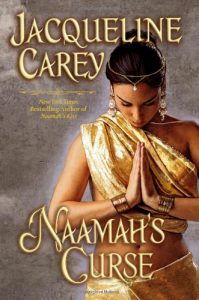
Naamah’s Curse

Have I mentioned how frustrated I am by my inability to find the place on an Amazon product page where I can click that I own it and then rate it? It used to be invisible just from some browsers, but now it’s invisible from basically all of them[1] (unless it’s actually gone), and either way, I like them being able to take my ownership and tastes into account when recommending things, and how can they take them into account if they will not let me show said tastes and ownerships them?[2] Not, tragically, that I would be giving Naamah’s Curse a particularly high rating.

I mean, throughout the long life of the series, it has been exactly the kind of thing I go for. Travelogue fantasy in which the heroes go from place to place, exploring new cultures and solving new puzzles: I’ve been reading it since David Eddings first launched the quest for a blue rock, and despite intra-authorial repetitiveness and the increasingly rare inter-authorial ability to provide a unique new take on the genre, I’ve never not enjoyed myself. Which, lest you take me the wrong way, applies here too. It’s just getting harder to enjoy myself in this particular case when it feels less like travelogue fantasy and more like authorial insertion in order to decry the evils of fundamentalist Christianity and the Hindi caste system. Still, it’s not entirely bad by any means, and none of the bad parts were screed-like; the anvils were just a little too heavy as they landed upon my head, is all. Still, I think Moirin may go to America in the next book, and maybe that will be pretty cool?

[1] I have admittedly not checked Opera or, um, the text-based one whose name I forget.
[2] Oh LOL-cat constructed speech, why must you be so awkward to adapt to conversational English?

The Steerswoman

The thing is, I finished this book days ago, and by that, I mean too many days ago. I’ve had tons of entertainments and about two-thirds of the next book since then, and I’m more sad at myself for failing to come to here than I’d normally be just for running behind. And that is because I liked it a lot better than the quality of this review will reflect. Still, this is the reality I’ve got, so I’ll do what I can.

The Steerswoman is the first book in a series about, y’know, steerswomen. (Mostly, though there are a few steersmen.) And the steerswomen are dedicated to knowledge. Gathering it, using it, disseminating it freely. And… but that right there is the thing. I started the book following Rowan’s adventures without any idea how the world worked, what the blue gemstones she was researching meant, or even why the wizards and the steerswomen are so strongly at odds. Truth be told, I still don’t know the answers to all of those questions. But watching the layers of the worldbuilding onion slowly peel back was every bit as entertaining as the unfolding of the actual plot. So I am forced to stop here, and add only that it’s a good book in a fantastic world that I want to excavate more thoroughly.

Best of all, I managed to not tell the story of why I finally started reading the series, which means I get to use it in a future review!

Marvel Zombies vs. Army of Darkness

You know that something has become a bona fide phenomenon[1] when it starts generating its own spin-offs. Not that Marvel wasn’t already a phenomenon, but the Ultimate series and 1602 and Marvel Zombies are the kind of thing I’m talking about here. Or when Cheers spawned Frasier. So, but obviously I’m really talking about comics, and specifically still about Marvel Zombies. Because what I would not have expected was for the important people at Marvel (by whom I guess I mean Joe Quesada, but who can keep track?) to already have spawned yet another alternate earth, just slightly different from the one where the interstellar zombie plague arose in the first place, in which to insert Ash from the Evil Dead series, as portrayed by an extremely young Bruce Campbell, and let him and the Necronomicon take on the ravening heroic hordes. I mean, really?

That said, if you like Marvel Zombies and you like Ash, you will definitely like this book. He fits in surprisingly well, and everyone’s reactions to him (disdain or disgust, for the most part) really felt pitch perfect to me. And yet his charmed existence keeps him going far longer than any mortal human in the Marvel universe has a right to, even before the zombie thing is a factor. But mostly, this is a laugh. Here’s the way I can tell the author knew exactly what book he was writing, in four words: Howard the goddamn Zombie Duck.

[1] I am not endorsing this outcome, only observing it.

Powers: Little Deaths

I am still trying to work my way through my reactions to the third volume in the Powers series. We’ve previously been introduced to the world and its concepts quite well, so by now the interactions between the main cop, his new partner[1], and the superhero-related crimes they investigate are comfortably old hat. And the stories in the book (big hero dies in a way that reveals salacious sexual peccadilloes; smalltime hero and villain conspire to make their comebacks) are quite good. Yet, I found myself really disappointed with it.

And the why? I feel like I’m being unfair, with the massive amount of monthly comics from the early ’70s I’m reading right now that are frequently guilty of this and yet I never give a second thought about it there. But, my problem with Little Deaths is that nothing new happens. Did I learn anything new about the world? Not that I can tell. Was an important new character introduced that I need to keep an eye on? It’s always possible, but I don’t believe it. Detectives Walker and Pilgrim entertained me as always, but no new facet of their characters or relationship was revealed. It seems ridiculous to complain about a comic book being more like cotton candy than steak, but it turns out that I’ve come to expect substantive new material from any given book, and today I simply didn’t get that. Oh well. At least I learned Olympia (who I hadn’t heard of until he died) has a thing for redheads? Useful!

[1] Although I say it that way, I kind of think that Deena Pilgrim is the character best suited as stand-in for the audience and therefore the actual main character of the series. The probably-cancelled The Good Guys on Fox does the same thing, though without superheroes. Still, I’m not sure how to refer to a rookie cop and his experienced partner, since the X and new Y flows so much better.

Abraham Lincoln: Vampire Hunter

If I look at it from outside myself, I am forced to admit that Abraham Lincoln: Vampire Hunter sounds exceptionally twee. “Hey, you know what would be zany? If in addition to ending slavery and saving the United States from utter failure as a national concern less than a hundred years in, Abe Lincoln also used to hunt vampires!” So, please don’t misunderstand what I’m saying here. I get how that premise lends itself to completely pointless silliness, I do.

But, here’s the thing: it doesn’t have to. And the way I know this is that our author (also notable for his recent release of an adaptation of Pride and Prejudice that I have not yet read) managed to tie together a whole lot of history, pathos, and adventure into what is at the least a semi-believable package. And honestly, it’s not the part with the vampires that leaves me in doubt, it’s the part where vampires could possibly still be a secret today, while having quite as many people know about them in the 1820s-1860s as this biography purports. My point is, the research is (at the least) usually valid, the narrative flows very well, and the outcome has few if any contradictions with the established history as I know it. I just nearly want to read a more traditional Lincoln biography to see what other differences exist, if any. (Particularly potential difference in the cameo appearances of other noteworthy folk.)

I will also say, in case it matters to any of my readers, that I didn’t feel that the adding of blame to vampires for slavery (particularly as it related to the Civil War, but also in general) seemed in any way to shift blame away from the humans in the South. But then, blame hasn’t ever really been a zero-sum game, so that’s not too surprising. I’m just glad to have not found apologism anywhere in here, as my experience would’ve been lessened greatly.

Hack/Slash: Super Sidekick Sleepover Slaughter

An interesting thing about the Hack/Slash series is that is has ongoing arcs, but not one overall arc; and in that way it is quite similar to all the old superhero comics I’ve been reading these last few years. The most recent volume, Super Sidekick Sleepover Slaughter, consists mostly of a side arc in which a tangential but still minimally related aspect of the current main arc (a decades-old secret society that may be behind all supernatural slashers) takes the driver’s seat. In this case, that arc revolves around a group of teens who have found a way to give themselves superpowers. It is fair I think to say that the title has NO SPOILERS WHATSOEVER indicating the outcome of their experimentation.

Meanwhile, dark portents are afoot back at Hack/Slash, Inc. headquarters. And then, for some reason, there’s a crossover with some alternate earth half-zombie guy and a rip-off of the Marvel Zombies. So, that happened? But the rest was pretty cool. I just wish the last crossover thing had a slightly more cheese-cakey aesthetic, to make up for my being otherwise bored.

Ex Machina: Term Limits

Having reached the finale of Ex Machina’s comic run, I can safely say that there was a pretty decent superhero comic in it, and a very good political comic in it as well, and they fought like cats in a sack for the spotlight on a non-stop basis that precluded any kind of rational pacing of either of those major storyline aspects. Which is unfortunate, since it colors my opinion negatively on what otherwise might have been two differently good things. I admit to having no way to be sure whether the pacing would work better if read in a chunk, and perhaps that is relevant?

Term Limits describes the end of the ongoing storyline that explains how Mitchell Hundred got his powers in the first place as well as the looming threat to humanity that is so intricately tied into those powers, and it simultaneously describes the end of his mayoral life in New York City, and then just for fun, it follows through the next three or four years to see how he and everyone else turned out. Y’know, pretty much exactly what you would expect the conclusion of a story to do. So yay for structure. There is something about the transparency of the political and historical wish-fulfillment of the overall plot that doesn’t sit that well for me, just as it always has not, but it really is just the transparency aspect; if wish-fulfillment bothered me on its own merits, I couldn’t have sat through the first episode of The West Wing, much less the entire series. But all in all, these complaints are minor, and I’m glad I read the series.

…except for the part where I can’t help looking back on Y: The Last Man with a more critical eye now and being skeptical of its own pacing issues that I hadn’t really considered the first time. Oh, well.

Crater Lake

Y’know, it’s hard to add much about the Deathlands books, at least anytime soon. I’ve already specified that they’re post-apocalyptic gun porn with implausibly equitable gender politics, right? Then yeah, at that point, there’s not yet a lot to add per book. In this specific book, our heroes are teleported[1] to Crater Lake, where they discover the first gender-inequitable civilization in the series, which is notable both for being populated by obvious bad guys and for not having occurred during any of the previous three books. They also discover, as I got distracted by all the (admittedly non-Bechdelian, but the book is from 1987 and aimed toward teenage boys and gun enthusiasts) non-sexism from pointing out already, the evils of government-funded weapons research and a great deal more about the mysterious Doctor Theophilus. (Which, to be clear, is pretty cool.)

[1] Which you would know if you also remembered that this particular post-apocalyptia has a sci-fi theme, which I know I’ve also mentioned.

The Walking Dead: Too Far Gone

Either Kirkman is getting transparent in his old age or I am getting good at seeing through him in mine, but the latest volume of The Walking Dead makes to answer the question I claimed was being raised in the surprisingly recent volume, Life Among Them. That question being (to recap), can Rick and his band make the transition from a life on the run to a life of planned safety, after so very long in the valley of the shadow of brain-eaters? I won’t, of course, tell you the answer, but I have to share the anticipation I felt from the title page, wherein the name of the book was revealed to be Too Far Gone.

Rick’s struggle (really, everyone’s, but as ever he serves as stand-in for the whole group and for the reader alike) to retain his humanity in the face of an increasingly inhuman world is all very interesting, but I feel compelled to talk about the new TV show rather than extensive spoilers I’d otherwise be forced to resort to. It’s good, and it quickly deviates to some degree from the written account, which is honestly preferable for this kind of story, more about characters than story arc. I guess I exaggerated a little, as I mostly want to talk about the effects of the show. I’m very pleased it’s on the recently successful AMC, where a lot of people are catching onto both a dramatic zombie story at a time when the genre has been overplayed to the point of parody and to graphic novels at a time when the surplus of superhero movies, however well made, are making people forget how much more the medium has to offer. I have anecdotal barstool evidence to back this up, too! …er, the part where people are taking the zombies and the graphic novels seriously, is what I mean to say.

So that’s cool, yeah?

Ultimate Spider-Man: Chameleons

It is Really Hard to wait for new graphic novels to be released on their own schedule, you know? Or it could be that with the decades of digital Marvel comics I have access to and the decade (singular) of Ultimate Comics I’ve read over the last few years, I’m just extremely spoiled right now. All the same, it’s more exciting now when a good one arrives on my doorstep, and I guess that’s a fair trade-off, right? Case in point, the newest Ultimate Spider-Man.

Chameleons introduces another take on an old villain, of course, as you can imagine from the title. Well, really, it’s more like what I can imagine from the title, since you don’t read this many comics from the ’60s (and now I’m almost halfway through the ’70s, so, wow), but yes, there was a master of disguise called the Chameleon, back in the day. But next to such “sub”-plots as the government’s ongoing war against mutants, the Watcher’s choice for savior of mankind[1], and the return of J. Jonah Jameson, mere supervillainy doesn’t hardly rate. And since the Chameleon story was the only one that had me gasp in disbelief, it’s not like I’m saying it’s just because it wasn’t very good.

I guess my point is that next spring the Ultimate Comics line is set to explode, with maybe five different new titles, but for now Bendis still has the most control over the path of the overall story, and while that means Spider-Man is sometimes a bit player in his own title, it also means that the overall story is in the most capable hands, and I really like what’s being done with it.

[1] I can’t be shocked by the [re]appearance of Rick Jones, but I sure can be disappointed. This must be what it feels like to a be a Trek fan who hates Wesley Crusher.