Category Archives: Words

A Storm of Swords revisited

Last time, I said this book maybe didn’t have much of a theme. I’m not sure if that’s true, though it still seems possible. I certainly noticed a lot of music, where there was not so much of any in the previous books, and not any in the next one too, at least to my entirely faulty memory. (On the bright side, it won’t be terribly long until I correct that impression, if needed.) That said, I can’t really attach anything to the fact of this being the most musical book in the series. Well, that’s not entirely true, as there is certainly an air of fiddling while Rome burns to the whole affair.

And that’s the truth of the matter, because there cannot possibly be another book in the series that so casually disposes of so many resources, lest Westeros be well and truly emptied before the Others (the Other? I’m starting to wonder just how accurate Melisandre might be about all this; it’s not like being a terrible person stopped anyone else from winning in this series) make their way into full-blown war against the world of life.

I can’t think of anything to add that wouldn’t be a massive spoiler, but I still cannot get over just how very much I ended up liking… well, probably you know exactly who I mean if you’ve read it, and if not, ask me and I’ll answer.

A Clash of Kings revisited

The truth of the matter is, good reasons or not, I really didn’t review the book very well last time. So I guess this isn’t so much a revisitation as an actual, um, visitation. (But with less ghosts/aliens than that.) So, here’s the thing about A Clash of Kings: the series no longer has shock value. Okay, that is almost certainly not true, but it no longer has shock value based on the paradigm-shattering events of the type seen in the first book of the series. Not to say that shock value is necessarily a benefit in the first place, I just find it impossible to think of the opening salvo to the series without the issue of expectations rearing its head. But in the second book, expectations have finally been set, and it’s time to see what will happen.

And what does happen? War. I suppose the title implies as much? But for my money, it’s some of the truest, grittiest war out there. I don’t mean the battle scenes, although I loved them, particularly the climactic battle of [spoiler elided]. I mean war and its effects on a pre-industrial society. Sure, we are seeing everything that happens through the viewpoints of lord, ladies, knights, or the children of the above, but that doesn’t mean they cannot see and be affected by (physically as well as emotionally) the devastation to the peasantry going on around them. If I had to pick a theme for the book, it would be simply that. War is hell.

I should add that I’m shocked by how very little happened. With very few exceptions, every character arc was advanced incrementally in terms of both geography and growth. None of it was the least bit unimportant, don’t mistake me, I just thought I’d see more. All of this tells me that the third book will be an even bigger deal than I had remembered, so that’s cool. (But seriously, this is a good book; I know it sounds like I’m describing the chess-positioning of some middle/late Wheel of Time books, and that’s not it at all.)

Incidentally, protected spoilers in the comments.

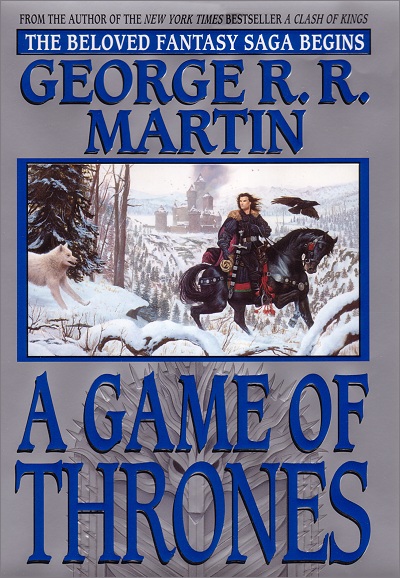
A Game of Thrones revisited

thrones22I know it looks like I decided to read a book because a TV show about it was on.[1] And, okay, that turns out to be minimally, tangentially accurate. Really, I was just going to start three or four books in to get myself more or less ready for the new book in July. But it turns out that it’s been five to six years since I’ve ready any of these, and after one of my friends started reading and discussing with me based on the strength of the show and I realized I had forgotten quite a lot, I decided to enh, screw it, and go ahead and pick up the whole thing. (Sadly, at this rate I will be a few weeks late for book five.)

All of that said, I don’t know how much I have to add to A Game of Thrones over my previous review. What has mainly struck me about this book is that in the midst of so much impending doom and so many horrible acts, there is really a lot of nobility. Any scene that contains the intersection of Jon Snow and a sword, for example. That, and that it’s well-written. My complaint about the prose from last time really does vanish the moment I’m not reading it aloud. Which is fine; not everything can be created solely for its rhythms. And contrary to previous unreviewed complaints I and others have made, each reread brings me more and more to terms with the fact that there just aren’t really any frozen zombies in this book, at least not relative to the promise of the prologue. I would recommend it unreservedly if there was nothing but wildlings and mammoths beyond the Wall, which just makes any zombie sightings delicious desserts atop an excellent meal.

Oh, and one other things that cannot be said often enough: fuck Gregor Clegane, right in the ear. Preferably, with Ice.

[1] Not incidentally, said TV show, widely not known as Article-less Game of Thrones, is really quite good. I think they are poised to make one very large mistake in the midst of a host of brilliant casting and editing choices, and even though said mistake is large if it happens[2], the fact that there’s only one is pretty impressive.
[2] It’s not too late!

Ultimate Avengers: Blade Vs. the Avengers

Taken by itself, Blade Vs. the Avengers was actually a pretty cool story, with mostly logical twists (one unmentionable massive spoiler aside), convenient clearing away of what I at least considered to be a good deal of chaff, solid character interactions (if basically no development), and one hell of a cliffhanger. Where it fails is in context, and I feel bad saying much more, depending on how spoiler-allergic you are. So, now’s your chance to stop.

Okay? Okay.

So, one of my two problems with it is that a vampire invasion (’cause, see, Blade, and his name in the title is why I don’t feel like this is a big enough spoiler to just avoid talking about it entirely) is entirely too much like a zombie invasion, which has been done  too recently (and also better) in Marvel. That it mostly stays clear of the Ultimate universe is really beside my point, here. The other problem is with Captain America. He’s really cool and all, and I like a lot of what they’ve done with him as a character, but I’m getting a little tired of their over-frequent choice to use him as a plot device. Particularly in the Avengers line, when he is explicitly not a member of the Avengers and doesn’t fall under Nick Fury’s purview anymore. Here’s all I’m saying: enough with the deus ex dux, already.

Homeward Bound

The problem with the Deathlands series, which will only grow in scope as I get further into it, is that the formula is already starting to preclude my ability to say anything new. This is not a problem with me reading them, by any means; what most people get in comfort out of re-reading favored books, I’m getting out of these. I’m only five in now, and there are almost certainly over a hundred, with new ones still being published every two or three months right now, but Homeward Bound doesn’t deviate from the formula established by the end of the third book, not a bit. The band of adventurers pops of out a teleportation room sealed up inside an undiscovered government hideaway, emerges into the post-nuclear landscape, runs off to do some good deeds, and then heads back for another teleport.

Sure, this book added a brief trip to an apparent moonbase (which, okay, that was pretty cool, but I wonder if it will turn out to have been flavor text rather than a hint at future adventures) and let the main character, Ryan Cawdor, come face to face with his past[1], but they couldn’t even leave me with the vague hint of doubt as to whether he would try to stick around and rule his ancestral barony instead of running right back to adventuring.[2] Nope, the last two pages are, “Let’s all pile in our car and drive back to the teleport room!” I’m only asking for that to be replaced by maybe 10 or 20 pages at the beginning of the next book, right? Still, better to know what I’m in for now than later, I guess? Enh, “in for”, I say, when the only real problem is the reviews. The books themselves I will continue eating like candy long past the point where my brain is fat and complacent.

I am amused at the contrast between this and Anita Blake, where I’m only tolerating the books for the reviews. If it weren’t for GRRM, that is what I’d have read next! Instead, the next while will be recap city. Sorry about that.

[1] The wrong being righted by Sam Beckett in this episode of Quantum Leap is that of the Cawdor family’s destruction by black sheep middle brother Harvey.
[2] Oh, and to clarify two points, 1) Obviously the title of baron didn’t come to be until, y’know, after the nuclear war. In many senses, his father was exactly the sort of power-grubbing man that the survivors of the Trader’s old crew keep coming up against in each “new” book. Oh, and 2) I just said the series lasts for like a hundred books, so no pretending that the party’s survival and success count as spoilers. (Like you were gonna read them anyway!)
Fables: 1001 Nights of Snowfall

The title is so obvious in retrospect, and yet I really didn’t anticipate the Arabian flavor of 1001 Nights of Snowfall until I read the first page of the book. After that, of course, I got to sit back and enjoy several stories of the history of the Fables before and during the War with the Adversary, even if not four (or, okay, even three) figures’ worth. And there’s not a whole lot more to say after that, though I found the secret histories of Snow White and Frau Tottenkinder[1] to be very entertaining and fully worth the price of admission. That there were in fact several other good stories, well, that’s good news too.

[1] That may not be her right name,and you may not know who I mean anyway, but she was once a witch who lived in a gingerbread house, if that helps.

New Ultimates: Thor Reborn

A thing I have noticed about the Ultimate series in the wake of their big climax a couple of years ago is that most everyone has seemed adrift. Sure, Nick Fury put together a new black ops team, but that dude always lands on his feet. Everyone else, though… mutants are outlawed and being hunted to extinction, the Fantastic Four broke up, the Ultimates are in an unsatisfying holding pattern, and Peter Parker, well, he’s doing okay I guess, but his personal life has been teetering on the brink of shambles for a little while now, and since his stories have always been strongest on the personal side, I think he gets to be included in the general malaise of the series after all.

My prediction is that Thor Reborn, nominally about a new plot by trickster god Loki (and with a sideline into a truly horrible version of the Defenders that I really just wish had never been involved in the plot at all), is really positioned to be the start of returning the Ultimate universe to some kind of status quo, where things can seem appropriately light-hearted and/or epic[1]. I mean, without discussing anything that happens in the book at all, just look at the title! Once dead characters start coming back, there’s no surer sign in comic booklandia that things are getting back to normal.

[1] Those sound contradictory, I know, but for comic books, they just aren’t. And the whole run has felt, well, pretty heavy for a good long time.

The Alienist

On recommendation of one of my graphic-novel-sharing friends, I picked up a turn of the 20th Century mystery book, The Alienist. (And, seriously, it was recommended several times, and has been mentioned several times more while I’ve owned it unread. Which is not a complaint about my pushy, pushy friend, it’s a wry nod to my massively overflowing bookshelf.) But the point is, I got to it, only to find (unsurprisingly) that everything I heard was true! It is in fact a pretty darn good fiction about the genesis of modern police procedure set against the trashy, immigrant-filled slums of New York City’s 1896. It occasionally bordered on feeling too modern, but never quite got there, all while managing to have a shockingly strong female protagonist in the cast, an occasionally Holmesian feel, and special guest appearances by Theodore Roosevelt and Charles Ranhofer. Oh, and “the first” serial killer. That may not actually be something for everyone, but it’s something for just about everyone I want to know.

Ultimate Thor

I’m excited by the fact that the Ultimate Comics imprint is finally wrapping up enough storylines to have started publishing graphic novels again. After so many months of a limitless supply (that has finally dried up this year as I caught up with the line), I finally have an inkling of what people who insist on watching TV episode after episode all in a row must feel like waiting for the sixth (or whichever) season of House (or whatever) to finish up. While I will be saddened sometime in June by the speed with which I ran through my glut, for now, I can bask in the existence of two more books in my house after this one, both of which will tell me more about the future of that world.

Unlike Ultimate Thor, which is wholly comprised of backstory and origin on the Norse god turned Ultimate who we most recently saw… well, that would be a spoiler, I suppose, so I will say no more than that he hasn’t been in any of the books since Magneto’s ultimatum played itself out, culminating in the devastation of New York City and ensuring the destruction of all mutant rights for years to come. Though that is the subject of another book. Anyway, my point is that Thor’s story here tells only of the past, spanning the history of Asgard and his divine family, the unexpected enmity of Baron Zemo in World War II, and his re-emergence in the modern world some months ago, around the time that the Ultimate universe started reckoning time. On the one hand, it’s a good story (and perhaps a necessary one, after the way that reality was toyed with in The Ultimates 2). But on the other hand, of course I’m eager for more aftermath and new storytelling instead of retreading the past. Which is why it’s so lovely that the two more books on deck freed me to enjoy this one for what it was.

Tiassa

Man. I love reading series, because you get the continuity of setting, and characters grow and change and develop over time and you get to see the outcomes of those as well. It’s I guess like the difference between a snapshot and a film. Or more accurately, between a film and a lifetime. But every time I need to review a book in a series, and that series has gone on longer than a trilogy or so, well, those times make me pretty frustrated. Because it’s virtually impossible to provide much information that isn’t rife with spoilers. I’m sure this isn’t the first and won’t be the last time I make such a complaint, but it bears saying.

Anyway, though, Tiassa, which title in the Vlad Taltos series has been one of the most anticipated of which I am aware, thanks to the main character of the Khaavren Romances series that parallels Vlad’s own being from the Dragaeran House of Tiassa. This either makes perfect sense to you if you’ve read either series or none whatsoever if you have not. So you see my dilemma. But if you have, you won’t want me to say much more, and if you have not, I think I can pretend like I would be telling you what to think about the book, sure, beyond the obvious statement that you need to go read Jhereg instead. See, there’s this guy, Vlad Taltos, who has at various times in his life been a crimelord, an assassin, a husband, a defender of the world, and a man on the run. And a number of other things as well. He lives in an empire peopled mostly by another species who deem him a second class citizen on good days. And these books tell the story of his life and/or the empire in which he lives. This particular book tells a story about a silver tiassa statue[1] and the swath it cuts through various events in Vlad’s life and through the future of the Empire. Also, Vlad and his fellow guest narrator each have fantastic narrative voices, which are not to be believed ever, even though sometimes they accidentally present an accurate picture of events.

You know, I really think I’m going to start re-reading these books. It has been way too long on most of them, and I’ve forgotten way too much, and it will be by-gum worthwhile. (Yeah, I have no idea when either, nor whether the previous statement will result in anything like accuracy. Which is not unlike listening to Vlad, come to think of it.)

[1] The Houses of the Empire are named after and share certain traits with animals that have been previously anthropomorphized by the Empire’s progenitors.