Category Archives: Words

The Shadow Rising

I think that I was a little hard on The Shadow Rising in my mind, when I claimed that The Dragon Reborn was the last book in the series that had a solid structure to bring everyone into the same storyline. I mean, yes, some of the characters have fully divergent stories for the first time, and they will remain diverged until the end of the series from here on out. I mean, some people reconverge at certain times, but never everyone all together. (P.S. Still spoilers, for now. Probably not much longer, I’ll be more careful, but they still exist for now.)

But the plotlines in this book constantly mirrored each other thematically in ways that I would be able to describe rather than assert if I had not waited so very long after the book for the review. (This is a real problem that I will try to avoid in the future. Because, pretty embarrassing, right? I mean, even one “for instance” and I’d be satisfied. But my brain is a blank slate on the point, other than having been impressed by it as I was reading. This is one of the upsides of re-reading a book when you know all the things that are going to happen in it. You can get a lot more deeply into the structure of the thing, the themes, the foreshadowing, develop a real appreciation for the craft of writing. When craft exists, at least, which it did here, despite my lack of proof.)

Plus also, some of the coolest scenes in the series, right? Well, at least, the highest concentration of them. Redstone doorframes? Rhuidean? I’m just saying, cool shit went down. Plus… so, this was the first of these books that I read any of. I was at UT for a weekend “come be at our school” trip, in the summer of 1992, and my occasional girlfriend was reading it, and I glanced at what she was reading, a scene where Mat was trying to convince Perrin that they should both ditch Rand, because, crazy channeler guy even if he is the Dragon, right? She explained to me that Mat was less of a dick than he sounded in that scene, and I eventually picked them up based on the recommendation. (Later, I realized that when she sent me through a three-ringed art installment on the UNT campus  hoping I’d have some kind of vision, that was a reference too.) My point is, it will always be special to me not just because I haven’t entirely gotten over the collapse of the Age of Legends and the Da’shain Aiel, but also because it marks the first words I read in the Wheel of Time.

Anyway, good book. But then, haven’t they all been, so far?
The Dragon Reborn

It occurs to me that every review after this one will be much harder. Because, see, The Dragon Reborn has a cohesive storyline that weaves its way apart and back together again, although arguably Perrin is barely involved in the climactic action, or for that matter any of the rest of the events, which mostly bring everyone together via traps and/or the whims of fate, and meanwhile Perrin is only being dragged along by Moiraine while causing ripples that will have future rather than current consequences. So I suppose I’ve just made a liar of myself, and the truth is that Jordan was already starting to drift away from everyone being a part of the same grand plan for a book’s arc.

But all the same, this is the last time that was even mostly true, and so it’s still noteworthy. Because Rand is… so, here’s a thing people talk about, why he seems so much crazier in this book as though the taint of saidin was ravaging him, then Jordan took stock and realized how much time was left and kind of backed off that plan for a while. Also, this may be a good time to mention that I’m still not caring about spoilers yet. Good? Good. So anyway, that’s a valid stance to take, authorial error. Whether it is such and I’m being apologist or not, I still think the text, especially the preceding events in the overall story, support another explanation. Which is, Rand is experiencing actual regular psychological trauma based on having just had a prophetic fight in the skies above Falme, taking a magical unhealable wound during said fight, being praised by everyone around him as the savior / destroyer of the world, and still not even being able to control the power he’s supposed to use to do whichever of those things turns out to be accurate. My point being, you don’t need magic evil to explain why he might have experienced a temporary break with reality that reset itself once all his doubts had been erased. Sure, he ended up with the crappy end of the bargain, but at least it was no longer just sitting there, unknown and unknowable. “Am I really really the Dragon? Fine, let’s get to work, then.”

I, uh, may have gotten ahead of myself there. So, anyway, you have Rand running off to fulfill the one part of the Prophecies of the Dragon he knows about, just so he can be once and for all sure instead of awaiting Moiraine’s pleasure. And you have Moiraine vexedly following, never so angry before or since at her own inability to to make it happen the way she wants to, and you have our three Aes Sedai in training headed off to spring a trap so it won’t get Rand instead, even though they know that’s probably why they know about it in the first place, and most of all you have Mat finally getting to be Mat, which is nice because I will like him for the whole rest of the series, except for the book he’s not in and the book where his voice is wrong, but it’s better than disliking him, which I have had to do now and again.

And this is me considering the reviews still pretty easy. Oy. The one bright side of reviewing books I’ve read lots of times and that furthermore almost everyone reading the review has read lots of times as well is that nobody has much in the way of expectations. Oh, also, Egwene? Totally binty. I wonder if this is objectively true or more a function of me liking Nynaeve so much better in my old age. I think it’s an objective truth that is undercut by her eventually growing into what she wrongly thought she already deserved in this book. Alright, I’m done. The next one may be a while in coming.

The Great Hunt

So then Rand got this idea about running off and living a hermit’s life in the middle of nowhere, one of very many middles of nowhere scattered throughout the continent because of how humanity is on a long gradual decline ever since the Breaking of the World, some 3500 years ago. This? This is why we don’t drill holes into the Dark One’s prison. Anyway, Rand’s idea made a lot of sense, because in the middle of nowhere he could not kill all his friends nor be gentled by Aes Sedai. The only downside is that, being the Dragon Reborn, he would also fail to save the world, which is probably worse than those other two outcomes. So naturally the plot ta’veren strikes in the form of creepy little Padan Fain stealing the Horn of Valere and riding into the sunset with it, right before Rand could have snuck off into obscurity. Et voila, a book.

This may leave you with the impression that I am meh on The Great Hunt, and really I’m not. (Truth be told, I expect to be meh on few if any of these books when read in one desperate gulp as I am doing. I’ve long had a theory that the problem with the books was two-fold: 1) far more repetition than non-casual readers need, and admittedly the huge gulp will eventually make that a trial, yes, and 2) too much space between books in which not enough happens, whereas the gulp will make that vanish entirely because over the course of the whole series, yep, quite a lot happens. Sure, there are other problems, but I think those are the two biggest ones. If I’m right, even a book that should be far more annoying upon re-read than the first time when I didn’t even know what to expect will also probably seem fine, and much moreso an old standby of basically good like the one from which I have just digressed broadly.) It’s just that I don’t have a lot to say, and even less to sum up, so that’s where my brain went.

It occurs to me that I possibly shouldn’t like this book, just because of the role it plays. The Eye of the World set up the central conflicts of the story, between Rand and Ishamael, between Rand and Fain, between Rand and his destiny, and of course between the entire world and the Dark One. Whereas this book sets up the some of the biggest distractions from those conflicts with the introduction of the horrible and functionally irredeemable Seanchan society and Rand’s debilitating, messianic spear wound. Plus, it introduces someone who should by rights have been an interesting distraction in the form of Lanfear, the original Dragon groupie, only to squander her before the series was even half over. I wonder if her character arc would have made more sense in a much shorter series. That said, her attempts at seduction (both the sexual kind and the “dark side of the Force” kind) were awfully clumsy here, and I wonder if that was about Jordan or about her character?

Am I rambling? Yes, yes I am. So let me leave you with this. Remember that time when they went through the Portal Stone and something went wrong and they each of them in the group lived the entirety of somewhere between hundreds to maybe infinite lifetimes? If you do not, then it is because you’re not aware that I am wildly unconcerned with spoilers for these early books, even though I announced it in front of the previous review. So that probably sucks by now, huh? Anyway, before I was so rudely interrupted, I was making a point. Sure, Jordan described each lifetime in just a few paragraphs, but they were still entire lifetimes. How horrible is it to imagine that you could be a person in the midst of some kind of scientific-magic overload, a dim reflection of someone’s incorrect fate, granted the entire lifetime that everyone gets, yes, but eventually doomed to be only a fading memory punctuated by Elan Morin Tedronai laughing that, as always, he has won again and your faded reflection was an exercise in futility.

Say what you will about Robert Jordan, but the man could be incredibly evocative. Which reminds me that, as a devotee of the post-apocalyptic, I’m disappointed that the dimming light of humanity which persuaded Ingtar to sell his very soul[1] has kind of fallen away from the story. At least, my memory of the latter books is that the land is never so vastly empty as it is right now. Probably I’m wrong objectively and it only seems thus because of Travelling. But it was tragic and beautiful, and I miss it.

[1] What, you’re still here complaining about spoilers? Seriously? I thought I had made myself clear! (I’ll start trying to keep track of them somewhere in the book 7 range or so, I reckon.)

The Eye of the World

It is likely that I’ve read The Eye of the World more often than any other book. But not in the last eight years or so, I guess? Hence this review, which is kind of difficult to put together. What can I say that hasn’t already been said extensively? In any event, the book is over twenty years old, so expect spoilers from here forward, and I can’t promise there won’t be spoilers of future books. But certainly not of the last several.

One thing is that I watched the Lord of the Rings extended trilogy on blu-ray last weekend, and there are large swathes of the book that feel a lot like The Fellowship of the Ring, far beyond the opening hundred pages with black-cloaked riders invading the idyll of the Two Shires, only to be turned away by a wizard and a ranger. Still, given the length of the series and only one aspect truly remaining similar throughout the series (I refer here to the Padan Fain / Gollum connection), it still basically feels like the first few pages were written to be familiar, rather than that a full-scale rip-off occurred. Still, I’m surprised I didn’t see more people saying that it had back in the day. (Until I remember I didn’t pick up one of these books until 1993, by which time four had already been published, so I suppose those cries had already echoed their way out into the void.)

As usual, the biggest tragedy of the book is Rand’s innocence, so soon to be shattered. I also notice that Perrin’s broodiness here matches his future multi-volume obsession with being the guy from Taken, and that Nynaeve is by far the best female character in the series (except maybe Moiraine, but it’s not really fair to count her, because she spends so much of her time as a cipher, mostly to be observed with only the barest of glimpses into her head). There is little that has made me so happy of late as her current position on the board.[1]

Otherwise, I only have two things to add about the kindle version and my current re-read. One is that through some quirk of odd fate, every instance of the word ‘whatever’ was capitalized. I really wonder whose search and replace thought that was a good idea? The other is a thing that I need to compare against a physical copy, so just a moment while I do that. (You can pretend while reading this sentence that the sentence isn’t here, and there was a pause while I hopped into the other room to dig through my bookshelf and make sure whether the copies are identical or not. This pause is also a good time to stop if you are worried about future spoilers somehow, because I take a lot of knowledge as self-evident in the rest of this paragraph.) And what hey, they match! So, here’s the thing: The grave is no bar to my call, right? The Horn of Valere? Here’s what is actually written on the Horn, though: Tia mi aven Moridin isainde vadin. Based on the rest of what I’ve seen of the Old Tongue, which tends to be pretty consistent, the literal translation is ‘To my call, Death is not a bar’. Unless, of course, one were to notice that a newish character has taken the name Moridin, and then one were to wonder why bother to capitalize that one word there, and then one were to notice that the Horn of Valere has been absent for pretty much the entire series, and having it just being Heroes of the Horn out again after all this time would feel kind of anti-climactic, and anyway, here’s my newest loony theory[2]: the Horn is going to somehow affect Ishamael reborn, directly, as has been prophesied for the duration of said Horn’s existence. And if the Horn is older than the Age of Legends (I wonder if we know that either way?), it is also an indication that this is the actual Last Battle after all, not just one such along the turning of the Wheel.

[1] Because that would be a spoiler for recent books.
[2] not obviously addressed in the current version of the FAQ, though my searching was not exhaustive by any means, and of course if someone has said it on rasfwrj in the past 8 or 10 years, I wouldn’t be in a position to know that.

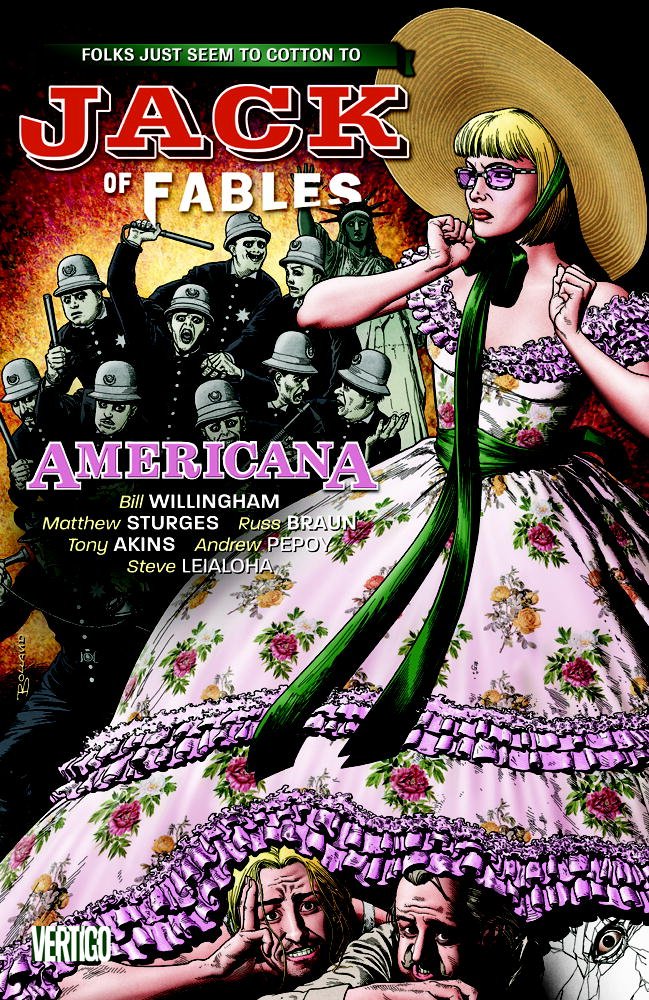
Jack of Fables: Americana

81lL7PMB-7LSo, this is cool. I’ve figured out what’s actually going on in Jack of Fables, way after the fact. (Probably way after anyone else who has read these books, for that matter.) Remember when he got captured by a bad guy named Revise who has been gathering up Fables and keeping them in a camp while making people forget that they ever had any stories, in the hopes of turning the whole world Mundane?

It turns out that Jack’s ongoing quest to garner increased fame, power, and wealth is actually beside the point, despite what he would constantly have you believe in his position as occasional narrator. Now that the war is over, this Revise guy is probably the most important thing happening in the entire Fables universe, and Jack just happens to be caught up in the swirl. I cannot decide if he would be offended by that or think it just and right that he’d be at the center of the action. (He would never admit he isn’t the center of the action, either way.)

Anyway, though, Americana: besides the other things that are obviously happening along the way as per above, Jack is now looking for a way into the American Fable country where he can find Cibola, the lost city of gold, and get, you know, rich. I’m glad that Revise’s three hot librarians[1] keep managing to keep tabs on Jack, though, because they are stuffy and hilarious, and I think he would be insufferable if left to his own devices.

[1] No, seriously. It’s not just comic art rendering everyone hot. There’s a t-shirt and everything! Also, in case you care, the three hot librarians are sisters.[2]
[2] Okay, I admit that knowledge to be gratuitous.

Ultimate Comics Spider-Man – Volume 2

I hate finishing the Miles Morales Spider-Man books, because I’m stuck the same place I’ve been for more than a year now, resenting the lack of Peter Parker. Why couldn’t he just have been a new character? And I want to say that the right answer is to just acknowledge it once and for all, take it as something that’s going to color all of my reviews, and consider the matter closed until and unless I change my mood on the topic. But then they write a scene where Aunt May and Gwen Stacy are trying to get on with their lives in Paris and see a newspaper announcing that there’s a new Spider-Man, and how am I supposed to ignore my plausibly unfair reactions when the writer of the story is right there telling me I’m not the only one?

All the same, it is getting old at this point, so I suppose I’ll follow my own initial advice and disclaim right here: I resent these books, so far, for not having Peter Parker in them. I also resent the comics industry in general for training me to believe that this is only a temporary situation, even though the Ultimate Comics line has been, if not perfect, at least very good about leaving dead characters dead. So I keep thinking, “sure, but this time is different”, and that thread of hope also makes it hard for me to commit fully to the stories about Miles the way that I should. The upshot of all this is that it’s an ongoing issue, and I know about it, and I’ll try not to mention it anymore. Just so long as you try to be sure you stay aware of it, because otherwise my potential future hemming and hawing may seem odd.

So, the kid Miles Morales who’s the new Spider-Man? He actually does have a pretty interesting life of his own, what with a criminal uncle who wants to exploit him, and his parents who have mixed feelings on the mutant-in-general and Spider-Man-in-specific phenomena, and his having been provisionally accepted by the official super-hero community, and especially by his being thirteen, which is just ridiculously young to be involved with all of these adults criminals and adult problems.

Of course, the aspect I am the most intrigued by is the mirroring effect, where Miles’ uncle is not only not the driving agent of positivity in his life, but may well turn out to be the agent of destruction instead. Which of course makes me pretty excited for the next book in the series, where that question is likely to come to a head.

Red Equinox

You remember those Deathlands guys, with their gender equality and their gun fetishism and their occasional mutations and their ability to teleport around the shattered ruins of the United States trying to find that perfect settlement for forever but otherwise righting wrongs while they keep ending up in the wrong place? Well, in Red Equinox, they got a callback to the second book in the series, which you undoubtedly remember is the one where they teleported for the first time, and ended up in Alaska where they could run into some invading Russians at the land bridge.

How can such a callback exist, you ask? See, this guy got to report on first American contact in the hundred years since the nuclear war, and so he got promoted home to Moscow. And meanwhile, Ryan Cawdor and company got to learn that the American embassy in Moscow has the same teleportation capability as so many of the hidden redoubts scattered around the Deathlands. None of which sounds so terrible, because you just leave, you know? Moscow is like the most dangerous place for an American to be! …too bad they broke the door you need to close to trigger the teleport sequence, eh?

The Walking Dead: A Larger World

I’m thinking that there are two things going on in The Walking Dead as an overall series. One of these is the occasional moment of plot shock. You may remember opening a certain door in the prison and learning exactly why a certain prisoner had been imprisoned, for instance, or more recently the outcome of a certain gunshot. Clearly these moments, while meaningful to the characters and their lives, are the simplest parts of the story creatively. So I’ve been trying to figure out what else is going on, especially after the mislead regarding a cure that kind of caught me off-guard and left me wondering if the series is even still worth reading. I do like the shocks and to see what happens next, don’t get me wrong, I just need to know that there’s some kind of plan to what happens next, and I’ve had my moments of doubt on that point.

As of A Larger World, I think I finally know what’s going on. This is… something I already said in the last review. And now I’m already halfway in with nothing more to say. Unexpected! See, my point had been that the series is basically Abraham Maslow’s hierarchy of human needs, with zombies. Our heroes started out just trying to not die, and then to find shelter and food and love, and now they are nearly at the end of the journey. There is safety, some amount of acceptance, and the promise of other survivors out there in the, er, larger world. Does this mean that communities can be built and the world return to normal? Yeah, I dunno, but I do know that you can’t carry the story farther than the outcome of that question. There might be one more book to the series, or there might be two, but I cannot believe there can be much quality literature beyond that point.

(I’ll still read it, because there will still be characters I care about struggling against zombies. But the story, such as it is, will be over.)

Ultimate Comics X-Men – Volume 1

It is frustrating to realize that the first volume of the Ultimate X-Men relaunch[1] is set entirely before Ultimate Hawkeye. (It is more frustrating to remember that this is a trend, with Ultimate X having been set before (and released well after) a certain recent Spider-Man storyline as well.) But except for timeline and mild spoiler woes[2], I am in the same position I was last time, grateful for a story that cuts the tension and doesn’t try to be everything. Which, when you consider that the driving force behind the current X-Men is the imprisonment or death of all mutantkind, is saying kind of a lot.

Anyway: in addition to giving me more time with Kitty Pryde, Rogue, and Iceman (and for now at least, Johnny Storm), there were hints that a good number of other folks are still kicking around, waiting to be re-introduced. And there were hints that this is a long haul story that will continue to focus on human interactions instead of that spate of “Look, this is big! And important! And explodey!” that I was just complaining about from the Ultimates yesterday. And since I know I can trust Bendis to keep doing right by Spidey, that means I should expect to like two-thirds of the current Ultimate storylines. I accept!

(Plus, despite my annoyance, the Ultimates are following a character I really want to see the next few steps from, so at least they have my interest, if not yet my entertainedness.)

[1] I cannot bring myself to say reboot because this is in no way a jettisoning of any continuity.
[2] And honestly, they may have each been written after the other events in the first place. I have no way (short of exhaustive and uninteresting research) to tell!

The Wind through the Keyhole: A Dark Tower Novel

Long ago, near the very beginning of Shards of Delirium, I made note of Stephen King’s retirement. I cannot think what made me believe, at the time, that it really might be true. I know intellectually that he will die someday, but since I barely believe that, what could have possibly made me believe the books would stop beforehand? Of course, I’ve written some significant number of King-based reviews since that time, in theory without making any further reference to this oddity. But this time, my Constant Author has taken things a step farther and added another entry to his already completed Dark Tower cycle, putting big lie to the long-existing small lie.

The Wind through the Keyhole picks up very near the center of the series and, of necessity[1], adds nothing to the progression of the events already chronicled. That right there will be enough to give a certain class of reader fits of disinterest, and while I don’t agree, I do understand. An argument could be made that it provides some deeper insight into Roland’s character and his history, but you will not find that argument here. What came varied, in my opinion, between obvious and facile. (Unless I am wrong and it is the indication I sought in vain in footnote one. I could accept that and would then retract both indictments.)

Here’s what the book does: it provides a mythology for Mid-World, which lack I had never precisely felt before. After all, Mid-World is already its own kind of mythology, and it had already contained its own stories,  some barely hinted at, some told in extensive detail. But stories are not the same as myths, and King has not written much in the way of mythology. It seems to me that perhaps this should change.

[1] In fact, there are spoilery reasons why I was keeping a careful lookout for this not to be true. But alas, no evidence presented itself to me.