Author Archives: Chris

Moon

Since I didn’t get Moon through Netflix, I really should have taken my opportunity to skip this review. I mean, it’s the kind of movie where knowing as little as possible is the best, and that makes it hard for me to mention the pure highlight that elevates it above other similarly-constructed movies that we’ve seen in the past, of which 2001 is certainly the most obvious. And yet, it’s a movie that I first heard about on Thursday, and managed to see on Sunday through no great expansion of effort, while gathering that basically every other person on the planet had not only heard of it but really liked it. (Well, almost everyone for that last point.) And so I feel obligated to say something about it, just because it was such a common thread of my weekend.

So, what happens is this: an energy corporation is strip-mining the dark side of the moon for a hydrogen isotope that can power over 75% of the world’s energy needs. (Or it might have been helium, but hydrogen makes a lot more sense, and really we’d have the same story if it had been unobtanon, so stop being so damn picky!) And they’ve got this moon base built that mostly runs itself, including the harvesters roaming around, and all that really needs doing is minor outdoor repair work and also the collection and launching of the hydrogen tubes once they’ve gotten full, for which they have hired Sam Bell for a three year tour of duty. The part where he’s alone except for GERTY, the helpful base computer/tethered robot, wouldn’t be too bad except that satellite links for live relay to earth are down, so he only gets communication with his bosses and family at about the rate of USPS letters. But he fills his time with old television[1] and craft-work and other such pursuits, and anyway, it’s only two more weeks until his tour ends and he gets to go home. Too bad he’s started to hallucinate. …or has he???

And anything after that, even the part I want to praise, even a discussion of theme beyond my willingness to say I think they did a good job there, would be way too much spoiler. So I’ll stop here and only recommend that if you’ve got a lazy Sunday afternoon and a craving for humanist sci-fi, this is a good place to go. (The movie, not the actual moon, which has been strip-mined something ugly, let me tell you.)

[1] If I wanted to pick a part of the movie that was kind of horrible, it’s that the two TV shows that made it on screen were Bewitched and The Mary Tyler Moore Show, both of which took me right out of the moment by triggering the realization that they picked their shows based on what would be cheap to get the rights to from TV Land or whoever owns them now, instead of what someone in a near-future setting would likely be interested in. I mean, geeze, at least Cheers or Cosby or Friends, guys!
Skyline (2010)

Sometimes, when a movie is universally panned, there’s a reason for it.

Skyline is another in a recent series of alien invasion stories that are told at the personal ground level, rather than with sweeping majesty like Independence Day was back when it re-opened the genre for public consumption. If you imagine War of the Worlds or Cloverfield, you are definitely on the right track. Aside from incidental plot and character arc divergences, these are all three (along with several others I could probably think of if I paused to do so) basically the same movie. So, what makes Skyline stand out? The first thing is the characters; every single one of these ranges between (at the high end) uninteresting and seedily unlikeable.[1] The second thing is the plot, which, after establishing that the Aliens are Here! and People are in Danger!, effectively goes nowhere at all for the rest of the movie, up to and including a conclusion that I can only presume was meant to by heart-warmingly thought-provoking, or perhaps vice versa. The third thing is… well, look, if you need a third thing, it’s because you are more forgiving of badness in movies than I am, and I’m pretty sure I’ve never met the person that fits this description.

[1] I should say that David Zayas, who I hope you will recognize as Angel Batista on Dexter, really wanted his character to be likable, but the script simply wouldn’t allow it.

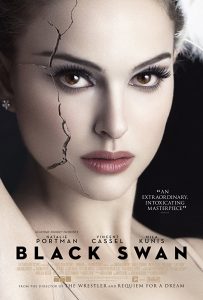
Black Swan (2010)

An interesting thing about Black Swan is how many different potential movies are crammed into its actuality. For instance, there’s a not particularly compelling ballet movie in it, which is sad when you consider how much effort Natalie Portman told Terry Gross that she put into training for the physical aspects of the part. And then there’s a somewhat formulaic suspense thriller in which Portman vies with ballet company newcomer Mila Kunis for the dubious affections of the company’s French artistic director as well as the lead in the first show of the season, Swan Lake, while a tragically underutilized Winona Ryder looks on from the sidelines as the cast-aside prima ballerina from seasons past. And if you’re getting the impression so far that I found it okay at best, you’re right up to a point; I would have been pretty disappointed if I had been watching either of those two movies.

The movie that I was watching, which I more or less loved, was a psychological study of an obsessive mind pushed to the brink of utter collapse under a myriad of internal and external pressures. And I don’t want to say more than that, because it made for utterly compelling watching as each element unfolded. I’ve been on record in the past as approving of unreliable narrators in fiction. I think this is the first time I’ve seen one on film that wasn’t eye-rollingly bad; to the contrary, I hope Portman earns some awards over the next few months.

The Steerswoman

The thing is, I finished this book days ago, and by that, I mean too many days ago. I’ve had tons of entertainments and about two-thirds of the next book since then, and I’m more sad at myself for failing to come to here than I’d normally be just for running behind. And that is because I liked it a lot better than the quality of this review will reflect. Still, this is the reality I’ve got, so I’ll do what I can.

The Steerswoman is the first book in a series about, y’know, steerswomen. (Mostly, though there are a few steersmen.) And the steerswomen are dedicated to knowledge. Gathering it, using it, disseminating it freely. And… but that right there is the thing. I started the book following Rowan’s adventures without any idea how the world worked, what the blue gemstones she was researching meant, or even why the wizards and the steerswomen are so strongly at odds. Truth be told, I still don’t know the answers to all of those questions. But watching the layers of the worldbuilding onion slowly peel back was every bit as entertaining as the unfolding of the actual plot. So I am forced to stop here, and add only that it’s a good book in a fantastic world that I want to excavate more thoroughly.

Best of all, I managed to not tell the story of why I finally started reading the series, which means I get to use it in a future review!

Marvel Zombies vs. Army of Darkness

You know that something has become a bona fide phenomenon[1] when it starts generating its own spin-offs. Not that Marvel wasn’t already a phenomenon, but the Ultimate series and 1602 and Marvel Zombies are the kind of thing I’m talking about here. Or when Cheers spawned Frasier. So, but obviously I’m really talking about comics, and specifically still about Marvel Zombies. Because what I would not have expected was for the important people at Marvel (by whom I guess I mean Joe Quesada, but who can keep track?) to already have spawned yet another alternate earth, just slightly different from the one where the interstellar zombie plague arose in the first place, in which to insert Ash from the Evil Dead series, as portrayed by an extremely young Bruce Campbell, and let him and the Necronomicon take on the ravening heroic hordes. I mean, really?

That said, if you like Marvel Zombies and you like Ash, you will definitely like this book. He fits in surprisingly well, and everyone’s reactions to him (disdain or disgust, for the most part) really felt pitch perfect to me. And yet his charmed existence keeps him going far longer than any mortal human in the Marvel universe has a right to, even before the zombie thing is a factor. But mostly, this is a laugh. Here’s the way I can tell the author knew exactly what book he was writing, in four words: Howard the goddamn Zombie Duck.

[1] I am not endorsing this outcome, only observing it.

Powers: Little Deaths

I am still trying to work my way through my reactions to the third volume in the Powers series. We’ve previously been introduced to the world and its concepts quite well, so by now the interactions between the main cop, his new partner[1], and the superhero-related crimes they investigate are comfortably old hat. And the stories in the book (big hero dies in a way that reveals salacious sexual peccadilloes; smalltime hero and villain conspire to make their comebacks) are quite good. Yet, I found myself really disappointed with it.

And the why? I feel like I’m being unfair, with the massive amount of monthly comics from the early ’70s I’m reading right now that are frequently guilty of this and yet I never give a second thought about it there. But, my problem with Little Deaths is that nothing new happens. Did I learn anything new about the world? Not that I can tell. Was an important new character introduced that I need to keep an eye on? It’s always possible, but I don’t believe it. Detectives Walker and Pilgrim entertained me as always, but no new facet of their characters or relationship was revealed. It seems ridiculous to complain about a comic book being more like cotton candy than steak, but it turns out that I’ve come to expect substantive new material from any given book, and today I simply didn’t get that. Oh well. At least I learned Olympia (who I hadn’t heard of until he died) has a thing for redheads? Useful!

[1] Although I say it that way, I kind of think that Deena Pilgrim is the character best suited as stand-in for the audience and therefore the actual main character of the series. The probably-cancelled The Good Guys on Fox does the same thing, though without superheroes. Still, I’m not sure how to refer to a rookie cop and his experienced partner, since the X and new Y flows so much better.

TRON: Legacy

I saw the Tron sequel (which I know I should be making all caps, yet cannot bring myself to) as a midnight premiere showing, which was… difficult. I can definitely tell I’ve turned some kind of corner, and it makes me sad. Anyway, I definitely liked it, which seems to be a minority opinion on the internet, though I’m not sure why. It is stupidly pretty (although young Jeff Bridges skirts the edge of the uncanny valley when seen in IMAX), it has a lot of coolness, and it has sfnal ideas that, while not very new, are certainly interesting. What’s not to like?

Well… if I had to pick something, it would be that there’s Too Much. I spotted aesthetic elements from The Wizard of Oz and The Empire Strikes Back, story influences from at least three different sources that I’ve since forgotten, and a reach[1] that, just like in the original movie, consistently exceeds its grasp. But I have a hard time grading that harshly, even as I understand why other people might not.

Nutshell: go see it. If you loved the original, this stays true to it while expanding into uncharted vistas, and if you never saw the original[2], this at least gets all of the tech stuff right, which is rare enough in Hollywood to deserve monetary reward.[3] Also, since I spotted a few frames worth of sequel-potential, I’d like to predict that their choice to act on one any time in the next 24 months will result in a terrible outcome. Heed my advice, $Disney_executive!

[1] This again referring to the storyline.
[2] It occurs to me that I’m forced into another one of my footnote plot summaries, since I forgot people might not know much about it, until just now in the editing pass. Both movies contemplate a human-permeable barrier into a computer network called the Grid, in which both full programs and stray lines of code have viable personifications and struggle against stronger programs who have forced them into either servitude or else brutally short lives in a games arena. Whenever a User enters the Grid, plot occurs!
[3] If you think I left out a third possibility, then I am currently glaring at you. For being a bad person.

Abraham Lincoln: Vampire Hunter

If I look at it from outside myself, I am forced to admit that Abraham Lincoln: Vampire Hunter sounds exceptionally twee. “Hey, you know what would be zany? If in addition to ending slavery and saving the United States from utter failure as a national concern less than a hundred years in, Abe Lincoln also used to hunt vampires!” So, please don’t misunderstand what I’m saying here. I get how that premise lends itself to completely pointless silliness, I do.

But, here’s the thing: it doesn’t have to. And the way I know this is that our author (also notable for his recent release of an adaptation of Pride and Prejudice that I have not yet read) managed to tie together a whole lot of history, pathos, and adventure into what is at the least a semi-believable package. And honestly, it’s not the part with the vampires that leaves me in doubt, it’s the part where vampires could possibly still be a secret today, while having quite as many people know about them in the 1820s-1860s as this biography purports. My point is, the research is (at the least) usually valid, the narrative flows very well, and the outcome has few if any contradictions with the established history as I know it. I just nearly want to read a more traditional Lincoln biography to see what other differences exist, if any. (Particularly potential difference in the cameo appearances of other noteworthy folk.)

I will also say, in case it matters to any of my readers, that I didn’t feel that the adding of blame to vampires for slavery (particularly as it related to the Civil War, but also in general) seemed in any way to shift blame away from the humans in the South. But then, blame hasn’t ever really been a zero-sum game, so that’s not too surprising. I’m just glad to have not found apologism anywhere in here, as my experience would’ve been lessened greatly.

Hack/Slash: Super Sidekick Sleepover Slaughter

An interesting thing about the Hack/Slash series is that is has ongoing arcs, but not one overall arc; and in that way it is quite similar to all the old superhero comics I’ve been reading these last few years. The most recent volume, Super Sidekick Sleepover Slaughter, consists mostly of a side arc in which a tangential but still minimally related aspect of the current main arc (a decades-old secret society that may be behind all supernatural slashers) takes the driver’s seat. In this case, that arc revolves around a group of teens who have found a way to give themselves superpowers. It is fair I think to say that the title has NO SPOILERS WHATSOEVER indicating the outcome of their experimentation.

Meanwhile, dark portents are afoot back at Hack/Slash, Inc. headquarters. And then, for some reason, there’s a crossover with some alternate earth half-zombie guy and a rip-off of the Marvel Zombies. So, that happened? But the rest was pretty cool. I just wish the last crossover thing had a slightly more cheese-cakey aesthetic, to make up for my being otherwise bored.

Ex Machina: Term Limits

Having reached the finale of Ex Machina’s comic run, I can safely say that there was a pretty decent superhero comic in it, and a very good political comic in it as well, and they fought like cats in a sack for the spotlight on a non-stop basis that precluded any kind of rational pacing of either of those major storyline aspects. Which is unfortunate, since it colors my opinion negatively on what otherwise might have been two differently good things. I admit to having no way to be sure whether the pacing would work better if read in a chunk, and perhaps that is relevant?

Term Limits describes the end of the ongoing storyline that explains how Mitchell Hundred got his powers in the first place as well as the looming threat to humanity that is so intricately tied into those powers, and it simultaneously describes the end of his mayoral life in New York City, and then just for fun, it follows through the next three or four years to see how he and everyone else turned out. Y’know, pretty much exactly what you would expect the conclusion of a story to do. So yay for structure. There is something about the transparency of the political and historical wish-fulfillment of the overall plot that doesn’t sit that well for me, just as it always has not, but it really is just the transparency aspect; if wish-fulfillment bothered me on its own merits, I couldn’t have sat through the first episode of The West Wing, much less the entire series. But all in all, these complaints are minor, and I’m glad I read the series.

…except for the part where I can’t help looking back on Y: The Last Man with a more critical eye now and being skeptical of its own pacing issues that I hadn’t really considered the first time. Oh, well.