Tag Archives: graphic novel

Fables: Storybook Love

The third collection in the Fables series is clearly a transition point, with two distinct storylines that collectively do a great deal to change the face of Fabletown, as well as a pair of actual fables, stories that have occurred since the exile from the homelands began. In the first storyline, a mundane reporter has discovered the collective and its immortality, with fallout and consequences for all concerned. In the second, Storybook Love, enemies that Bigby Wolf (the sherriff of Fabletown, you’ll remember) and Snow White (its day-to-day administrator and deputy mayor) have recently made come back to haunt them, with, once again, fallout and consequences for all concerned. Only, a little moreso. Plus, Prince Charming gets tired of his free-wheeling lothario lifestyle and sets the wheels in motion for a political power play! Dramatic!

Hints of the inevitable on-screen confrontation with the Adversary crowd the wings, but the main stage where Bigby and Snow are advancing their relationship by what I’ll charitably refer to as incremental degrees is where the show is really at. The occasional noir bent of the series helps my case here, but I’m unable to avoid spotting the influences of Moonlighting on this series. Which is a really odd pair, don’t get me wrong.

The one-shot actual fables that I mentioned earlier, by the way, were both pretty decently put together, though probably forgettable in the long run. (Unsurprisingly, I like Gaiman’s Death better than Willingham’s.)
Ultimate X-Men: Ultimate War

This latest UXM title continues the trend of improvement while at the same time falling terribly short of the expectations Mark Millar has set in his Ultimates titles, a fact advanced from sad to ironical by virtue of the fact that Ultimate War is plotted as a battle between the X-Men and the Ultimates. Set between the first two Ultimates volumes (you can tell because Quicksilver and the Scarlet Witch are recruited to the Ultimates’ ranks here), the X-Men are being hunted down because Professor X made a possibly understandable but ultimately flawed choice regarding the fate of Magneto, some months back. Now that Magneto is on the loose and running his mutant terrorism organization again, well, mutants in general and Xavier’s X-Men in particular are once again in heavy political disfavor. As a result of which: battle between superhero teams. It’s a common enough trope, but the intelligence of the writing mostly makes it work well.

Or perhaps I’m just easily impressed by the X-Men being decently written instead of terribly? I can only hope the trend continues, either way.

The Ultimates 2: Grand Theft America

With this fourth volume of the Ultimates series, Mark Millar has done something amazing, and all the more amazing because of how unimpressed I’ve been with his take on the X-Men and the Fantastic Four. He’s capped off an already impressive sequence of stories with what is clearly the strongest entry, and he’s managed to be politically relevant without edging far into preachiness at the same time. I can’t help but reflect on my (currently stalled) readings of late 1960s Marvel comics and feel like this modern take is very much in keeping with the early days of the brand. Which pleases me.

Grand Theft America chronicles a masterful plan to cripple the United States and her super-human defenders in one stroke, with assistance from sources that might qualify as expected or entirely shocking. (I know I had one of each.) And they’re playing for keeps, so don’t expect anyone to be safe, emotionally or physically. I really can’t say anything more without digging far too deeply into plot spoilers, but, wow. Best superhero comic I’ve ever read, I think it is fair to say.

Mouse Guard: Fall 1152

It was my birthday, not so long ago, and I received a fairly random graphic novel about some mice, right? Just lately I’ve read it, and it was pretty okay. Mouse Guard: Fall 1152 chronicles the doings of several members of the Mouse Guard over the course of the Fall of 1152. (I’m more proud of that than you might imagine.)

But seriously, there’s a hidden society of mice, and for the purposes of transportation and trade, the Mouse Guard keeps the roads safe of enemies: weasels and cats and so forth. The map indicates that they’ve found a way to turn back large predators from their terriroty via a scent barrier; it’s clear that the world has more depth than was presented in this original book. However, all is not well in mousey-town, as someone has snuck out a map of the home city of the Guard for the purposes of villainous treachery.

The art has a very A.A. Milne or Peter Cottontail feel to it, just slightly cartoonish versions of real animals[1], but since everything is at mouse-scale, the occasional marauding snake or crab is quite exciting. The story’s pacing and spare prose adds to my impression that it was meant to be a kid-book. And believe me, it’s a pretty good one that a new reader would get a lot of enjoyment out of. I got probably 50 pages of enjoyment out of the 192 page book, myself. The story was fine, it was just widely paced, like I said. But the art made up for most of that. I just didn’t expect to finish quite that large of a book in a single day around my unreasonably crowded work schedule.

[1] To the extent that mice wear cloaks and carry swords. Which I assume is a very wide extent indeed.

Ultimate X-Men: Hellfire & Brimstone

By the time I finished the fourth X-Men book, I’d had it split up to read parts or all of two other books, plus it’s been more than a week since I finished it. And I’ve already denigrated the previous books in the series, to greater or lesser degree. So it will likely come as no surprise that I’m having a difficult time working out what to say about Hellfire & Brimstone, all things considered.

What is surprising is that despite still being a Mark Millar title, I really kind of liked it. The plots were a largely disconnected mishmash, about the introduction of Kitty Pryde[1], about a new evil growing underneath Magneto’s old island where the Brotherhood of Mutants used to hang out, about some rich people trying to summon a demon or an Old One or something to destroy the universe in exchange for limitless power, and about the evil mutants searching for new leadership. And it’s not just that they appear to be disconnected on the surface: they’re mostly just as disconnected by the end of the volume. But I guess each story was good enough on its own, or had sufficiently cool moments, that the entire thing was elevated as a result. However it worked, I’m relieved to have caught one that ended up being pretty darn good, for a change.

[1] That seems to be her real name, not her superhero name. Which: wow. (She can move freely through solid objects, if you care.)

Y: The Last Man – Whys and Wherefores

As promised, I’ve finished Y. Whys and Wherefores felt very much like the last volume that it was, from start to finish. Although there are certainly plot elements left to resolve (not least among them Yorick’s years-long quest to reunite with his girlfriend, Beth), the primary purpose of the book was clearly the tying up of loose ends and general denouement, which is appropriate after a series this long. It worked just as you’d expect, structurally.

What I’ve been trying to decide since I read it (and in the handful of hours I spent staring at the mostly blank screen after I wrote the first sentence this morning) is how I felt about the ending from a purely story-driven perspective. And of course, spoilers mean not being allowed to really go into details, nor even wanting to. Whatever else it was, it was a powerful finish. Which I guess answers my question pretty well all by itself. It’s also a very thoughtful finish. I’m not sure if introspective is the right word to apply to static history imprinted onto dead trees, but even if I cannot apply it to the book, it certainly applies to my mood after the fact.

Shakespeare has been on my mind all along, of course, and well on purpose. I’ll have to reread these someday as a single unit while watching for Shakespeare in general, all English-majory and analytical, but my point right now is that it has occurred to me, with surprising belatedness, that Yorick certainly qualifies for the descriptor of a fellow of infinite jest, which is good: played differently, The Last Man‘s potential for unrelenting grimness would have overwhelmed any other possible message. In retrospect, I’m starting to think that the Walking Dead series might suffer from a terminal case of the same disease.

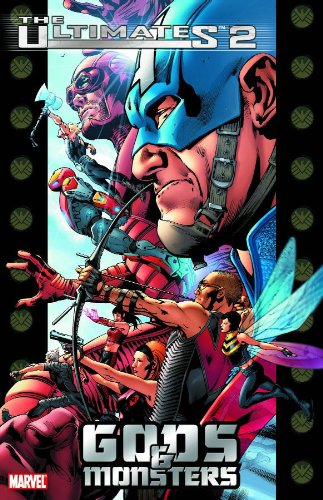
The Ultimates 2: Gods and Monsters

61rnRASuyiLFinally, something good out of the Ultimates universe again! I’m reading the four series, and Spider-Man has been great for the teen set while Fantastic Four has been okay, and X-Men feels adult even though they’re all teens too, but it’s been the not-that-good cousin to the clearly adult and clearly good Ultimates. My point in all of this, aside from the subtle recap, is to express my relief; the last few books I’ve read have been iffy.

Not so God and Monsters! I mean, it starts off all soap opera with a recap of how the various government-sponsored superheroes have been pairing off, and how the remaining unpopular heroes have been doing. (Giant-Man has been having the kinds of marriage problems that do not result in paparazzi wondering who you’re being frisky on the beach with, and the Hulk murdered a lot of people, so.) But after all the stage-setting is in place, it immediately turns into Schrödinger’s plot, wherein one of two possible things is happening. Either Thor really is the Norse god of thunder, and his brother Loki is altering reality to torment him and Midgard in general, or else Thor is a delusional Norwegian hippy who has become incredibly dangerous because of his unbalanced ratio of powerfulness to sanity, and meanwhile the Ultimates are being gradually turned into yet another military arm of the United States government. For my part, I’m honestly not sure which possibility is more dire for our heroes.

Also, there’s a downright hilarious sequence revolving around a group of second tier superheroes of the type you’d expect to start crawling out of the woodwork in this kind of world, looking to feel special without any pesky powers or skills getting in the way. And the Ultimates contain a secret traitor! Maybe! (Like I said, it has a lot of soap opera elements to it. But I am okay with that kind of thing.)

Ultimate Fantastic Four: Inhuman

The fourth entry in the Ultimate Fantastic Four series was mostly of the ungood. The first half of the surprisingly short book revolved around a character whose plot and disposal were both extremely predictable if you’re familiar with the Mad Thinker from the FF’s original run, but who appeared to be annoying and pointless if you aren’t. And the the second half was even more of the same, as though the only purpose of the series is to hit all the highlights from the 1960s version. And as much as I’ve complained about the Ultimate X-Men run, they’ve never once seemed blandly formulaic. On top of which, the art reminded me of someone who was not very talented trying to copy the character-style of Girls (which style you will no doubt recall I already found unsatisfactory) combined with repetitive backgrounds and heavy reliance on “characters in shadow”, as though the strain of cranking out such minimalistic-yet-bad art got to be too much, and only having to do shaded in outlines on some pages was a rest break from that.

On the bright side, none of the other books have seemed this bad, so there’s every chance that the quality will swing right back up again? (Plus, you know, the art may have unfairly lowered my overall opinion of the volume. If anything, I hope that’s true.)

Y: The Last Man – Motherland

If memory serves, the most recent volume of Y: The Last Man ended on a bit of a cliffhanger, in which… well, okay, I guess I can assume you may not have read Kimono Dragons and therefore not spoil you. But you really, really should. (I mean, and the others ones first, right?) This is noteworthy because of how Motherland starts out offset by about an hour earlier in time, or possibly with a little bit of a ret-con. I spent the first dozen pages wondering if I had misremembered things entirely, but they eventually got back on track.

And then… answers. Answers about the ninja.[1] Answers about humanity’s future. Possibly answers about the ultimate cause behind the now four year old mass male die-off , though I’m not sure whether I trust them, nor whether I like them if they’re true. But don’t worry, because all those answers are revealed with the series’ standard mix of action, drama, and panache. This is by no means an infodump devoid of any plot or character development. Plus, there are a couple more framing stories about how characters in the series’ past are getting along now.[2]

You really can tell that the series is drawing to a close, because at least one storyline has ended here. (Two, if the answers behind the extinction were factual.) The only thing left now is for Yorick to resolve his long-running emotional turmoil for a girl who, notably, he has never been on the same continent with since the series began. Well, okay, and there are a few other odds and ends as well, but the thing with Beth is the heart of the primary dangling plot, and anyway, the other stuff probably all falls under the spoilers heading again. In any event, I’ll be reading it quite soon, so that’s good news.

[1] Have I mentioned how much I love that there’s a ninja?
[2] Well, they were both at the end, but since their release order would put the very final issue at the beginning of the book, I’m calling them framing stories regardless. I’m torn, because putting that story first would have worked a lot better literarily: both because of the framing thing and because the last couple pages of the previous issue / closing frame would work so well as the end of the book, if they’d been there. But on the other hand, there’s a spoiler in the “opening” framing story (due to it being out of the chronological sequence they ultimately decided upon instead) that would have removed some tension from the primary arc of the book.

The Order of the Stick: On the Origin of PCs

The convenient thing about having a friend who owns and is willing to lend out the second Order of the Stick prequel novel is the increased likelihood with which he will own and be willing to lend out the first one. (Signed by the author with a drawing of Belkar, no less! Which, if you knew the guy, Belkar was definitely requested art.) The upshot of which is that I snagged and read it as well. And will return the book no later than Friday, if you happen to see this, Ryan. And, y’know, because of the borrowing, I read it way out of the order I would otherwise employ. Which is cool, as it provided good perspective between the books.

On the Origin of PCs does the same thing as Start of Darkness, except for the good guys. What motivates them? How did they meet? Why are they on the trail of a douchebag lich? The stories are every bit as funny as in the other book and in the comics themselves, but there’s one stark difference between the books that also highlights a difference in the comics. When the PC prequel was written, the comic was a lot more about humor and a lot less about story depth. Which is not to say that the comics have grown less funny, only that the plot has become increasingly more important. But it happened so gradually that, without a comparison point such as between these, highlighting how much better of a story was present in the other book, it would be difficult to see how much the main sequence comic has improved.

Still, though: this one was funny and had nuggets of pretty awesome information that have yet to pay off in the comic itself, years later now. That is pretty good news, if you ask me.