Tag Archives: graphic novel

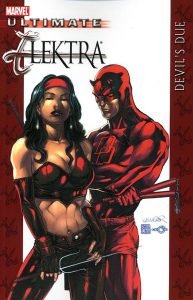
Ultimate Elektra: Devil’s Due

It has not been difficult for me to find graphic novels from the Ultimate Marvel series in my various used bookstores. I don’t have all of them by any means, but I’ve been able to pick up a lot just by keeping my eyes open. And then there’s the ambitiously numbered volume one of the Ultimate Elektra series, which seemed to have five or more copies available at every store I entered over the course of 2008. Which, despite the underlying snarkiness of that fact, is not to say that it was a bad book.

I imagine that if you knew nothing about the characters, even had not seen the Daredevil movie[1], then Devil’s Due might have told a pretty good story. See, there’s this ninja chick named Elektra, and she wants to protect her father from various lowlife thugs who are trying to destroy his business and / or manipulate him as part of a money-laundering scheme, presumedly because he owns a dry-cleanery. There’s also a blind lawyer who will probably be the Ultimate Daredevil someday, only he’s shown up in other Ultimate entries as himself instead of a shoddily-costumed law student; am I to assume this occurs before the rest of the Ultimate universe timeline? But I digress.

Anyhow, Daredevil, being the law and order type, wants Elektra to stop being such a deadly vigilante, she wants him to get off her back and stop being such a drag, and Manhattan crime boss Wilson Fisk, AKA the Kingpin, wants the lot of them to stop doing things that might result in his prosecution. The story has potential for nuanced shades of grey and moral quandaries; I think the biggest failure of the book lay in the knowledge that no character was ever going to budge from their initial position, which removed any hope of moral drama.

On a more nitpicky note, if Matt Murdock is going to dress all in dark clothes with a bandanna mask over his eyes, can they stop showing him in the red Daredevil uniform on the covers?

[1] You are incredibly lucky, by the way, for this one.

Ultimate Fantastic Four: God War

51OxcYYylpL._SY344_BO1,204,203,200_With Skrull and zombie troubles safely behind them, the Fantastic Four can finally turn their attention back to their research and romance and whatnot. Or they could if Manhattan wasn’t being threatened by still more interdimensional travelers, that is. Too many, as it happens; I think this must be what newspaper and NPR movie reviewers feel like when watching science fiction. There were a bunch of humanoids that had no apparent way of sharing a common species, although they might have been engineered instead, which would explain that part. And they had a lot of standard nouns for names[1], but I was only ever able to associate a couple of their forms to names, and only one or two more to character types.

The plot was clear enough, I guess. There’s some kind of war (perhaps a God War?) in progress in this other dimension, and all the unsortable Seed 19 people are on the run from a bad guy named Thanatos, who dies and resurrects regularly, for no clear reason beyond that it maybe fits his name. And they have a friend who they’re trying to save that’s apparently pivotal to the war, again for no clear reason. And Thanatos (plus the good guy, who lives in a giant, world-spanning tree[2]) has a long-standing prophecy about how Reed Richards will help him win, which doesn’t really seem like Mr. Fantastic’s style, but I cannot deny that by the end of the book, Reed was ominously constructing something that looks like it might have been the Cosmic Cube, an original series staple that gave people cosmic powers. That Cube was less inexplicable than anything here only because Stan Lee pretty clearly meant for cosmic powers and transistor powers and radiation powers to be cyphers that allowed his protagonists to do whatever they needed to do, via the scientific power of handwavium. I’m not convinced that Mike Carey has such an excuse here, which is probably what made the book so hard to swallow. Give me my underlying rationales, dammit!

[1] I honestly can’t remember any of them except Tesseract, now, or I’d give examples. But the book is in another room, so meh.
[2] I mean actually down inside the guts of it, or whatever trees have. Not up in the branches.

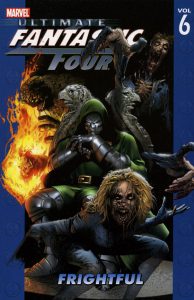
Ultimate Fantastic Four: Frightful

I’m not really sure what was done differently, but the latest volume of the Ultimate Fantastic Four managed to be as busy as the last few have been while simultaneously not feeling like each individual story was rushed. If anything, it felt like a return to the madcap days of the ’60s where each storyline lasted for two or three issues and hints of the future or ties to the past bled into each individual magazine; in short, like there was an ongoing, somewhat-planned story arc. It turns out, I really dig that.

Frightful features time travelling adventures in which dimensional spiders stand ready to eat you if you cause a paradox, yet another return of Doctor Doom, recurring super-zombies, and a Lovecraftian threat of world-crushing proportions! Also, whatever has been wrong with the art lately, they sorted that out too. Best book in the series since the first one, as nearly as I can tell.

Hack/Slash: Death by Sequel

The second volume of the Hack/Slash series benefitted from my reduced expectations almost as well as as the first suffered by my heightened ones. Where the first one revolved around the origin story and growth as a team of the lead characters, Death by Sequel settles into a more episodic format that seems to better suit the genre they are taking on. And yet, during the two related stories that comprise the volume, it is clear to see Cassie and Vlad’s friendship deepening beyond their working relationship. It’s not the kind of story where they might eventually have a romance, which for my money makes the attention to their closeness all the more impressive.

Also, as you might expect, they wander about trying to kill evil murdering things in the night, so you don’t have to die. And they do so in inappropriate clothing whilst spattering about as much gore as is feasible. So that’s good of them. Still, the best part of the book was the scattering of 3-4 page trailers for “upcoming” storylines. Pitch-perfect parodies of the kind of movie that the actual written stories are based on; I’m not sure whether the stories try to achieve the same level of parody and fall short, or if the authors understand that it wouldn’t be sustainable over the comic’s potential long run. Either way, as lightly enjoyable as the stories are, the trailers were hilarious.

Ultimate Spider-Man: Venom

51Tv0wFlAfL._SY344_BO1,204,203,200_I’ve been reading a lot of Marvel comics lately, as I trust you’ve noticed. Some of them are not so good, some brilliant, but in most all cases, I’ve had a fair bit to say, one way or another. The problem with Venom (and possibly the series in general; I remember this being an issue last time too) is that it can’t be brilliant all the time. Yet, it’s never the least bit bad. Other than saying, “Wow, this was good again, and you should be reading them if you have any taste for the genre at all,” I don’t have a lot to add. Which is a problem, because I can’t really just say that all the time.

On the bright side, Venom had some noticeable awesomeness going on, in the family arena. Still reeling from romantic difficulties and bits of negative public perception, Peter Parker stumbles across some old home videos that lead him to a childhood friend and old research into (depending upon whom you ask) a gel that can cure cancer or a military exo-suit. And these in turn lead him to his first tenuous answers about his parents’ sudden death ten years ago and into the fight of his life.

I’m always a sucker for dark family histories and unfolding mysteries, so that plus the always tight dialogue is more than enough to draw me in. There’s also the stirrings of a theme about the way that people who seem like they might have had identical childhood nurturing and opportunities can nevertheless diverge so drastically, and the parallels between that concept and the divergence of Venom from Spider-Man. But it wasn’t really followed through on, to my eyes; or maybe it wasn’t there at all and the English degree in me is trying to dig it out regardless. Also, though, the final chapter went a long way toward redeeming a character who had previously been tarnished enough that I was looking for ways to dislike him in other Marvel Ultimate titles as well. So that’s nice!

Lucifer: A Dalliance with the Damned

In this third volume of the Lucifer series, story pieces are beginning to fall into place. Lucifer has finally gotten what he’s always wanted: a chance to show up his God by forming a Creation of his own, and doing it better. Better is a nebulous concept in this context, but I think that’s as it should be; clever though the Lord of the Morning Lightbringer is, I doubt he really understands the jealousy and resentment tangled up in his motivations here. Meanwhile, as usual, all creatures great and small scheme against him, up to and including an unsurprisingly jealous God and a possible rift with his constant companion from all the way back to the Sandman days.

Mundane events continue apace as well: many beings are drawn toward Lux, Lucifer’s former nightclub and current gateway to the new Creation; the ever-intriguing Elaine Belloc finds herself in dire straits; and aspects of Hell are explored in the titular A Dalliance with the Damned. As has reliably been the case thusfar, the most interesting themes in the series deal with humanity and free will. How might demons and humans react to a damned soul elevated to equal status within Hell’s hierarchy? How might Adam and Eve have reacted to the sole edict, “Do not worship me. Just be free.”? What might tempt them in such a circumstance?

I can tell this series is just beginning to pick up steam, and it has a doozy of a potential endgame. In theory, Carey may be attempting to settle an irreconcilable difference between two almost equivalent beings with diametrically opposing viewpoints of The Way Things Ought To Be. I’m not prepared to actively compare it with Gaiman’s Sandman, but there’s no doubt in my mind that it’s a worthy successor.

Ultimate X-Men: Return of the King

Sadly, I’ve already written this once, and some strange combination of unfamiliarity with the machine I’m writing from and a copy/paste failure conspired to eat it, right after I’d finished everything but the html. This is, as you might imagine, lame. If I had not liked the current Ultimate X-Men as much as I did, the review would probably have been hurt by this turn of events?

Luckily, though, I did like Return of the King. For one thing, I think Mark Millar is finally getting better at writing about things that are interesting, but I know for a fact that he was helped by a return to the roots. That’s right, as the title indicates, Magneto is back with a vengeance. And since the X-Men are on the run from a government who (justifiably?) blames them for his return, there’s not much of anyone who can put a stop to his latest plan to rid himself of the pesky homo sapiens once and for all. I’m saying: way cool.

Ultimate Fantastic Four: Crossover

If it seems like ages since I’ve hit the Ultimate Fantastic Four series, that’s because I’ve been trying to get all my other series into balance so I can be on pretty much the same volume number in all three and not have to think as much about where I am in any given one (and with the fourth slot reserved for short term series, if you care). Having gotten back, I was immediately struck again by how very much I hate the current artist. Luckily, the rest of Crossover was pretty good.

Mark Millar has his hands all over Marvel’s Ultimate universe, it seems, and I’ve had extremely positive reactions in some instances as well as pretty negative reactions in others; in this case, I am cautiously optimistic. He helped his case with extreme pandering, admittedly. The book starts off with zombified Marvel superheroes[1], and then it dovetails into a story about the Submariner that seems to be predicated on the idea that he genuinely is as much of a pretentious git as I personally find him to be, thoroughly unlikeable in every way. The only downside is that both stories fly by too quickly to really get involved in. Which, upon reflection, was one of my more minor complaints about the previous volume, also [partially] penned by Millar.

The book wrapped up with a reasonably effective *dun-dun-DUN* moment that might have been more effective still if I had caught the intended reference. On the bright side, it definitely worked for your “new” reader here, which at least partially indicates that their attempts to be accessible to whole new generations are succeeding.

[1] Apparently from an alternate universe largely identical to the modern version of the comics I was reading from the ’60s, back before I got too busy to do so.

Ex Machina: March to War

I’m headed toward the impression that maybe Ex Machina doesn’t know where it’s going after all, which would bother me less, I think, if I didn’t have the excellent Y: The Last Man series by the same author to compare with. As it is, March to War still delivers on sometimes thought-provoking and always entertaining post-9/11 political content, so I can’t complain very much; and it will only help matters if I lower my future expectations.

In this fourth volume, if you wonder, former superhero and current New York City Mayor Mitchell Hundred must deal with political protests of the war in Iraq and a new terrorist attack on his city, and an annoying radio personality as a framing device for a flashback to the time that he had an archenemy with a surprising and complementary power. So that’s pretty good stuff? Yeah, it is.

Ultimate Iron Man

To my surprise, the copy of Ultimate Iron Man I found used a few months ago is unlisted at Amazon. I had intended to say that it’s practically unfindable, which probably says more about my perception of Amazon’s ubiquity than of objective reality. Nevertheless, I did find it and read it, and in a continuation of recent comic trends, it’s written by someone who’s far more famous for doing something else, in this case for writing Ender’s Game. So that’s good, right?

I mean, it’s not like it’s bad. I’m not convinced it really matches what’s going on in the rest of the Ultimate universe, which may or may not matter. Instead of a re-envisioned telling of the Iron Man story (as portrayed well but with a lot of room for expansion in the Ultimates books about which I’ve raved so extensively), we’re given a straight origin story, one that has nothing in common with the 1960s version. I shouldn’t ought to complain about that, but the others have drawn so heavily from the well that this stands out. What is worse, though, is that it’s really not all that heroic, neither literally nor in scope. It’s mostly corporate espionage coupled with biological industrial accidents, disguised as a coming-of-age story in which not much age is, er, come of.

Maybe it was kind of bad after all? It just really didn’t go anywhere, the suit felt like a tacked-on afterthought, and then it failed to have an ending. I guess I’d read the sequel if it fell into my lap, but only because I know it won’t be very long, as is the wont of these kinds of books; and because maybe the next bit would have an ending. Still and all, I kind of hope it doesn’t fall into my lap. I could use the time rereading Ender’s Game, for example.