Category Archives: Words

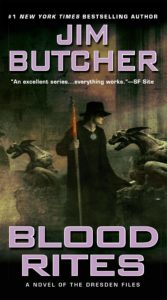
Blood Rites

At some point between the last Dresden Files book and this one, I got accidentally spoiled for a piece of character development between Harry Dresden and Thomas Raith, a vampire of the White Court he’s been palling around with lately. (That is, of course, a drastic simplification and barely accurate at that, but so be it.) As such, it’s going to make it tricky for me to dig into the rich thematic ground here that I would and often have plumbed with great abandon for similar situations in other works. And while I could probably still kill this paragraph and start over in a theme-based review without letting you get spoiled by the character elements, these things are mostly more about me than the actual stuff I consumed, as you will have no doubt noticed by now.

After reading five previous novels, what I find that has been the most glaringly absent from the series, the single thing I could point at and say, “Where’s that?”, is porn. Thankfully, Blood Rites has solved this problem to my satisfaction. It’s like, you can only read so many books in a series and remain interested before someone puts some porn in there, am I right? And at long last, there Harry is, surrounded by women in lingerie, watching the cameramen and the boom operators as the director tries to get the shot just right. Because, porn![1] So, um, anyway, Harry is hired to clean up a little bit of entropy that has gotten all over the porn studio.[2] And as the formula dictates, he finds all too rapidly that he’s in something way over his head. Because, there’s the porn and the thing with Thomas, sure, but there’s also more fallout from the war between the wizards and the less pleasant vampires of the Red and Black courts, and at last a little bit of overt sexual tension between Harry and his long time CPD contact, Karrin Murphy.[3]

Plus, bonus awesome evil-detecting puppy!

[1] Oh, hey. You didn’t think I meant, y’know, a gradual devolution of the ongoing plotlines until all that’s left is a series of orgies “held together” by a pregnancy scare? Jesus, that would be a terrible book.
[2] Ew.
[3] I grew up on Moonlighting. Sue me.
Lucifer: Inferno

Here’s an irony for you. Despite being the book I finished most recently (and wrapping up today’s spate of reviews, in fact), it’s the one I remember least. Not, I’m pretty sure, as a reflection on Inferno‘s quality, either. I know I was liking it as I read. Anyway, though, I can say a few things about it. The first of which is that it feels like the second half of its predecessor, The Divine Comedy. And, okay, eponymously speaking, that seems apparent. But I still find it noteworthy because of the regularity with which graphic novel editors make a point of having standalone collections, as far as an ongoing series can accomplish that. And given the thematic divisions that tend to accompany plot breaks in Gaiman’s work and its spinoff here, it’s more noteworthy still. Which I guess is a lot of time spent to say, “Huh, it’s two halves of the same basic storyline, and that doesn’t happen often,” but like I said, it is unusual for the format.

Thirdly[1], I have a fair amount of respect for the character evolution that Carey has been giving Lucifer. He’s always been an interesting and occasionally, briefly, likeable anti-hero. It would be hard to publish very many months’ worth of comics without that much to recommend the main character. But at some point that has crept up on me unawares, there was a tipping point to a process I hadn’t really perceived before the fact: he’s been gradually infusing Lucifer with a certain nobility of spirit[2] to match his uncompromising (albeit typically self-serving) sense of honor, to the point where now, any time things seem to be going pear-shaped, I’m not merely interested to see the story of how he twists things to his advantage and wins after all. No, at this point in the tale, I unexpectedly find myself genuinely disappointed at the idea that he might not win through. Sympathy for the devil, indeed.

Also? Mazikeen[3] has surprised me once again, and I think before very long at all she will be my favorite character in the series, and maybe even retroactively a very strong finisher in Sandman itself.

[1] I know what you are thinking. I respectfully disagree.
[2] See also the impressive To Reign in Hell, by the always impressive Steven Brust.
[3] Who I see I have never previously mentioned is Lucifer’s one-time right-hand woman, and more recently (as the newly-appointed leader of her people) one of his many grasping adversaries. Though of course it’s more nuanced than that.

Ultimate Marvel Team-Up, Volume 3

This third volume marks the last of the Ultimate Marvel Team-Ups, and I cannot say I’m sorry to see them go. For every reasonably good story, such as Spidey’s encounters with the woefully underused Ultimate Black Widow or the Chinese storybook account of his meeting with an ultimate (as opposed to Ultimate) fighting guy (Shang-Li, or something, who I guess was relevant in mainstream Marvel continuity at some point, that point probably falling in the 1970s?), there’s a kind of terrible story about him running into Blade (Blade, for fuck’s sake!) and Elektra and the old-people version of the Fantastic Four[1] and a particularly bitchy Daredevil, all for no apparent reason. Yet even here, there are moments of good writing, such as when he has a conversation with Johnny Storm about power and responsibility as related to stable living, or when he gives a class speech about his research into a hero. The last bit, in fact, rose above every attempt by writer and artist alike to be cloying and overwrought, and I have to give mad props to the soul of the story for managing that in the face of such strong opposition from its creators.

Which I guess is my point in a nutshell. It really has been a very rarely bad series, but I’m so used to unadulterated brilliance from the majority of the Marvel Ultimate universe that something merely okay but with moments that shine still feels like too much work. So, I’m glad it’s over because I’d continue to go looking for those moments, and now I won’t have to anymore, secure in the knowledge that I’ll have them dropped in my lap by ongoing future titles instead, where the rhythm has already been perfected. (These three books were among the earliest written in the Ultimate continuity, in case you were not previously aware.)

Oh, and I’m also glad it’s over because the art kept changing, sometimes in the middle of the same story, and as annoying as that sounds, I also almost never liked any of that art. Would stable and bad have been better or worse than fluctuating and bad? This is a question I hope never to consider again.

[1] Who have since been replaced-or-retconned in Ultimate continuity, as you will no doubt be aware from my review earlier this morning, and from the nine previous ones.

Ultimate Fantastic Four: Ghosts

It’s been almost a week and an unfortunately high number of other books since I read Ghosts, but I can certainly say that I liked it. The Cosmic Cube storyline that started all the way back in God War finally comes to a head, and in such a way as to make me like that book a little better than I did at the time[1]. Basically, big bad guy Thanatos shows up to swipe the Cosmic Cube he tricked Reed Richards into making for him, which has consumed Reed’s attention for so long that all of his relationships are falling by the wayside. And as if a godlike dude with complete control over death being given a device chock-full of cosmic powers[2] isn’t enough to worry about, two threats from the communist past are also hanging around to make life tricky for our overwhelmed heroes. So, if you’ve been missing the Crimson Dynamo from your admittedly non-existent Ultimate Iron Man series[4] or the Red Ghost (who you may recall controls hyper-intelligent animals and is also sort of a ghost) from this series, Carey has got you covered! Meanwhile, brief spoilers below the break. Continue reading

The Time of the Dark

It turns out, and probably unsurprisingly, that the landscape is littered with old fantasy series that never struck my fancy or I otherwise never got around to, and that’s nevermind the many current(ish) ones I’m interested in. So what brings an otherwise random element of that book-studded landscape[1] to my attention? I think more unsurprisingly than the last not very surprising thing I said, I started reading the Darwath trilogy on the advice of a pretty girl.

The Time of the Dark is very much the picture of a book that was written for me.[3] It has a couple of people who more or less stepped through a random portal in the universe to end up in a fantasy realm, much as I’ve wanted to do since I was in high school, and that realm is threatened by eldritch[2], floating Lovecraftian abominations that avoid the light of day, not unlike the premise of Pitch Black. And there’s even a proto- Chain of Dogs situation that informs the final third and climax of the book. Ultimately, the only bad thing I can really say about the book is that the me it was written for is probably ten or fifteen years less experienced, minimum, in the elements of fantasy and horror that it describes. But it’s quite easy to recognize all the holy wow moments I would have had if I’d read it at around the same time I was reading, say, Eddings.

In addition to the cool plot and setting tricks, there seems to be some veins of philosophy beneath the surface that I expect to show up a lot more strongly in the second and third books. And also, there are some mysteries yet to solve, even aside from the central one of whether humanity can be saved from the Dark Ones. (Oh, right, speaking of things that are designed to lure me in, civilization is on the brink of utter collapse. So, yeah.) Good stuff, and I am pleased to be reading more soon.

[1] I’m really loving this imagery, by the way. I mean, not my portrayal of it, just the idea that you’re walking around, and there are these piles and drifts of book every which way, scattered about like a nine-pins. Except for the problem of rain, that would be a pretty sweet world.
[2] You pretty much always have to say “eldritch” in these situations, you know?
[3] Aside from the ridiculous cover art, that is, which I feel obliged to mention since it’s the only literal picture in sight. In its defense, that is (inexplicably on first blush) a literal portrayal of a scene from early in the story.

Ex Machina: Power Down

Even though Power Down had been published for more than a year by the time I read and reviewed Smoke, Smoke, it feels as though the creative team saw my pacing and thematic concerns and leapt to address them. Which is not to say that the latest Ex Machina suddenly revealed all kinds of backstory thusfar unbeknownst even to Mayor Mitchell Hundred about how he acquired his power over all things mechanical. The story has only just reached its midpoint, after all. But with new rumors of the (still potentially alien) forces behind Hundred’s powers, not to mention transdimensional Communism, it’s pretty clear that the writers have finally and explicitly acknowledged there’s a lot more going on here than simple politics with a superheroic twist. And all this fails to even address the continued interior sabotage of Hundred’s political career, or the sinister truth behind New York’s 2003 blackout and its effect on The Great Machine. So, don’t give up just yet!

Ultimate Spider-Man: Hollywood

I’m officially a broken record. All the same, the Ultimate Spider-Man series continues to impress. You really wouldn’t think that another fight with Doctor Octopus would be all that much of a much, but where Hollywood shines is in all the gaps and cracks getting filled in with juicy, delicious plot. And also, in this case, heaping doses of meta-humor. Because, you see, there’s a certain movie about a certain urban superhero, filmed by a certain Sam Raimi and starring a certain Tobey Maguire. And it’s being filmed in Manhattan without the permission of or payments to a certain Peter Parker.[1] As if that (and let us not forget Doc Ock) wasn’t enough, longtime Parker houseguest Gwen Stacy reaches a critical turning point!

[1] I think that said movie, in reality, was one of the inspiring forces behind the Ultimate universe reboot of Marveldom in the first place. Which takes the metaness to a whole new level.

Ultimate X-Men: Cry Wolf

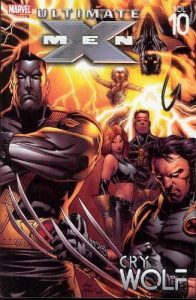
I am really ambivalent about my latest X-Men, Cry Wolf. On the one hand, it was a good story that hung together well and shifted around several of the character elements in new ways, such that I am looking forward to what comes next. Also, unlike the last time he showed up, Gambit got a proper introduction and seemed like a real person. Which is good, because he’s apparently a favorite, but I don’t really know of him from anywhere but these books.
But on the other hand, too many of the events seemed forced for the sake of hitting key plot points from the original run. It’s all good and well for there to be a triangle between Bobby Drake and Kitty Pryde and Rogue, but build it up a little bit, yeah? I’ll care more if it doesn’t seem to be performed by rote. I’m willing to reserve judgment on the Fenris Corporation, as I assume they’ll be relevant later and this wasn’t just a whirlwind but ultimately pointless mention.

(I’m not leaving out the actual plot on purpose, it’s just that it was a hanger for the character interactions and changes, and thus seems less important than the other stuff I talked about.)

Millennium Falcon

I’m not entirely sure why I bother to review Star Wars books at this point, except that it’s expected of me to review everything. It’s just, the context is pretty small, or something. Nonetheless, I’ve typed this much, so I may as well finish up! Millennium Falcon performs a few duties for the Extended Universe. Primarily, it puts together a history of one of the most famous starships in science fiction from before the days when Han Solo owned her (starting with a fairly cheesy Christine-on-the-assembly-line homage and, thankfully, improving from there). Secondarily, it provides a plot hook for a treasure hunt, and then places the Solo family on that hunt as a way to heal some of the still painful wounds brought about by the most recent Sith assault on the galaxy. Lastly, and probably most importantly to the ongoing storylines, it sets up the newest political threat to the Jedi Order, albeit behind the scenes and in throwaway moments.

The book itself was good but not great. I can’t really recommend it as a standalone, and if you weren’t planning to read it in that sense, you probably will regardless of anything I say on the topic. But the secondary characters were all pretty decent, and the stories-within-the-story format reminds me a lot of World War Z.

Louisiana Power & Light

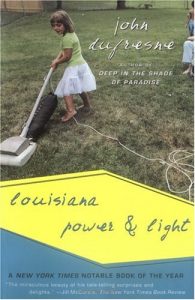
I’m in a book club. Well, that’s not entirely accurate. As with all book clubs above a certain mayfly-like age, it has died an inglorious death, somewhere in the middle of the first book.[1] But I can say with pride that I did not contribute to that death. Yay! The book selected was one of those modern fictions in the sense that it was published since the middle of the last century and doesn’t have a particular sub-genre, but not in the sense that it was designed solely to fill me with rage. Which does make it rather a stand-out, and I’m glad someone put me onto it!

Unfortunately, the lack of genre convention makes it hard for me to describe Louisiana Power & Light without jumping right into spoiler territory. But I can at least minimize, one supposes. In 1970s small-town Louisiana, everyone is in everyone else’s business; in that sense, it reminds me a lot of some of Stephen King’s work, except with thoroughly Southern rather than Yankee sensibilities. The focal point of everyone’s attention for the previous century, though, has been the Fontana family, who all but literally crawled out of the swamp decades ago and have since brought forth a multitude of only male children who have, one by one, been brought down by tragicomic fates; in short, the very stuff of which local legends are made. But now, orphaned Billy Wayne Fontana, being raised by nuns who are grooming him for a life in the seminary, is the only one left.

And, that, ultimately, is what the whole book is about. The town has a collective narration, and that collective is primarily concerned with Billy Wayne’s outcome and offspring. It shifts rapidly between sympathetic and judgmental, ready for the Fontanas to finally stop blighting the locality with misery and failure at every moment and yet gleefully ready to recount hundreds of stories about minor setbacks and major tragedies wrought by his family’s history. And certainly the individual characters are equally concerned with his ultimate fate, though in different and often kinder ways. Untangling the motivations of the collective narrator and sifting fact from wishful thinking is a delight, though I admittedly always groove on untrustworthy narration, and the uniquely Southern digressions are one of the few things I miss in my mostly genre-fiction bookshelves. It’s just, people here really do talk and act like this, even at the very edge of the South, and it always amuses me to see someone capture it. But the very best parts of the book are the moments when Billy Wayne Fontana (and especially his younger son, who I deem not a spoiler since he’s mentioned pre-emptively in the prologue) notices and tries to act upon his own fate, instead of just floating like a ragdoll toward the inevitable thunderous waterfall just around the bend; because when that happens, the narrator is finally at a loss and we get brief glimpses of what the Fontanas really are. Legends have their place, but a dose of truth makes the legend that much sweeter, I figure.

[1] I acknowledge that many book clubs make it as far as the middle of the second book.