Category Archives: Words

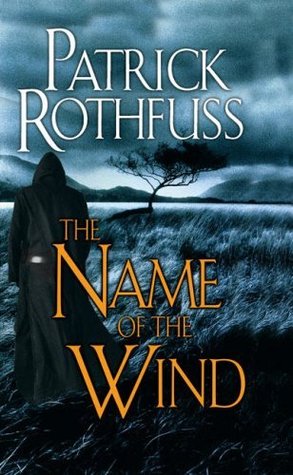
The Name of the Wind

186074Last year, I read an author’s first book about which I had only the best to say. I like this kind of thing, because I get to know about a good author early in the career, and I can keep up over the progression and have thoughtful, chin-stroking opinions and pass on the news to other people to repay all the times that people have done this for me. The thing is, though, it really doesn’t happen very often. So you can imagine my surprise when I’ve got another one, a mere year and a half later.

The Name of the Wind tells the first third of a story that borrows liberally from the tone of Scott Lynch’s books, the voice of Steven Brust’s Vlad Taltos, and the plot, among many others, of Harry Potter. How many of these are actual influences I cannot guess, of course, but there’s no question that whether influence or simple similarity, Patrick Rothfuss has created a character and a story that both are very much all his own. His world is a fairly standard fantasy landscape in trouble: the roads aren’t safe, war and the rumor of war are on everyone’s mind and tongue, and demons stalk the landscape. But stories and legends abound, very old and recent alike.

A chronicler of such stories is following rumors of one Kvothe[1] the Bloodless, Kvothe Kingkiller. He finds trouble on the road and yes, demons, but he also seems to have found what he is looking for in the guise of a small-town innkeeper. And to even his own surprise, Kvothe agrees to have his story told, if it be told exactly as he tells it, with neither embellishments nor redactions. Of course, who but Kvothe himself is to say how true the story really is, but as it involves magic, demons, dragons, and still more stories of the world underlying his own tale, it makes for a worthy read.

Well, okay, lots of terribly unworthy reads have those things too, but Rothfuss’ premiere work has, as I’ve already implied, an excellent voice telling it. This is the rare work in which the prose and plot are of equally high measure. It also has an entertaining mythology, an engagable and interesting take on magic, and, regardless of Kvothe’s veracity, a great deal of truth to it. The best of the book, though, is Kvothe himself. Unreliable narration has been a pretty sure guarantor of my enjoyment of a book for some time now, but The Name of the Wind is all the more interesting for alternating between Kvothe’s tale and the room in which he tells it, where we can see him through eyes other than his own. He contains in him the heroism he claims, the boundless sense of duty he may not even wholly be aware of, and unplumbed depths of bitter anger that appear whenever the world does not really conform to his liking. Despite how pleasantly entertaining he comes off in the story, an event during its telling that lasted for a mere page told me far more about him than anything he actually said. And this is exactly the kind of thing I love to read about. I suspect it may have to do with my hobbyist interest in psychology? In any event, my only warning and the only complaint I have about the book at all is my lack of clue about when the first sequel will be published.

[1] “Pronounced very nearly the same as Quothe”
Lucifer: Mansions of Silence

With the conclusion of Mansions of the Silence, I have completed over half of Mike Carey’s Lucifer story. And from a structural perspective, it is pretty obvious that the story is about half over. Well, I can’t say that much, but it’s at least obvious that it has reached a dividing point. That’s it’s half instead of a third or whatever, that can only be seen in retrospect. My point, anyway, is that the loose ends are rapidly being tied off. In keeping with his character, Lucifer is repaying his debts regardless of the cost to those around him.

Half the story follows his crew on a journey he himself cannot take, to rescue the soul of Elaine Belloc and clear that debt to her. And it makes for a pretty good travel-adventure yarn, sailing through the planes of the heavens on a Norse boat of the dead, built by honest-to-God[1] giants out of the fingernails of dead Vikings. Good mythical stuff, is all I’m saying. Meanwhile, the angel himself and his brother Michael take advantage of a device Lucifer recently found that can see into the mind of God, the results of which have almost certainly set in motion the second half of the story in ways that are currently well beyond my perception.

Pausing to take stock and look at the series through the Sandman lens[2], the storyline is pretty much as complex still, but the literary weight is… I’m having a hard time with it. It’s either not so much there, which is kind of reasonable, Sandman being pretty much seminal in the field of literary graphic novels. Or else, it’s there, but much weightier and a lot of it is sliding by me. Which is certainly possible. But without being too full of myself, if I’m missing it, most of the other readers are too. Anyhow, I say again: not quite living up to Sandman means you have a damn fine story happening.

[1] Er. Yeah, sorry about that.
[2] Since this seems to be my day for comparisons.

Ultimate Extinction

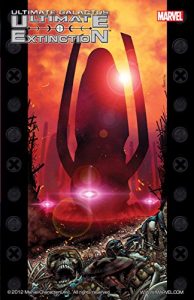
Concluding the Ultimate Galactus trilogy, Ultimate Extinction finally brings us the arrival of the traveling destructive force known as Gah Lak Tus, its Heralds, and quite possibly the end of humankind in the galaxy. As previously, the main hallmark of the book is that new characters[1] are produced only to be minimally utilized. To their credit, most of the characters that appeared in the earlier volumes return for this one, but that causes even more of a mish-mash feeling than the “Ultimate Universe is pulling together” feeling they were undoubtedly attempting to evoke. All in all, Ultimate Galactus was a decent story that was hampered by being told too fast for the amount of story that wanted to be told.
[1] That is, new Ultimate characters that I might have heard of if I had read deeper into the original continuity.

Ultimate Spider-Man: Hobgoblin

Not only am I running out of ways to say that the Ultimate Spider-Man series is fantastic, I’m kind of running out of ways to say I’m running out of those ways. I’m not sure I’m even objective on the topic anymore; it may have turned bad and I simply failed to notice in a whirlwind of fannish obsession. To nobody’s surprise, anyhow, I really liked Hobgoblin. Harry Osborn, son of the Green Goblin, is not having the best few months. His father has turned into a beast that regularly stalks him and killed his mother, and Harry most recently witnessed his father’s apparent (or actual?) death at the hands of the Ultimates and his very good friend Peter Parker. As usual, though, Harry’s return to school and mental state is only a small part of the book’s story. The tragedies that have dogged the Parker household during the same months that treated Harry so badly are finally pushing Peter to the breaking point.

I know things have to turn around soon, since the Ultimate universe apparently has an expiration date that I might be broaching by late this year. But honestly, I’m not sure how at this point. Pete is a pretty moody boy lately, and with good reasons. And the more tightly the inhabitants of that universe are tied together, the more interesting the stories get. Nick Fury’s small role in this book practically guarantees that whatever comes next for Peter Parker, it will not be the sudden positive turn that he really deserves.

The Wayfarer Redemption

Imagine you are a teenager, maybe just starting college. And you’ve been raised in the traditional American Christian mindset, the one that is so generic and ubiquitous that if you tried to imagine a painting of it, we’d have more or less the same painting in mind. But you’re at college now, away from your old life and on your own for really the first time. And your roommate is a Wiccan, and after you get over the exotic amusement, you start talking a lot, and damned if the Wiccan isn’t saying a lot of stuff you’re interested in. A few minutes later[1], bam, you have a full-blown conversion experience, you love Mother Gaia, you worship in the moonlight in the center of the quad, and you’re certainly naked when you do it. You hug trees, not to conform to a filthy hippy stereotype so much as because you genuinely feel connected to each and every one of them. This is for reals the best experience of your life, and it’s aggravating how people are rolling their eyes at you and trying to get you to chill out with all the “We are one” talk, and even your Wiccan roommate feels like you’ve gone overboard.

Okay. Got it?

That person, I think, is who wrote The Wayfarer Redemption. About a thousand years ago, humans got proselytized into cutting down all the trees and plowing the world into flat and perfect order, because the people who hang out in the trees with little horns on their heads and the ones who hang out in the mountains with wings are evil and in fact Forbidden and need to be kept away from humans, and cutting down all their trees is a good way to go about it. Except now there are frozen ghost dudes and a monster-guy named Gorgrael leading them, and there’s a prophecy that says a lot of people have to do a lot of things, like throwing off the shackles of their oppressive religion and teaming up with the Forbiddens, learning to love trees and talk to stags and embrace the Mother[2] and also find each other terribly attractive and fall in love on pretty much that basis alone. It’s fairly generic fantasy pulp that is mostly saved by the bad guys being somewhat cool. On the downside, the writing is iffy and feels like a first book, in that there’s way too much telling about peoples’ motivations instead of showing. Both plot and writing improved as the story progressed, though I’m not sure it got enough better to carry a trilogy.[3] I most likely would not have finished it, except it was recommended to me and I felt the obligation. Still, it was getting better instead of worse, so there’s every chance I’ll read the next one.

[1] Or maybe a few weeks? Things change fast in college, it could be either one.
[2] Sadly, not a euphemism.
[3] P.S. This is the first book of a trilogy.

Spike: Lost & Found

I have a tendency to regularly troll a number of area Half-Price Books, looking for ever more cheap, used copies of the huge stack of Ultimate Marvel comics that I read. I end up seeing a number of other titles as a result, and grab the odd one now and again. Today’s such find, Lost & Found, was an extremely short Buffy-themed comic set more or less as an episode in Angel’s final season. In a sequel to the Gem of Amarra sequence, Spike and Angel go looking for yet another vampire that seems to be able to survive the sunlight. It’s not a bad little story, short though it be. It tries and (I think) fails to provide much in the way of character development for Spike or Angel, but if it had been the main arc of an actual episode in the show, I would have liked watching it. To be perfectly clear, it very much needed a secondary arc to have felt fully formed, though.

Ultimate X-Men: Magnetic North

Historically, I’ve been down on the Ultimate X-Men titles as compared to the other ongoing series. I know there was a point, several books ago, when I changed that opinion. Magnetic North marks another such shift, as this is simply one of the best Marvel Ultimate titles I’ve read, period. Almost every minor and major event in the past several books is pulled together into one web of intrigue, surrounding the escape of Magneto. It is both too complex and too good a story to get into in more detail than that, and in all honesty, I think the title and the cover[1] revealed as much as I already have anyway. It has a cinematic plot, with almost as many story and character twists as there are pages to turn. I just cannot stop being excited over these books!, and more the further into them I get.

[1] at least, the cover of my copy, which does not match the one Amazon shows.

Ultimate Secret

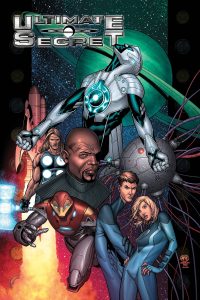
Ultimate Secret continues the Ultimate Galactus trilogy in much the same fashion as the opening volume. That is, it tells a reasonably good story whose main flaw is feeling entirely too short. I mean, most of the Ultimate books have felt like discrete storylines in the lives of our heroes. The Galactus books, on the other hand, have felt very much like part of an (extremely incomplete) ongoing story. It is not particularly a flaw, except that it makes it hard to feel much excitement for the review; it’s as though I’m reviewing thirds of a book, instead of three books.

Another way it matches the first volume is that it uses the Galactus story to talk about other characters entirely that had not yet been drafted into the Ultimate universe.[1] In this case, the fight is against the alien Kree who are sabotaging mankind’s space program, in the hopes that when Gah Lak Tus arrives, the planet will have no survivors. The story was decent, it just wasn’t what I was looking for. Again. I’m really relieved this is only a trilogy, as I’m not sure I could take much more pushing back the payoff.

Except for the lack of character continuity, what this has most reminded me of is the old G.I. Joe event weeks when they’d present a five-part series in which Cobra and G.I. Joe were crossing the world in search of parts for a doomsday machine, and inevitably Cobra would manage to get all the parts, fire up the machine, and then lose anyway. The continuity meant that each episode had a series payoff feel, unlike these books, but there’s still definitely a race across the world in search of clues feel. (Does anyone but me remember those episodes fondly? I mean, clearly there’s a movie studio that hopes so.)

[1] Captain Marvel? Really?

Luke Skywalker and the Shadows of Mindor

You would think, given a decisive lack of job, that I would have plenty of time to read, right? And I can’t in any real honesty say I haven’t had, but I somehow haven’t been reading much nevertheless. Less than usual, even, which is a bit puzzling. I guess all those lunches at work added up? Anyhow, what I have been reading is a perfectly serviceable Star Wars book. I wish I could say more for it, but it really very much reminds me of the early books chronicling the chaotic period after the fall of the Empire, before the people in charge had started taking firm plot-based reins on the progression of the extended universe. So, some of the books would be top notch, some would be godawful bad, and the majority would be like this: perfectly okay, good Star Wars feel, but ultimately forgettable.

Luke Skywalker and the Shadows of Mindor suffers the most, I think, for being so plot-based. After a 20 book series with an epic plot and a 9 book series with reasonably epic character progression to follow it, it’s just hard to go back 30 years and read a standalone book that has yet another take on the dark side of the Force and how different people perceive it, yet another wholly alien species that must be understood if the day is to be saved, yet another stack of TIE Fighters and stormtroopers. The characters were all on, and that means a lot. And there’s a reasonably good running gag behind the awkward title. But on the whole, it was entirely too missable for my tastes. I hope the next one I read, which delves the farthest yet into the future of that universe, is a substantial sight better.

Hack/Slash: Return of the Revenge Part 4

I don’t know if I’ve said lately how much I appreciate that there’s a generic horror-movie comic around that simultaneously makes fun of and embraces all the relevant tropes. (I mean, last time they had by God Chucky, right?) So: Hack/Slash, thank you muchly for existing! I keep seeing indications of a movie version on the horizon, but I kind of don’t want one, as once it’s a movie, the tongue-in-cheekness of it all flies right out the window. Still, it’s pleasing that the comic’s doing well enough for people to consider that.

One consequence of this appreciation is that I have bought (well, a year ago) and read Return of the Revenge Part 4, in which, as you might possibly expect, old nemeses crawl out of the woodwork to trouble Cassie Hack and her monstrous companion Vlad once more. I know I already said it in the previous review, but I am very much in enjoyment of the month-to-month storylines version of the comic that has only recently (for me) started to occur. Every single issue has just a ton of stuff going on. In this book alone, we have an ongoing quest to discover the whereabouts of Cassie’s long-missing father, an Archie comics parody, and secret society hot tub lesbians. Plus the revengencing enemies I already mentioned, some brand new enemies, the progressing personal lives of the five-ish regular characters in the series, and some pretty brutal moral dilemmas that are only now starting to be planted for eventual dire fruit. Good times!