Category Archives: Words

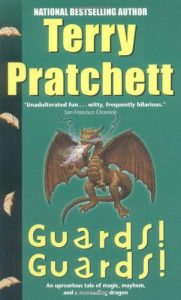
Guards! Guards!

This is the point at which, if I understand conventional wisdom, the Discworld novels start to become “good”. Also, more incidentally, this is probably the first Discworld book I ever read, far back in the depths of junior high. (All I remembered is the “mllion to one shot” gag, so, it was basically like reading it all over again.) And most incidentally of all, I’m pretty sure it’s the farthest I had read into the series, so everything from here on will be entirely new, cultural zeitgeist notwithstanding. Anyway, that “good” thing, though: as much as I have enjoyed the last several books on their own merits, Guards! Guards! definitely has some barely definable adult quality that the previous books have not had, though some have grasped at it.

In addition to first introducing Ankh-Morpork’s city night watch and its world-weary, heroic-in-spite-of-himself Captain Samuel Vimes, a group character study that could have carried a book with no plot whatsoever, the novel also for the first time superficially grazes the inner political workings of the city at the dark, ulcerated heart of the Disc. It asks and perhaps answers the essential question of whether democracy or monarchy ought best be left to run amok through the lives of a citizenry that barely comprehends either and tends to cheer whichever of the two it has seen least recently. Also, and here is the only point at which it diverges from any standard reality to which you may be accustomed, there is a dragon.

Hack/Slash: Reanimation Games

The thing about a cheesy 80s-slasher-movie-themed comic, albeit with modern sensibilities regarding every aspect of the actual content, is that there’s only so much praise you can sing. I can tell you about the skillful way that each volume weaves together seeds planted in previous issues into a new tapestry of angst, obsession and gore, all the while planting new seeds for future volumes. I can gesture emphatically at the art, which is always clear and articulate without wandering off into post-modern regions that elevate experimentation above functionality, and which also provides occasional cheesecake. But these descriptions are quite generic, however heartfelt the sentiment that underlies them, and when you peel them away, Hack/Slash is still a cheesy 80s-slasher-movie-themed comic. And for the general mass of graphic novel audience out there, you were already sold or turned off by that line of description, irrespective of the actual contents.

For the vanishingly small group of people who care, Reanimation Games is focused primarily on the culmination of Cassie Hack’s search for her father, who ironically has built his career around the study of the causes behind and uses of the very slashers that Cassie has hunted and destroyed ever since her mother first turned into one. Detours along the way include encounters with the scientist guy from the Re-Animator movie series and with the Suicide Girls[1], and the usual careful examination of the trials and triumphs of Cassie’s small circle of friends. I guess what surprises me with each new volume is not that I’m entertained; it’s nice, easy brain candy in exactly my flavor. No, what surprises me is that it’s good enough that I want people to see it as the small step above brain candy into genuine quality that it consistently achieves.

[1] If you don’t know, these are not a mysterious cult nor movie shout-out, but instead a generally tastefully gothy porn collective that you will not I think have very much trouble finding on the internet, if you were to put your mind to it. For some reason, Cassie has been considered sufficiently gothy-attractive for the comparison to be made, and for some reason, the creator decided that, hey, sounds like a good crossover to me! And here we are.

Ultimate Annuals Volume 2

I know this is supposed to be a review of the second (and I suspect final) volume in the Ultimate Annuals series. But it’s not so much a series as it is a collection of the oversized annual edition of each of the four major Ultimate serieses, and unlike last time, I’ve read most of these recently. Like, the X-Men story is I think the most recent thing I’ve read in that run, in which Nightcrawler goes from an unfortunately prejudiced dude who needs to have a good lightbulb moment to a disturbingly broken kidnapper who is probably on the verge of defection to evilness, over the next storyline or two. Or the Fantastic Four story in which Mole Man returns with a new plot to kidnap geniuses and harness them for his own uses. Okay, that one was pretty good, but I’ve already reached the end of the Ultimate FF run (save for the Ultimatum stuff), and it didn’t actually have the payoff it seemed like it should have had later on, so I am retroactively a little disappointed in it. Plus, the only story that isn’t collected in another book I’ve already read, in which Captain America and that Falcon guy from Ultimate Galactus head into the post-war American landscape[1] to fight an old Nazi menace? It kind of bored me. I think I blame this on it being the first Ultimates story I’ve seen that wasn’t written by Mark Millar. He’s good at those!

So, okay, yeah. Pretty disappointing book all in all, though I have given unfairly short shrift to the FF story. Except, y’know, Spider-Man. His story, which you may recall me choosing not to review when I read Deadpool earlier this week, is another clash between Peter Parker, Daredevil, and the Punisher. Except, right, I never read the original such clash because it was somehow left out of the three Ultimate Marvel Team-Up books in which comics-run it occurred. Luckily, someone eventually released a giant collection of that entire run in one book, making my three individual volumes obsolete. So, I read the three comics in question out of that, just to feel caught up. In short, across pages of annoyingly impressionistic artwork, we’re introduced to the Punisher, cop-turned-vigilante who hunts and kills dirty cops and dirtier criminals and spends most of his time in jail for said vigilantism, and Daredevil, blind lawyer with super-heightened alternate senses that allow him a better grasp of the world than any civilian and most superhumans. And Pete puts the Punisher back in jail while annoying the snot out of Daredevil for his happy-go-lucky attitude and his penchant for jumping into the middle of things first and asking questions later. (Which is I guess why Nick Fury is annoyed by him too. Also Blade.[2])

So, anyway, in this follow up meeting (Also including the Moon Knight (who I still have no kind of handle on), the Kingpin (still a magnificently realized bastard), and Kangaroo (uh…)), Daredevil still finds Spider-Man annoying and the Punisher still finds him detrimental. But none of that is really the point. The point is this: there’s been a long-term piece of plot involving the new[3] police captain, Jeanne de Wolfe, that I haven’t ever mentioned partially because it’s been largely in the background and partially because, well, any amount of detail places us squarely in spoiler city. But the thing is, as much time as I spend talking about how great the USM series is, right? This is just on a day-to-day basis. In the meantime, there are these deep undercurrents spanning something like half of the series to date that I’ve never even felt the need to mention. And of course there’s an inevitable huge payoff, that leads me to have to jump back into two paragraphs of review material just to explain how even an oversized single comic in this series is still so very cool. This is why I can’t stop gushing, no matter how hard I try to hold myself back. Because it’s just always this good.[4]

[1] Yeah, for serious, I really really need to do a quick reread of the four Ultimates titles that have been released so far, ’cause I barely have any idea what’s up in that quadrant of the Ultimate universe anymore, and I’m starting to reach the point where everything really does tie together. Maybe I’ll do one mega-review? Maybe not, depends on how it strikes me I guess.
[2] Yeah. The half-vampire guy. Seriously.
[3] The old captain was Gwen Stacy’s father, up until he was shot and killed by a guy in a Spider-Man costume. Good times!
[4] And the last page or two, in which Daredevil has a conversation with the Moon Knight guy? I’ve learned my lesson and mention it now, as I expect it to be the next major undercurrent.
Ultimate Spider-Man: Deadpool

I almost wish, if only for half a moment, that Bendis would write a bad, nay, even a merely mediocre run of Ultimate Spider-Man, just so I’d have something new to say. “It’s just so good! You’ll love it!” Whatever, man. I’m losing all credibility over here. But, okay, why do I love it this time? I have an answer to that. Now and again, one of the series will focus on a character with whom I’m unfamiliar, and the author will seem to be so proud of having worked that character into the Ultimate continuity that the book just coasts on recognition factor without really trying to be actually good in its own right. In fairness, that plan has worked on me when I did recognize whatever new character it was, but for the many times when I do not, the laziness outshines everything else.

Except this time, not so much. I’m not particularly familiar with Deadpool, and really all I know about him is that in the Wolverine movie earlier this year, he was maybe kind of indestructible? That character is largely dissimilar to this one, in any event. But, and here’s the part where I fulfill the inevitable gushiness quotient, Bendis went ahead and wrote a fine plot around the advent of Ultimate Deadpool. See, Spider-Man gets mixed up in a plot to murder the X-Men on broadcast television[1], and this guy Deadpool is the main hunter. But despite all kinds of mutant powers and explosions of exactly the types that a superhero comic needs to have to maintain credibility[2], most of the focus is on Peter and the delightfully unconfident Kitty Pryde, his recent paramour. Because, as has consistently been the case throughout the USM run, Peter Parker’s life is the important thing; super-villains and web fluid alike take the back seat. This is why it works. But also, Aunt May has a hot date, so I guess maybe it isn’t always about Pete after all. Then, for a change of pace, vampires! And more friendship trouble with Mary Jane! And the Kingpin! But I’ll glance at that last bit in my next review.

[1] Which is actually a callback to a previous UXM storyline, but I forget which one. It was alright, in any event.
[2] Unlike me, you see, is the thread tying this review together.

The Hero of Ages

Sometimes I know exactly what to say about these things. Other times, and they feel increasingly common (though perhaps that’s my imagination instead? I hope so), I’m a little bit stuck. Is it that the middle of the night makes me too tired for inspiration? Is it that inspiration itself is rarer on some days than others? Is it simply that the book is too easily spoiled if I give very much depth to a plot review, and so I’m going to have to actually stare at the themes for a little while instead, and should maybe ought to quit whining about it and move along? Well, okay, that’s pretty clearly it, but in my defense it is the middle of the night too.

The Hero of Ages concludes Brandon Sanderson’s Mistborn trilogy in grand apocalyptic style. Another year has passed since the events at the Well of Ascension, and circumstances are more dire than ever. In truth, I read a lot of books that describe the end of a world, usually but not exclusively Earth. Sometimes, there are comets. I’m just saying, I know from apocalypse, and out of all such books I’ve read, this is the one that best demonstrated the hopelessness and wanton destruction of a world going through its last throes. I had to slow down now and again just to keep from letting myself get washed away by the currents of despair. But what’s cool is, the book is kind of about that: the capacity for trust in the face of destruction, faith in the face of despair. Also, it’s still about cool powers of jumping around and stabbing every enemy in sight, and sometimes seeing the future, so it’s not like that part of the series has taken a backseat as it progressed; if anything, the magic system has only grown in complexity.

Although the circumstances were not optimal, I’m glad I got a chance to see this author thrust into the limelight, and I’m looking forward to whatever he writes next. (Okay, technically, it’s already written. But I will totally read it, honest! Just not sure how soon.)

Ultimate Annuals Volume 1

The reasonably self-explanatory first volume of Ultimate Annuals collects the annuals from each of the main comics in the Marvel Ultimate line-up. An annual, if you’re not familiar, is a extra-large comic published outside the monthly run, sometimes used as the climax of or opening to a major storyline but just as often not very relevant to the immediate continuity. Though, Marvel being who they are, continuity is generally king. The downside to these books is two-fold, in that 1) most of said annuals have already been produced in their respective series, and 2) one of them has not, so I needed the book anyway. Far easier than finding and sorting an actual comic in the middle of my graphic novel shelf, and probably not that much more expensive, used. So, that happened.

However, reading so much material I’ve seen before, and some of it recently, did free me up to pay attention to other concerns, such as the artwork and each story’s place in the arc. So, there’s a Fantastic Four story in which the Inhumans are shoehorned so that they can be seen, and I guess that is my problem with a lot of what I read of the Ultimate Fantastic Four run in the first place. The lack of consistent writer over any period of time made it so that a lot of what I read failed to engage me on a new coolness level, instead of the baseline “I recognize that!” level. Plus, in this case, the art was just distractingly bad. (Not to my taste, if you prefer.) And then there’s an X-Men story that checked in on Rogue, Gambit, and Juggernaut, and it was a pretty good one that did shift things around some and matter later, but felt maybe a little rushed. And then there’s a Spider-Man story that I read in literally the most recent Spider-Man book, and while the story itself was sweet and funny and seems like it will matter for at least the next while, the art was distracting there too, not for being bad, but for being even marginally different after so much consistency throughout the USM run.

And finally, the Ultimates story that I had not read before. By now I was already paying attention to the art, but I think I would have anyway, because it was so distractingly familiar. Finally placed it, same guy that did the art for the Preacher series. His style definitely fits the Ultimates, so that was alright. The story was Nick Fury unravelling a few layers of his ongoing plans, which mostly involve improvements to superhuman defenses and the political fallout from that, but also touch on his ongoing suspicions about Henry Pym’s loyalties and his worldwide search for evidence as to the life or death of Bruce Banner. ‘Cause, for serious, the Ultimates books have always been less “super” and more “spy/political”, and I once more avow my almost certainty of re-reading that entire sequence before I get to the build-up to Ultimatum, probably sometime next year?

Takeaway lessons: 1) Rereading comics can be pretty okay. 2) I allow myself to re-use words with distracting frequency, if I decide they have become thematic rather than merely indicative of vocabularic deficiencies. 3) That Ultimates series just keeps on delivering, but is somewhat more dense compared to the other series, and thus needs more contemplation. 4) Amount, quality, or newness of material have no particular bearing on how long I’ll keep nattering about them, and it’s mostly down to my writing mood when I sit down.

Fables: Homelands

As the Fables world grows to include more and more key characters, some are falling into the background to make way for the rise of previously bit characters. And certainly the tone is changing away from the noir feeling of the early volumes as the stories start to grapple not just with events involving the fable characters, but with their overarching histories and futures. Or maybe it’s just that recent political upheaval is what has pushed Bigby Wolf and Snow White off the main stage, and the tone change is down to their absence as well. I figure it might be both, but I’ll have no way to really know until the Wolf is back and the noir returns, or doesn’t.

Homelands focuses on two characters over another handful of quickly passing years. In the opening, Jack Horner, and the Beanstalk, etc.[1] hatches another scheme for riches and fame, with better than usual success. It may be my independent knowledge, but it very much felt like Willingham saw that Jack was his for-fun character and didn’t really fit the flow of the main Fables story, and this was an explicit way to put him in position for the spin-off series, Jack of Fables, which I will begin reading relatively soon in the sequence, I think. And then in the main part of the storyline, Boy Blue infiltrates the fallen Homelands on a daring quest to rescue his love, save his best friend’s life, and with a little bit of luck, unmask and assassinate the Adversary himself! If that sounds pretty cool and exciting, well, sure enough, Fables keeps on delivering. And if you expect it to keep on delivering in ways the characters (and sometimes readers) cannot hope to foresee, well, that just means you’ve been paying attention.

[1] They’re all the same Jack, you see.

Ultimate Spider-Man: Silver Sable

As promised, a long overdue return to my graphic novel sequence! I’m still gradually catching up with the Marvel Ultimate series; the book I’m reading right now… is not the book I should be reading right now, apparently[1]. Son of a bitch. On the bright side, none of that has any effect on this particular review. And it’s not like I’m ever caught without a backup book in this kind of situation, it’s just frustrating to break order yet again, when I’m only finally getting back into it! So, I guess I’ll start over? Right, then.

That guy Spider-Man, yeah? He has been having a rough couple of months. He lost two close friends right in a row and then had to[2] break up with his girlfriend, and all the while the villains are mostly getting cannier. Plus, enough people have seen his face that if they all got together they could work up a composite and start putting him on milk cartons. When you get right down to it, it’s really about time he caught a break. And, well, that actually sort of happens in Silver Sable. I mean, on the one hand, he is being stalked by one of the pre-eminent bounty hunter types in the world, and that’s not so great. But for once, the chaos surrounding Peter Parker is really not of his own making, not even indirectly. Plus, as the X-Men had previously spoiled for me (since I’m reading a little bit out of order and all), he has a new girlfriend who is far less likely to be killed as a result of Spider-Man’s interference in a normal life. All in all, the book is a humor-centric piece of breathing space amid the various tragedy and drama in Peter’s life. And I’m glad; as well as Bendis handles the drama, it was starting to get a little oppressive in here! …though I can’t help feeling bad for Mary Jane.

[1] It was supposed to be Ultimate Annuals. I instead have Ultimate Annuals 2. And I’m really not sure how my filing system allowed it to happen!
[2] Had to? Plausibly yes. He certainly did, regardless.

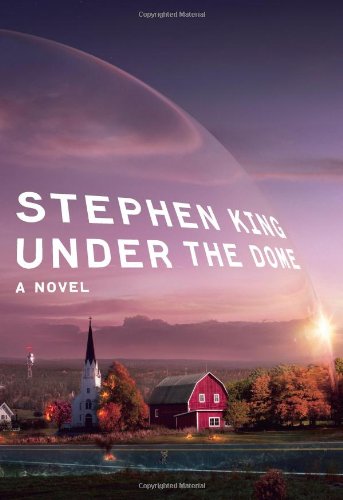
Under the Dome

41PZik3LNWLAs with the majority of Novembers in my adult memory, there’s a new Stephen King novel on shelves. Less usually, I got it for about 75% sale at Amazon, because apparently they and like Wal-Mart are in a weird book price war right now for best-sellers? At that price, I’d have bought it unemployed without blinking. (I guess technically I did, since the pre-order was placed just before my start date, last Monday.) In the subsequent week and change, I have read Under the Dome. Don’t worry, I’m finally reading graphic novels again, the schedule will resume normalcy at this time.

The premise is simple, and I think that simplicity is where the genius of the book lies. Imagine a small town, full of people who are good, bad, and indifferent, corrupt and pure, power-hungry and service-minded. Any small town will do. And then, cut that town off. Completely, and in some cases, literally. Under the Dome is about that: about the people on the outside who want to find a way to help; about the people on the inside who want nothing more than to get out and get on with their lives; about the not entirely stable people they could be trapped with; and about the people who only see an opportunity for greatness. Aside from King’s reliable eye for characters, what struck me most about the book was the breakneck pace. Not even halfway through the book, and it already felt like the inevitable decline and fall of Chester’s Mill, Maine was hurtling toward me faster than I could turn the pages. The last couple of days’ reading was actually stressful in some ways. (Not that I minded.)

In the end, the only complaint I have is about the Dome itself, and I don’t really know of a way around it. People will naturally want to know how the Dome got there and why, and I know the question had to be answered. But I submit that this misses the point of the book, and if there were a reasonable way to pretend that its origin could be ignored, it should have been. The book is about people who are trapped, people who are concealed from the eyes of the world and from its external consequences, and the way they behave in these extreme conditions. And that part was golden, and it filled up probably a thousand pages of excellent literature. So, there’s that going for it! (For the record, I am more or less satisfied with the origin story part; it’s just I know some people will not be. I may not have been, if I had actually cared at all? No way to be sure, I expect.)

The Well of Ascension

I was already reading this book when the Robert Jordan book came out, which explains both why I have skipped my allotment of graphic novels and why I read two books in a row by the same author. At least it isn’t the same series? Anyhow, The Well of Ascension chronicles the continuing adventures of… well, I guess I never talked about the characters in the first Mistborn book, did I? So, anyway, there’s this skaa thieving crew and our heroine, Vin, and they achieved a pretty big victory at the end of book one. And now, as book two opens, they and their noble allies must face new dangers in the form of invading armies, untraceable spies in their inner circle, and a growing certainty that the world is still in the same grave danger that the Hero of Ages was supposed to have defeated a thousand years before.

Sanderson has done a pretty good job of maintaining sense of wonder, by delving more deeply both into mistborn abilities and into the history of the Hero of Ages and the Final Empire. As in the previous book, each chapter starts with an excerpt of writings from a thousand years prior when this chain of events first began. Unlike last time, however, the writings are more or less in order of the story they are telling; it was all I could do not to ignore the book and jump ahead to read the entire ancient record at once, and then come back. All of which to say: see? totally sense of wonder. The mood of the book is by turns ratcheting tension, romantic angst, a little bit of creeping dread, and occasional doses of intense action, all of which build toward a pretty explosive last hundred pages. I was out at dinner Tuesday night and just itched to read the last 20 pages instead of interacting with my companions. I didn’t, but probably only because Skwid was there to answer my minor spoiler and relieve the tension just enough to hold out until I got home.